What Is a Seed Phrase? A Complete Guide to Crypto Recovery Phrases
Published November 5, 2026
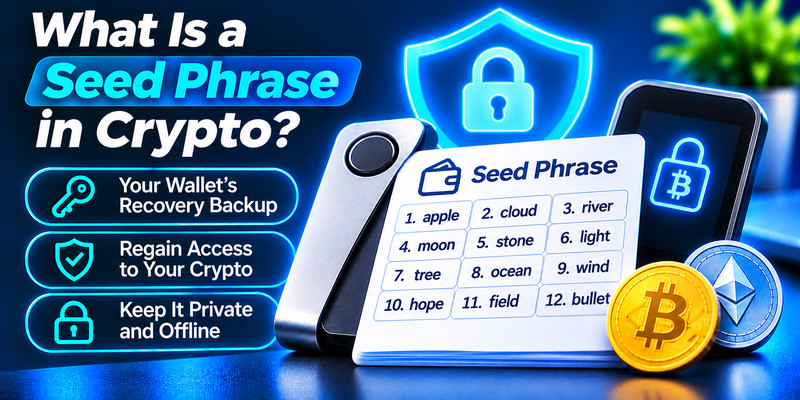
Short answer: What is a seed phrase? A seed phrase (also called a recovery phrase or mnemonic phrase) is a list of 12 to 24 words, generated by your crypto wallet, that works as the master backup of that wallet. Anyone who has the words in the right order can restore the wallet and move every asset inside it, so the phrase must be written down offline and never shared with anyone.
If you are new to crypto, the first question you will meet is what is a seed phrase and why every wallet insists that you write it down. The answer matters more than almost anything else in self-custody, because a seed phrase is the only thing standing between you and permanent loss of your funds, or between a thief and your entire portfolio.
This guide explains what is a seed phrase in plain English, how it works behind the scenes, how it differs from a private key, how to store it safely, and what to do when something goes wrong.
What is a seed phrase? Key takeaways
- A seed phrase is 12 to 24 random words that can rebuild your whole crypto wallet.
- Words come from a fixed list of 2,048 words defined by the BIP-39 standard.
- Whoever holds the phrase controls the funds. Wallet providers and support teams never need it.
- Store it offline, on paper or metal, in more than one safe place. Never take a photo or save it in the cloud.
- If you lose it with no other access, nobody can recover your wallet for you.
What Is a Seed Phrase?
So, what is a seed phrase in the simplest terms? It is a human-readable version of the secret number that your wallet is built from. When you create a self-custody wallet, the app generates a random number and turns it into a short list of ordinary English words. That list is your seed phrase.
You will see the same thing under several names:
- Recovery phrase
- Backup phrase
- Mnemonic phrase or mnemonic seed
They all mean the same thing. The word “seed” fits because every private key and address in your wallet grows from this single starting point, much like a plant grows from a seed.
A seed phrase only exists when you hold your own keys. With an account on a centralized exchange, the company stores the keys for you, so there is no phrase for you to keep.
Because a recovery phrase may be the only way to restore a self-custody wallet after device loss, creating a reliable backup is essential. Follow our guide on how to back up a crypto wallet to learn how to record recovery information, verify backups safely, and prepare for wallet restoration.
Secure your accounts with fast, reliable two-factor authentication. Download now and protect your login in seconds.Download Authenticator App
What Does a Seed Phrase Look Like?
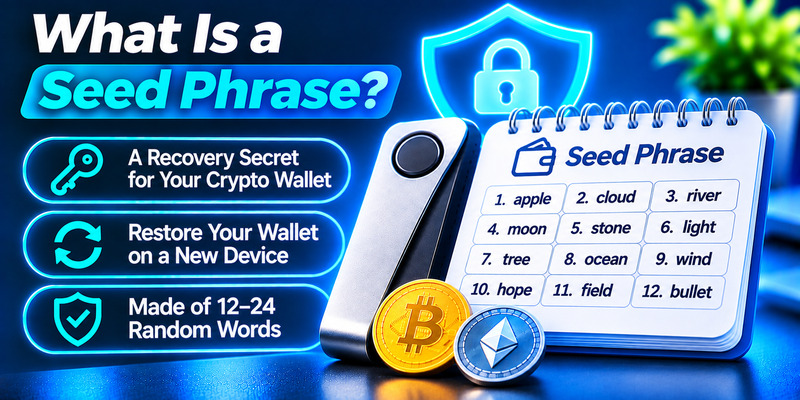
What is a seed phrase supposed to look like on screen? It is a numbered list of short lowercase words, usually 12 or 24 of them, and the order matters. The layout looks like this:
1. word 2. word 3. word ... 12. word
In a real wallet, each “word” is a plain English word, and because the phrase is random, the words do not form a meaningful sentence.
We deliberately do not print a full working phrase here. Any valid combination of words can be a real wallet, and sample phrases published online may be watched by others. Never copy a phrase from a website, and never use one that someone else generated for you.
Read morre: How to Secure a Crypto Wallet: 10 Steps to Keep Your Crypto Safe
How Does a Seed Phrase Work?
To understand what is a seed phrase technically, it helps to follow the steps that happen when a wallet is created. The process is defined by a few open standards called BIPs (Bitcoin Improvement Proposals).
- Random data is generated. The wallet creates 128 to 256 bits of random data, called entropy.
- A checksum is added. A short checksum, taken from a hash of that data, helps the wallet detect typing mistakes later.
- The data is split into words. The result is cut into 11-bit pieces. Each piece is a number between 0 and 2,047 that points to one word on the official 2,048-word list.
- A master seed is produced. The words, plus an optional passphrase, are run through a key-stretching function (PBKDF2 with 2,048 rounds of SHA-512). The output is a 512-bit master seed.
- Keys are derived. Under the BIP-32 standard, that master seed produces a whole tree of private keys. Under BIP-44, those keys are organized by coin, account and address index.
- Addresses are created. Each private key produces a public key, and the public key produces the address you share to receive funds.
This design is called a hierarchical deterministic (HD) wallet. “Deterministic” means the same phrase always rebuilds the exact same keys and addresses, in any compatible wallet. One seed phrase can therefore control Bitcoin, Ethereum and many other networks at once. If you plan to use a dedicated signing device, our guide on how to set up a hardware wallet explains how to initialize a device securely, generate recovery information through the trusted setup process, and verify a backup before transferring significant cryptocurrency.
Why Is a Seed Phrase Important?
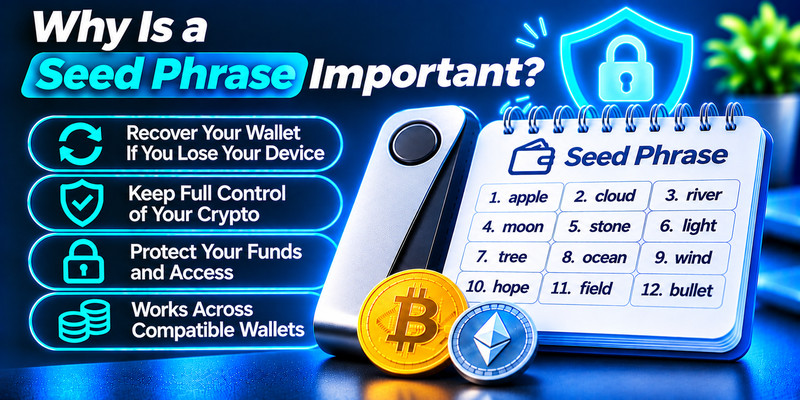
Understanding what is a seed phrase is not enough. You also need to know why it deserves more care than your passwords. It does four jobs at once:
- Recovery. If your phone is lost, broken or stolen, the phrase is how you get your funds back on a new device.
- Ownership. Whoever controls the phrase controls the assets. This is the idea behind the saying “not your keys, not your coins”.
- Portability. You can move your wallet to another app or a hardware device without sending funds anywhere.
- Simplicity. You back up one list of words instead of dozens of long private keys.
The flip side is that a seed phrase offers no safety net. There is no “forgot password” button, no customer service team and no way to reverse a transaction. The same design that stops anyone from freezing your funds also means that a mistake is final.
Read more: How to Protect Your Seed Phrase: 10 Essential Tips
What Is the Difference Between a Seed Phrase, a Private Key and a Wallet Address?
These three terms are often confused when people ask what is a seed phrase and what it controls. They sit at different levels of your wallet.
| Seed phrase | Private key | Wallet address | |
|---|---|---|---|
| What it is | 12 to 24 words that rebuild the whole wallet | One long secret that controls one address | A public identifier derived from a key |
| Format | Words from the BIP-39 list | Long string of letters and numbers | Shorter string, such as one starting with 0x or bc1 |
| Safe to share? | Never | Never | Yes, it is meant to be shared |
| If it leaks | Every address in the wallet is exposed | Only that one address is exposed | Nothing is exposed |
In short, the seed phrase creates the private keys, and the private keys create the addresses. Nobody can work out your private key from your public address.
Can a Seed Phrase Be Hacked or Guessed?
So what is a seed phrase’s real weak point? It is not guessing. A seed phrase cannot be guessed in any practical sense. A 12-word phrase holds 128 bits of entropy, which means roughly 3.4 followed by 38 zeros possible combinations. A 24-word phrase is astronomically larger. No computer on Earth can brute-force a properly generated phrase.
The real threat is exposure. Attackers steal seed phrases through:
- Phishing sites that imitate a real wallet and ask you to “verify” or “sync” your words.
- Fake support agents on social media or messaging apps who offer help and then ask for the phrase.
- Malware that reads your clipboard, logs your keystrokes or scans photos for text.
- Insecure backups, such as screenshots, cloud notes, emails or password managers.
- Physical access, including someone finding your written copy, or a camera filming it during a video call.
A good rule is that no genuine wallet, exchange or support team will ever ask you for your seed phrase. Fake wallet websites often imitate trusted providers and request recovery words under the pretense of verification, synchronization, or account recovery. Learn how to avoid phishing scams to recognize fraudulent links, suspicious login pages, and attempts to steal sensitive wallet information.
Read more: What Is Smishing? How Text Message Phishing Works
How to Store a Seed Phrase Safely
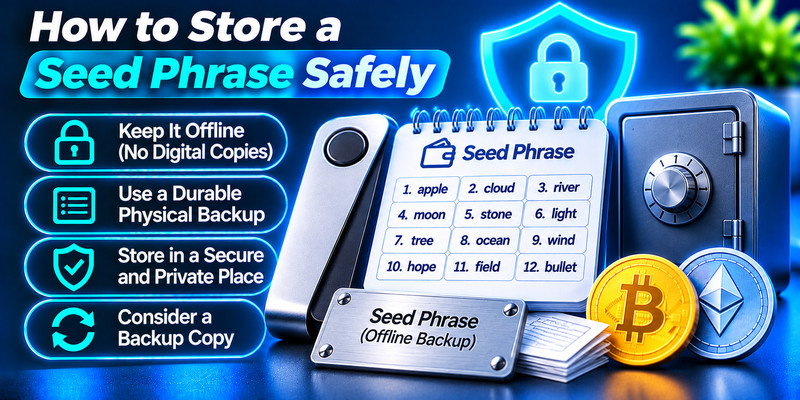
Knowing what is a seed phrase is only half the job, and storage is the other half. The goal is to keep it offline, durable and out of sight, while still being recoverable by you.
Do:
- Write it by hand on paper, or stamp or engrave it on a metal plate.
- Double-check every word and its number against the screen before you close it.
- Keep at least two copies in separate secure locations, such as a home safe and a bank deposit box.
- Test your backup by restoring the wallet with a small amount of funds.
Don’t:
- Take a photo or screenshot of the phrase.
- Save it in a notes app, email, cloud drive, chat or password manager.
- Type it into any website, form or support chat.
- Store it on your computer or phone.
Paper is cheap and works well in a fireproof, waterproof place. Metal backups cost more but survive fire, flooding and corrosion, so they suit larger holdings. Do not split a phrase into halves: losing either half loses the wallet.
What Is the Optional Passphrase (the “25th Word”)?
Beyond what is a seed phrase itself, BIP-39 lets you add a custom passphrase on top of your words. Many people call it the 25th word. It is not a PIN for the app. It changes the master seed itself, so a different passphrase opens a completely different wallet.
That has two consequences. First, an attacker who finds your 12 or 24 words still cannot open the wallet without the passphrase. Second, if you forget the passphrase, your funds are gone even if you still have every word. It suits experienced users; for most beginners, one well-stored phrase is safer.
Read more: What Is a Spoofed Email? Sender Impersonation Explained
Seed Phrase vs 2FA Authenticator: Are They the Same?
What is a seed phrase compared with a 2FA code? They are not the same, and mixing them up is a common mistake. A two-factor authentication (2FA) app generates short-lived codes that protect your logins, including your exchange account. A seed phrase is a permanent master backup for a wallet you control.
They protect different things:
- 2FA codes protect accounts that a company hosts. If you lose your phone, you can usually recover access through backup codes or account recovery.
- A seed phrase protects a wallet that nobody hosts. If you lose it, there is no company to ask.
Never store your seed phrase inside an authenticator app, a notes app or any digital vault. Keep it on paper or metal, and save your 2FA backup codes separately from it. A TOTP authenticator app generates temporary verification codes for supported online accounts, including some cryptocurrency exchanges. These codes add a login security requirement but cannot restore a self-custody wallet, replace its recovery phrase, or prevent access when the wallet’s private keys have been compromised.
What Happens If You Lose Your Seed Phrase?
If you lose the phrase but can still open your wallet on your device, act immediately: create a new wallet with a new phrase and move your funds across.
If you have lost the phrase and also lost access to the wallet, what is a seed phrase backup worth? Nothing, because the funds cannot be recovered. This applies to every non-custodial wallet, because the provider never stores your phrase. Be especially careful with “recovery services” that promise to restore a wallet for a fee. Real recovery without the phrase is not possible, and these offers are a common scam.
Frequently Asked Questions About Seed Phrases
What is a seed phrase example?
When people ask what is a seed phrase example, the answer is a numbered list of 12 or 24 simple English words in a fixed order, such as “1. word, 2. word, 3. word” up to the last position, each taken from the 2,048-word BIP-39 list. We do not publish a full working example, because any valid combination controls a real wallet and sample phrases may be watched by others.
What happens if someone finds your seed phrase?
They can import your wallet on their own device and move every asset out within minutes, without needing your phone, password or fingerprint. Transactions are irreversible, so the funds are very hard to recover. If you think your phrase has been seen, create a brand new wallet with a new phrase straight away, send a small test transaction, then move all funds. Revoke any token approvals on the old wallet and never reuse the compromised phrase.
How do I know my seed phrase?
If you are wondering what is a seed phrase in your own wallet, remember it was shown once, when you first created the wallet, and you were asked to write it down. If you did, check your paper or metal backup. Many software wallets let you view it again in the security settings after you enter your password or biometrics, so look for an option called something like “Reveal Secret Recovery Phrase”. Most hardware wallets do not display it again after setup. If you only use an exchange account, you do not have a seed phrase, because the exchange holds the keys. If you cannot find it anywhere and cannot open your wallet, it cannot be recovered.
Should I use the 12 or 24 seed phrase?
Both are secure, and either is far beyond what attackers can guess. Whichever you pick, what is a seed phrase if not the key to everything, so protect it equally. A 12-word phrase has 128 bits of entropy and a 24-word phrase has 256 bits. Twelve words are easier to write down and are the default in many software wallets. Twenty-four words add a larger safety margin, including against theoretical future quantum attacks, and are common on hardware wallets. For most people, how safely you store the phrase matters far more than whether it has 12 or 24 words.
Now you know what is a seed phrase: a short list of words that carries the full power of your crypto wallet. What is a seed phrase worth to you? It lets you recover funds after a lost phone, move to a new wallet and prove ownership without trusting anyone. It also means you carry the responsibility. Keep it offline, keep more than one copy, never share it and treat every request for it as a scam. If you remember only one rule, remember this: the words are the wallet.