Best Cold Wallet for Crypto in 2026: Top Picks, Safety Tips and How to Choose
Published November 5, 2026
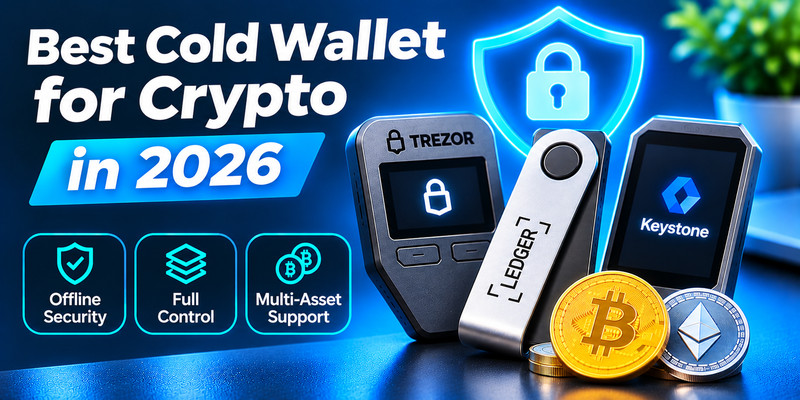
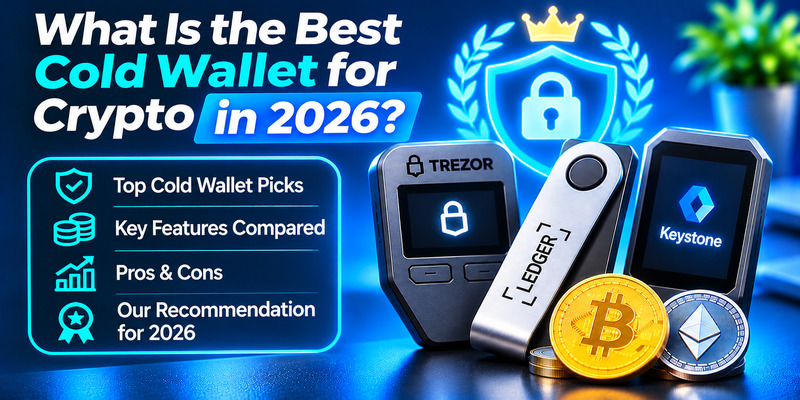
The best cold wallet for crypto in 2026 is Tangem for most people, thanks to its EAL6+ certified chip, simple card design and low price. Trezor Safe 3 is the best budget and open-source pick, Ledger is the best-known ecosystem, and NGRAVE ZERO offers the highest certified security (EAL7) for large, long-term holdings.
Short answer: choose a hardware wallet with a certified secure element (EAL5+ or higher), make sure it supports your coins, buy it only from the manufacturer or an authorized reseller, and store your recovery backup offline. No single device wins for everyone, so the best cold wallet for crypto is the one that fits your assets, budget and habits well enough that you actually use it.
This guide explains what a cold wallet is, how it works, how the leading models compare, what the 2026 security incidents really mean, and how to pick and set up the best cold wallet for crypto for your situation.
Best Cold Wallets for Crypto in 2026: Quick Comparison
Prices below are approximate and vary by region, bundle and promotion, so confirm the current price on the manufacturer’s official store before you buy.
| Wallet | Best for | Approx. price | Security chip | Connection | Open source |
|---|---|---|---|---|---|
| Tangem (card set) | Overall and beginners | $55–$70 | EAL6+ | NFC (phone) | No |
| Trezor Safe 3 | Budget and transparency | $59–$79 | EAL6+ | USB-C | Yes |
| Ledger Nano X | Mobile use and wide coin support | $99–$149 | Certified secure element | USB-C, Bluetooth | No |
| Ledger Stax / Flex | Screen and design | $249–$399 | Certified secure element | USB-C, Bluetooth, NFC | No |
| NGRAVE ZERO | Maximum security | $398–$498 (bundle) | EAL7 | Air-gapped (QR) | No |
| SafePal S1 | Cheap air-gapped signing | About $50 | EAL5+ | Air-gapped (QR) | No (X1 is) |
| OneKey Classic 1S | Open source, many chains | $79–$99 | EAL6+ | USB-C, Bluetooth | Yes |
| Cypherock X1 | Key splitting | $99–$129 | EAL6+ (cards) | USB-C, NFC cards | Yes |
Secure your accounts with fast, reliable two-factor authentication. Download now and protect your login in seconds.Download Authenticator App
What Is a Cold Wallet in Crypto?
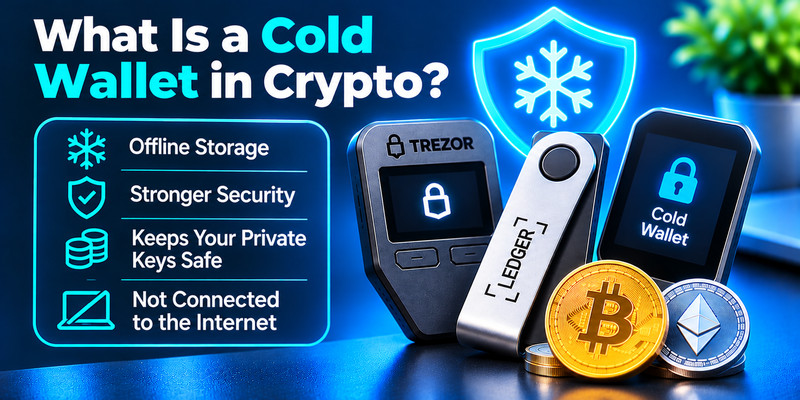
A cold wallet is a crypto wallet that keeps your private keys offline, away from any internet-connected computer or phone. Most cold wallets are hardware devices, which is why people use the terms “cold wallet,” “hardware wallet” and “cold storage wallet” almost interchangeably. Some cold wallets are cards, some look like small USB sticks, and some are fully air-gapped gadgets with a camera and screen.
It helps to understand one important point: your coins never actually live inside the wallet. They exist on the blockchain. The wallet stores the private key, the secret that proves ownership and authorizes every transaction. If someone steals the key, they control the funds. If you lose the key and have no backup, nobody can recover it for you.
That is why the best cold wallet for crypto is built around one job: generating and guarding that key inside a tamper-resistant chip so it never touches a connected device.
Read more: Best Hardware Wallet for Crypto in 2026: Top Picks, Safety Guide and How to Choose
How Does a Cold Wallet Work?
A cold wallet works by signing transactions inside the device. When you send crypto, your phone or computer builds the transaction and passes it to the wallet. The wallet shows you the details, you approve it with a button, a tap or a fingerprint, and the device signs it internally. Only the signed result leaves the device. The private key itself never does.
Cold wallets differ in how they pass data back and forth:
- USB or Bluetooth devices (Ledger, Trezor, OneKey) connect to an app on your computer or phone.
- NFC cards (Tangem, Arculus) work by tapping the card against a smartphone.
- Air-gapped devices (NGRAVE ZERO, SafePal S1, Ellipal Titan) use QR codes only, with no cable, Bluetooth or Wi-Fi at all.
Most models also give you a recovery method. The classic approach is a 12- or 24-word recovery phrase you write down. Others use backup cards (Tangem) or split the key into several pieces (Cypherock X1), so losing one piece does not lose your coins.
Cold storage reduces the exposure of private keys to internet-connected devices, but it is only one part of cryptocurrency security. Our guide on how to secure a crypto wallet explains how to combine secure key storage, transaction verification, recovery planning, and phishing prevention.
Read more: How to Recover a Lost Crypto Wallet: The Complete 2026 Guide
What Is the EAL Rating and Why Does It Matter?
EAL stands for Evaluation Assurance Level, an international scale from 1 to 7 that shows how rigorously a chip was tested. Higher numbers mean more thorough design review and penetration testing. Most serious cold wallets use chips rated EAL5+ or above, and the highest rating in this category belongs to NGRAVE ZERO at EAL7.
One caution: an EAL rating tells you how deeply a component was tested, not that the whole product is flawless. A wallet can use a certified chip and still have a software bug. Treat the rating as a strong signal, not a guarantee.
Cold Wallet vs Hot Wallet: What Is the Difference?
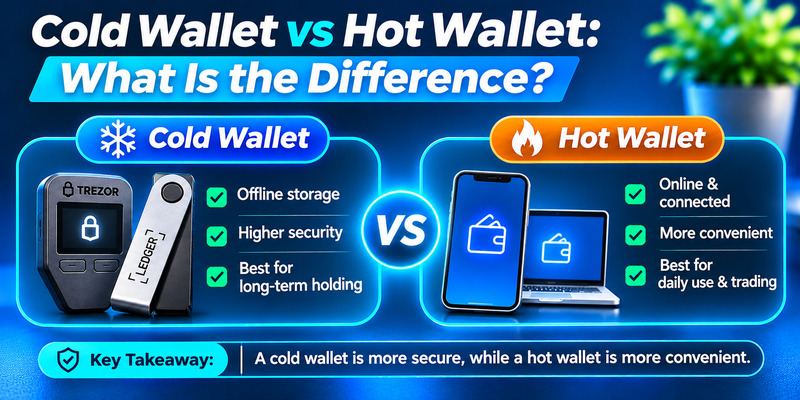
A hot wallet is software (an app, browser extension or exchange account) that stays connected to the internet. A cold wallet keeps keys offline. The trade-off is convenience against protection.
| Feature | Cold wallet | Hot wallet |
|---|---|---|
| Internet connection | Keys stay offline | Always online |
| Security | Higher | Lower |
| Convenience | Slower, more steps | Fast, easy for daily use |
| Cost | You buy a device | Usually free |
| Best for | Long-term and large holdings | Trading, DeFi, small balances |
Most experienced users run both. They keep the bulk of their holdings in the best cold wallet for crypto they can find and use a small hot wallet, such as MetaMask or Trust Wallet, for everyday spending and apps. Many cold wallets can also connect to those hot wallets, so you can use DeFi while the keys stay on the device.
For cold wallets that use a recovery phrase, protecting those words is essential because someone with the required recovery secrets may be able to restore the wallet without your device. Learn how to protect your seed phrase with offline storage, physical security, backup verification, and precautions against fraudulent recovery requests.
Read more: How to Secure a Crypto Wallet: 10 Steps to Keep Your Crypto Safe
What Is the Best Cold Wallet for Crypto in 2026?
There is no universal winner, but these are the models that consistently rank highest across independent reviews, grouped by what they do best. Here is how the best cold wallet for crypto looks for different types of holders.
Tangem: Best Overall and Best for Beginners
Tangem is a card-shaped wallet that signs transactions when you tap it on an NFC-enabled smartphone. Its secure chip is EAL6+ certified, and the keys are generated inside the card and never exposed. There is no cable, battery or screen, and no USB, Bluetooth or Wi-Fi.
The backup system is what makes Tangem unusual. Instead of relying only on a written seed phrase, a card set (usually two or three cards) holds copies of the same key, so if you lose one card, another restores access. Tangem supports well over 14,000 assets across 90 or more blockchains, according to recent reviews, and a two-card set costs roughly $55–$60.
- Pros: easy setup, no seed phrase to mishandle, low price, strong chip certification.
- Cons: it needs an NFC phone (there is no desktop app), the firmware is closed source, you review transactions on your phone rather than on a device screen, and the card backup is created at setup, so you cannot add a spare card later.
For most newcomers, Tangem is the best cold wallet for crypto because it removes the step where beginners make the costliest mistakes: handling a recovery phrase.
Trezor Safe 3: Best Budget and Open-Source Choice
Trezor launched one of the first modern hardware wallets in 2014, and its devices run open-source firmware that anyone can inspect. The Safe 3 is the entry model: an EAL6+ secure element, a small monochrome screen, two physical buttons and a USB-C connection, typically priced around $59–$79.
Trezor Suite, the companion app, lets you manage, swap and buy assets while every transaction is confirmed on the device itself. Trezor supports Shamir backup on its newer models, which splits recovery into multiple shares. The trade-offs are a plastic body, a screen that can scratch, no air-gapped mode, and more limited iOS support than rivals.
Step up to the Safe 5 (color touchscreen, roughly $129–$169) or the Safe 7 (about $249) if you want a better display and Bluetooth. If transparency matters more to you than a seedless setup, Trezor is the best cold wallet for crypto on this list.
Ledger: Best-Known Ecosystem
Ledger has been making hardware wallets since 2016 and is one of the two largest providers in the market. Its range runs from the Nano S Plus and Nano X, through the newer Nano Gen5 (about $179) and Flex (about $249), up to the Stax (about $399) with its curved E Ink touchscreen. Devices connect through the Ledger Live app, support thousands of coins and tokens across 90 or more blockchains, and handle staking and NFTs. Ledger also works with third-party wallets such as MetaMask for DeFi.
Ledger’s firmware is closed source, though its devices are independently audited and the company runs a bug bounty program. Be aware of the controversy around the optional Ledger Recover service, and note that the January 2026 breach at Ledger’s payment processor exposed customer contact details, not funds or devices (more on that below).
The Nano X is the easiest starting point for people who want Bluetooth and a screen, while the Stax and Flex are about design and comfort rather than extra security. For users who want one polished app and wide asset coverage, Ledger is often the best cold wallet for crypto.
NGRAVE ZERO: Best for Maximum Security
NGRAVE ZERO is a fully air-gapped wallet with EAL7 certification, the highest level on the scale, plus biometric and PIN authentication. It signs transactions by QR code and can be paired with durable graphene backup plates for your recovery data.
It supports around 3,500 assets and NFTs, which is fewer than most competitors, and it is the most expensive option here (roughly $398–$498 depending on bundle). It is also slow for everyday use. That makes it a strong match for a long-term vault and a poor match for frequent trading. If you hold a large amount and rarely move it, NGRAVE ZERO is arguably the best cold wallet for crypto in terms of certified security.
SafePal S1 and Ellipal Titan: Best Budget Air-Gapped Options
The SafePal S1 (about $50) and Ellipal Titan line (about $99–$169) both sign transactions by QR code with no wired or wireless link, and both use EAL5+ chips with anti-tamper protection. They support thousands of assets across 100 or more networks and pair with companion mobile apps.
The downsides: QR signing adds steps to every transaction, and reviewers have flagged that SafePal has no public bug bounty program and has had less independent verification of its core app. They suit cost-conscious long-term holders who value isolation.
OneKey, Cypherock X1 and Arculus: Worth Considering
- OneKey (Classic 1S about $79–$99, Pro about $278) offers open-source firmware, EAL6+ chips and support for 100+ blockchains, plus a feature that warns about risky signatures.
- Cypherock X1 (about $99–$129) splits your key across a vault and four NFC cards using Shamir-style secret sharing, so any two of five pieces can restore it. It is powerful but more complex to manage, which makes it better as a second wallet than a first.
- Arculus is a metal card paired with a mobile app, using biometric, PIN and card tap together as a three-factor model, with EAL6+ certification.
Fake wallet websites, malicious applications, and fraudulent support messages can trick users into revealing recovery phrases or approving dangerous transactions. Follow our guide on how to avoid phishing scams to recognize impersonation attempts, verify suspicious links, and protect sensitive wallet information.
Read more: What Is Smishing? How Text Message Phishing Works
Open Source vs Closed Source: Which Is More Secure?
Open-source wallets such as Trezor and OneKey publish their firmware so independent researchers can audit how keys are generated and transactions are handled. Closed-source wallets such as Ledger and Tangem keep firmware private and rely on third-party audits and bug bounties instead.
Neither approach guarantees safety. The 2026 Coldcard incident (below) involved open code that contained a flaw for years. What matters is how well each team executes, audits and responds when something goes wrong.
Are Cold Wallets Safe? What the 2026 Incidents Really Mean
Three very different events made headlines in 2026, and treating them as the same story gives a distorted picture of risk.
The Coldcard firmware flaw (July 2026): funds were stolen. A build error in a 2021 firmware release made some devices generate keys with a weak, software-based random number generator instead of a proper hardware source. Attackers could reconstruct private keys offline, and reported losses ranged from tens of millions to more than $100 million depending on the estimate. This was a failure in key generation itself, not an online hack. Anyone who generated a seed on an affected Coldcard should treat it as compromised and move funds to a new wallet.
The Ledger and Trezor vendor breaches: data leaked, funds were not. In January 2026, attackers breached Global-e, a payment processor used by Ledger, exposing customer names, addresses, emails, phone numbers and order details. A separate breach at fulfillment provider ShipMonk exposed order data for roughly 81,000 Trezor customers. No devices, recovery phrases or funds were compromised. The real danger is phishing and physical-safety risk, since those lists identify crypto owners.
The Trezor Safe 7 chip finding (June 2026): a lab result, not an exploit. Ledger’s security researchers demonstrated an attack on a chip used in the Safe 7, but it requires physical possession, specialist equipment and expert skill, and there is no evidence of real-world use.
The takeaway: the best cold wallet for crypto still beats a hot wallet or an exchange for long-term storage, but the device is only as safe as its key generation, your purchase source and your behavior.
Read more: Signs of a Scam Text Message: A Practical Checklist
Is a Cold Wallet 100% Safe?
No. A cold wallet removes most remote attack paths, but it does not remove human error. The most common ways people lose crypto with a cold wallet are:
- Losing the device and the recovery backup together.
- Entering a recovery phrase into a fake website, app or “support” chat.
- Buying a tampered or counterfeit device from an unofficial seller.
- Approving a malicious transaction without reading it on the device screen.
- Storing the recovery phrase digitally, such as in photos or cloud notes.
No legitimate wallet company will ever ask for your recovery phrase by email, text, phone call or letter.
How to Choose the Best Cold Wallet for Crypto
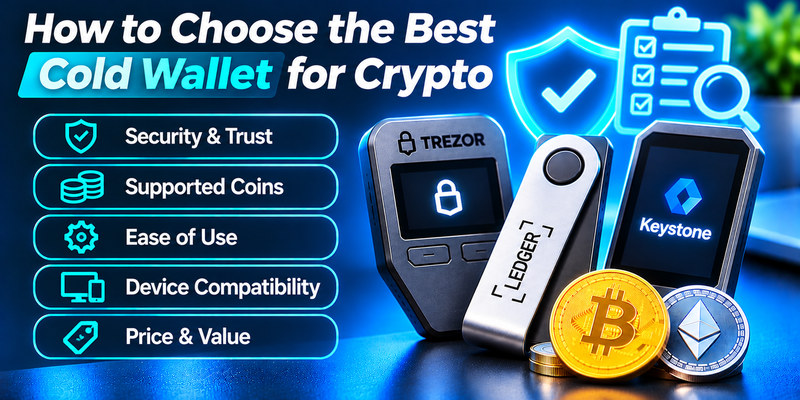
Use these five criteria to narrow the field.
- Security architecture. Look for a certified secure element (EAL5+ or higher), a PIN, optional passphrase support, and ideally independent audits and a bug bounty. Check how the vendor handled past vulnerability disclosures.
- Supported assets. Confirm that your exact coins and networks are supported before you buy. This matters most for less common tokens and for coins such as XRP, Bitcoin or Solana.
- Ease of use. If a wallet feels like a chore, you will leave funds on an exchange. A wallet you avoid is not a secure wallet.
- Price and form factor. Entry models cost about $50–$100. Premium screens and air-gapped designs cost $250 or more but add convenience or isolation, not necessarily more protection.
- Backup and recovery. Decide whether you prefer a written phrase, backup cards or split-key recovery, and make sure you can realistically manage it.
A practical rule: match the wallet to the value at stake. For a modest portfolio, an affordable EAL6+ device is plenty. For a large, rarely touched stash, consider an air-gapped model or a multi-piece backup setup.
Which Cold Wallet Should I Use? A Simple Decision Guide
| If you are… | Consider |
|---|---|
| A beginner who wants simple setup and no seed phrase | Tangem |
| On a tight budget and value open-source code | Trezor Safe 3 or OneKey Classic 1S |
| Mobile-first with lots of different coins | Ledger Nano X or Nano Gen5 |
| Holding a large amount long term | NGRAVE ZERO or Ellipal Titan |
| Cost-conscious but want air-gapped signing | SafePal S1 |
| Advanced and want distributed backups | Cypherock X1 |
How to Set Up and Use a Cold Wallet Safely
- Buy directly from the manufacturer or an authorized reseller. Never buy a used device, and avoid marketplace listings that you cannot verify.
- Inspect the packaging and verify the device. Follow the maker’s official setup guide, check for tamper evidence, and update to the latest firmware.
- Create your PIN and back up the recovery data. Write the recovery phrase on paper or metal, never on a phone, and store it somewhere secure and separate from the device. Consider a second copy in another location.
- Send a small test transaction first. Move a small amount to confirm the address and flow work, then transfer the rest.
- Verify every transaction on the device screen. Check the receiving address and amount on the wallet itself, not just in the app.
- Keep firmware updated. Install updates only from the official app.
Choosing the best cold wallet for crypto is only half the job; careful setup is what makes it effective.
Read more: How to Spot a Phishing Email Before You Click
What Are the Disadvantages of a Cold Wallet?
- Upfront cost. Software wallets are free, while the best cold wallet for crypto costs money.
- Less convenient for frequent trading. More steps are needed for each transaction.
- Risk of loss or damage. Without a backup, a lost or broken device can mean lost funds.
- User error. Poorly stored recovery data is the most common cause of permanent loss.
- Limited features. Cold wallets do not pay interest on their own; staking and swaps depend on connected apps.
- Hardware lifespan. Most devices last roughly 5 to 10 years, but firmware support can end sooner, so plan to replace aging devices.
Protect the Accounts Around Your Cold Wallet with 2FA
A cold wallet protects your keys, but you still rely on exchange accounts, email and wallet apps to buy, sell and move funds. Attackers often target these weaker links first. To strengthen them:
- Turn on two-factor authentication (2FA) for every exchange and email account.
- Prefer an authenticator app or a hardware security key over SMS codes, which are vulnerable to SIM-swap attacks.
- Store authenticator backup codes offline, separate from your recovery phrase.
- Use unique, strong passwords in a password manager.
- Treat every unsolicited message about your wallet as phishing until you verify it yourself.
Pairing the best cold wallet for crypto with strong 2FA on the accounts you use to fund it closes most of the gaps that remain.
Frequently Asked Questions
What is the most secure cold crypto wallet?
By certification, NGRAVE ZERO is the most secure, with EAL7 and a fully air-gapped, biometric design. Tangem, Trezor, OneKey and Ledger’s higher-end models use EAL6+ chips and are also very strong, and air-gapped options such as Ellipal and SafePal S1 add isolation at lower prices. “Most secure” also depends on your habits: a well-guarded backup on a mid-range device beats a premium wallet with a careless recovery plan.
Is cold wallet 100% safe?
No wallet is 100% safe. Cold wallets greatly reduce online attack risk because keys stay offline, but you can still lose funds through lost backups, phishing, counterfeit devices, approving malicious transactions or, rarely, a firmware flaw like the 2026 Coldcard incident. Buy from official sources, keep firmware current and store your recovery data offline.
What is the most trustworthy crypto wallet?
Trust comes from track record, transparency and independent verification. Ledger and Trezor have the longest histories (both since the mid-2010s), regular third-party audits and active bug bounty programs, and Trezor adds fully open-source firmware. Tangem and OneKey also publish certifications and security details. Whichever you choose, look at how the company responded to past incidents, not just its spec sheet.
Which cold wallet should I use?
Use Tangem if you want the simplest setup, Trezor Safe 3 or OneKey if you want an affordable open-source device, Ledger if you want wide asset support in one app, and NGRAVE ZERO or an air-gapped wallet if you hold a large amount for the long term. Always confirm that the wallet supports your coins first. For most people, the best cold wallet for crypto is the one you will use consistently.
Do I really need a cold wallet?
If you hold a meaningful amount of crypto for the long term, yes, a cold wallet is usually the best way to protect it. If you only trade small amounts frequently, a well-secured hot wallet may be enough, but you should still move savings offline.
Can you lose crypto in a cold wallet?
Yes. If you lose the device and have no backup, or if your recovery phrase is stolen, you can lose access to your funds. A device failure alone is not a problem when your backup is safe, because you can restore on a new wallet.
Conclusion
The best cold wallet for crypto balances certified security, support for your assets and a workflow you will stick with. Tangem is the best all-rounder, Trezor Safe 3 is the best affordable open-source option, Ledger leads on ecosystem and polish, and NGRAVE ZERO leads on certified protection. Pick the model that matches your holdings, buy it from the official source, back up your recovery data offline, and secure your exchange and email accounts with 2FA.
Done well, the best cold wallet for crypto turns self-custody from a risk into your strongest layer of defense.
Disclaimer: This article is for educational purposes only and is not financial, tax or investment advice. Crypto is volatile and carries risk. Prices and specifications change, so verify details on official manufacturer websites before buying.