
Polymarket Hack 2026: How to Protect Your Crypto Account
Published October 30, 2026
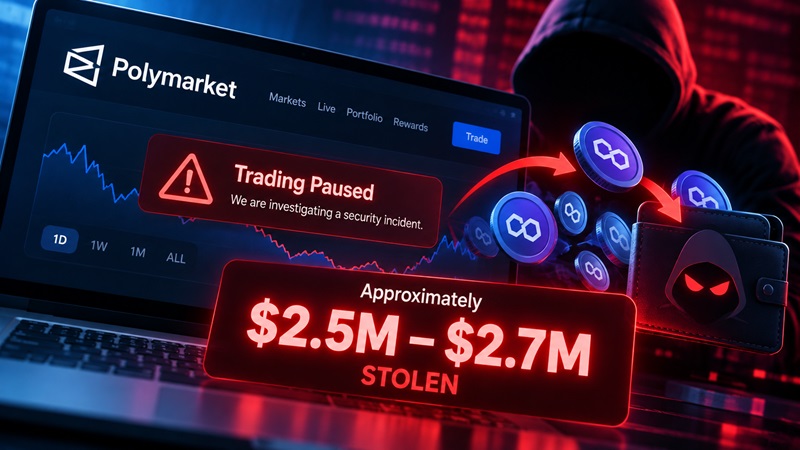
Polymarket temporarily suspended trading on October 29, 2026, after a third-party security breach led to unauthorized transactions affecting users of its international prediction market platform. Blockchain analysts estimated that approximately $2.5 million to $2.7 million in cryptocurrency was stolen during the incident.
Polymarket confirmed that it had identified and fixed the issue, referred the breach to law enforcement, and promised to reimburse affected traders. Trading resumed later that day.
Quick answer: The Polymarket hack 2026 was linked to compromised third-party software that could exploit active trading sessions. If you use Polymarket, review your transactions, check connected wallet permissions, secure the account used to sign in, and avoid suspicious recovery messages. Two-factor authentication helps protect logins but cannot stop every session-based or platform-level attack.
Here is what happened, why the incident matters, and how to protect your cryptocurrency.
Polymarket Hack 2026: What Happened?
On October 29, 2026, Polymarket reported a major security incident affecting Polymarket.com, its international cryptocurrency-based prediction market platform.
Users began reporting unexpected withdrawals and unauthorized sales of their prediction-market positions.
Polymarket responded by restricting trading to cancel-only mode, preventing new orders while allowing existing orders to be canceled. It also paused transaction relayer operations during its investigation.
According to the official Polymarket status history, the company identified a compromise involving one of its third-party service providers.
Key facts about the incident
| Incident Detail | Reported Information |
|---|---|
| Date | October 29, 2026 |
| Platform affected | Polymarket.com international platform |
| Type of attack | Third-party software compromise |
| Suspected vendor | DebugBear |
| Estimated stolen assets | $2.5M–$2.7M |
| Estimated affected users | Around 700, according to blockchain researchers |
| Trading suspension | Approximately one hour |
| Official incident status | Resolved on October 29 |
| Reimbursement | Polymarket promised to compensate affected traders |
Important: The dollar amount and victim count are independent estimates, not final totals confirmed by Polymarket.
The company’s incident timeline shows that the disruption began at 18:05 UTC and was marked resolved at 19:05 UTC on October 29.
Polymarket stated that affected users would be reimbursed and that relevant law enforcement authorities had been notified.
What caused the security breach?
The Polymarket hack 2026 was associated with a third-party monitoring service called DebugBear.
DebugBear provides website performance monitoring tools, including JavaScript code that websites can embed to analyze real user experiences.
Security researchers discovered that a script delivered through DebugBear infrastructure contained malicious cryptocurrency-draining functionality.
According to BleepingComputer’s investigation, the malicious code could interact with authenticated Polymarket trading sessions and attempt unauthorized transactions.
DebugBear acknowledged a security incident and advised customers using its Real User Monitoring product to remove the embedded script.
The key takeaway: The attack did not necessarily require victims to disclose their passwords or recovery phrases. It exploited access available within active trading sessions.
How Did Hackers Drain Polymarket Accounts?
The Polymarket hack 2026 demonstrates a security risk known as a software supply-chain attack.
This occurs when attackers compromise a trusted third-party component used by another application or service.
In this case, the suspicious component was JavaScript delivered through a website-monitoring provider.
Step 1: Compromise a trusted third-party script
Websites often rely on external scripts for analytics, monitoring, payments, and other services.
These scripts may run inside visitors’ browsers as part of the normal website experience.
Researchers reported that malicious code was distributed through DebugBear’s monitoring infrastructure.
Because Polymarket had integrated the third-party service, visitors using affected versions of the website could potentially load the malicious script.
Step 2: Identify authenticated trading sessions
The malicious JavaScript was designed to detect whether a user was signed in to Polymarket.
Researchers found that the code attempted to interact with existing trading functionality rather than requiring every victim to enter credentials into a fake website.
This distinction matters.
Even a correctly authenticated session can become vulnerable if malicious code executes within the trusted website environment.
Step 3: Sell positions and move cryptocurrency
The reported code examined users’ balances and prediction-market positions.
Depending on the account configuration, it attempted to sell positions or transfer digital assets to addresses controlled by attackers.
Blockchain investigators observed suspicious cryptocurrency transfers, with estimates reaching approximately $2.7 million.
The Polymarket hack 2026 shows why wallet security must address both the login process and the transactions authorized through a platform.
Step 4: Transfer stolen assets
Researchers traced transfers involving POL, the native cryptocurrency of the Polygon network.
Some funds were reportedly moved through additional addresses and blockchain services.
The final financial impact remained under investigation as of October 30, 2026.
Is Polymarket Safe After the Hack?
Polymarket reported that it identified and fixed the issue and restored trading on October 29, 2026.
Its official incident history classifies the disruption as resolved.
However, restored operations do not automatically mean that every affected account has been independently verified as secure or that every reimbursement has been completed.
The Polymarket hack 2026 also highlights an important distinction between a blockchain smart contract and a website interface.
A blockchain application may use non-custodial wallets while still relying on website scripts, authentication services, and transaction infrastructure.
If one of those components is compromised, users may face risks even when the underlying blockchain continues operating normally.
Users should follow official Polymarket security announcements and independently review their account and wallet activity.
Avoid making security decisions based only on social media posts or unsolicited private messages.
How to Protect Your Polymarket Crypto Account
The Polymarket hack 2026 is a reminder that cryptocurrency security requires more than a strong password.
The following precautions can help reduce exposure to unauthorized access, phishing, and risky wallet permissions.
1. Review your Polymarket transaction history
Sign in through the official platform after confirming its current status and security guidance.
Inspect your account for unexpected activity, including:
- Unauthorized withdrawals
- Unfamiliar trading orders
- Unexpected sales of open positions
- Changes in your cryptocurrency balances
- Wallet transactions you did not authorize
Compare the platform’s activity records with the relevant blockchain explorer.
If you discover suspicious transactions, save their transaction hashes, timestamps, and destination addresses.
2. Check connected wallet permissions
Many cryptocurrency applications interact with wallets through smart-contract permissions.
These permissions may authorize a contract to access specific tokens.
Review the applications connected to your wallet and investigate any approval you do not recognize.
Disconnecting a wallet from a website is not the same as revoking on-chain token approvals.
MetaMask explains this distinction in its official token approval guidance.
Review and revoke unnecessary or suspicious permissions using a trusted wallet interface or verified blockchain explorer.
Revocation generally requires an on-chain transaction and may involve network fees.
3. Secure the account used to sign in
Polymarket supports several authentication methods, including Google sign-in, email verification, and connecting a cryptocurrency wallet.
According to the official Polymarket signup guide, users can sign up using a Google account, an email address with a verification code, or an external wallet.
The security steps depend on the method you use.
If you sign in with Google, protect that Google account using a unique password and strong authentication.
You can follow our guide to google account two step verification.
If you use email verification, secure the associated email account and never share its login codes.
If you connect an external wallet, protect its private keys, recovery phrase, and device.
4. Enable strong two-factor authentication where supported
Two-factor authentication provides an additional security check beyond a password.
A supported two factor authentication app can help protect a Google or email account used to access Polymarket.
Where available, phishing-resistant passkeys provide stronger protection against fake login pages than manually entered OTP codes.
However, 2FA cannot guarantee protection against malicious scripts that exploit an already authenticated trading session.
For more information, read our best account security practices.
5. Never approve unexpected wallet transactions
Cryptocurrency wallets may ask users to sign messages, approve token spending, or authorize transactions.
Before approving any request, check the website, network, contract, recipient, and requested permission.
Avoid blindly accepting unlimited token allowances.
Be especially cautious of unexpected messages telling you to authorize a transaction to protect or recover your funds.
A legitimate security announcement does not require you to reveal your seed phrase to an unknown person.
6. Protect your private keys and recovery phrase
A recovery phrase or private key can give another person control over your cryptocurrency wallet.
Never share these credentials with support agents, social media contacts, or unfamiliar websites.
For substantial holdings, consider a reputable hardware wallet that displays transaction details on a separate trusted device.
Hardware wallets can reduce some risks associated with exposing private keys, but they cannot prevent every malicious transaction if the owner approves it.
7. Be alert to fake Polymarket refund messages
Major security incidents often create opportunities for additional scams.
Attackers may impersonate customer support and offer fake refunds or recovery services.
A fraudulent message may claim that you must connect your wallet, sign a special recovery transaction, or disclose your private key to receive compensation.
Use only Polymarket’s independently verified official support channels to discuss reimbursement.
Do not trust a recovery page simply because its message mentions the October 2026 incident.
What to Do If Your Polymarket Wallet Was Compromised
If you suspect that your assets were affected by the Polymarket hack 2026, prioritize protecting any remaining funds.
First, stop signing new transactions or approvals through a suspicious interface.
Review your wallet activity using a trusted wallet application or blockchain explorer. Record unauthorized trades, withdrawals, and relevant transaction hashes.
Next, inspect connected applications and smart-contract allowances. Revoke suspicious permissions where appropriate.
If your private key or recovery phrase may have been exposed, create a new wallet with a completely new recovery phrase on a trusted device. Where safely possible, move remaining assets to that new wallet.
If you signed in using Google or email and suspect those credentials were compromised, secure the corresponding account and terminate unfamiliar sessions.
Finally, contact Polymarket through official support channels and preserve evidence for any reimbursement request.
Do not assume changing your password will reverse an unauthorized blockchain transaction or remove an existing token allowance.
The appropriate recovery process depends on whether the problem involved an account session, token approval, or exposed wallet key.
Can Two-Factor Authentication Prevent Crypto Hacks?
Two-factor authentication is an important security control, but the Polymarket hack 2026 shows its limitations.
Different attacks require different protections.
| Security Threat | Can 2FA Help? |
|---|---|
| Stolen account password | Yes, when the attacker lacks the second factor |
| Unauthorized Google account login | Yes, with properly configured MFA |
| Email account takeover | Yes, when supported |
| Real-time OTP phishing | Partially; OTP codes can still be stolen |
| Compromised wallet private key | No |
| Malicious smart-contract approval | No direct protection |
| Hijacked active trading session | Not reliably |
| Compromised third-party website script | Not directly |
The most effective security strategy combines strong authentication with secure wallet management, transaction verification, and trustworthy application infrastructure.
A hardware-backed passkey can reduce phishing risks at sign-in, while wallet approval controls help limit certain blockchain risks.
Neither can fully compensate for malicious code executing within a trusted service.
For a broader approach, follow our personal cybersecurity checklist.
Frequently Asked Questions
Was Polymarket hacked in October 2026?
Yes. Polymarket confirmed a security incident on October 29, 2026, involving a compromised third-party provider. The incident affected its international platform and prompted a temporary trading suspension.
How much money was stolen in the Polymarket hack?
Blockchain researchers estimated approximately $2.5 million to $2.7 million in stolen cryptocurrency. Polymarket had not publicly confirmed a final loss total or affected-user count in its initial incident statement.
How many Polymarket users were affected?
Blockchain analytics reports suggested that approximately 700 users may have been affected. This remained an independent estimate rather than a confirmed final count from Polymarket.
Has Polymarket resumed trading?
Yes. Polymarket’s official status page recorded the incident as resolved at 19:05 UTC on October 29, 2026, following a temporary trading interruption.
Will Polymarket refund affected users?
Polymarket publicly promised to compensate affected traders. However, the initial announcement did not establish a complete reimbursement schedule or confirm that every claim had already been processed.
Affected users should contact verified Polymarket support channels.
Was the Polymarket blockchain hacked?
The reported incident involved compromised third-party software interacting with the international trading platform.
Available evidence does not establish that the underlying Polygon blockchain itself was compromised.
Can Google Authenticator prevent Polymarket wallet theft?
Google Authenticator can help protect supported account logins, including a Google account used to access Polymarket.
However, it cannot directly prevent theft caused by malicious transaction approvals, compromised private keys, or abuse of an active trading session.
Final Thoughts: How to Stay Safe After the Polymarket Hack
The Polymarket hack 2026 demonstrates how a third-party software compromise can threaten cryptocurrency users even when they have not knowingly disclosed their passwords or recovery phrases.
The October 29 incident resulted in a temporary trading suspension and independently estimated losses of approximately $2.5 million to $2.7 million.
Polymarket reported that the issue had been fixed and promised to reimburse affected traders, but the incident highlights broader risks involving website integrations and active trading sessions.
For users, the most important actions are to review wallet activity, verify transaction approvals, protect login accounts, and avoid fraudulent recovery messages.
Two-factor authentication remains valuable, but crypto security requires multiple layers of protection beyond the login screen.
Sources
- Polymarket — Official Status and Incident History
- Reuters — Polymarket Resumes Trading After Third-Party Breach, October 29, 2026
- CoinDesk — Polymarket Suspends Trading After Third-Party Breach
- BleepingComputer — Polymarket Halts Trading After Crypto-Draining Script Breach
- Polymarket Help Center — How to Sign Up
- MetaMask — How to Revoke Token Approvals
