
What Is a Multi Signature Wallet? How It Works, Benefits & Risks
Published November 10, 2026
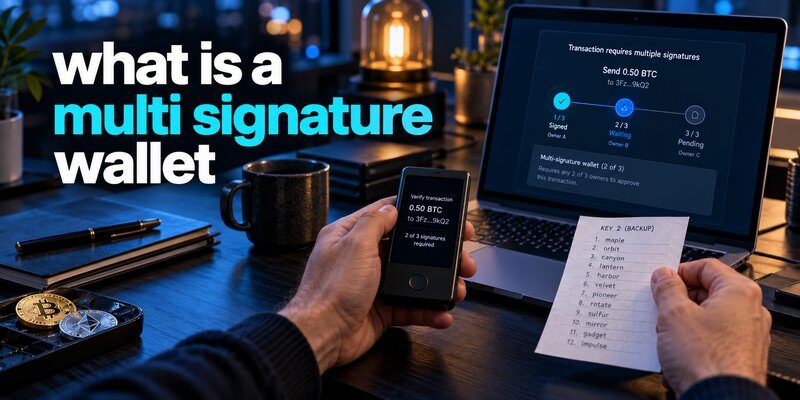
What is a multi signature wallet? A multi signature wallet, also called a multisig wallet, is a cryptocurrency wallet that requires two or more private keys to authorize a transaction according to a predefined signing policy. Unlike a traditional wallet controlled by one private key, a multisig wallet distributes transaction approval across multiple keys, devices, or individuals.
For example, a 2-of-3 multisig wallet requires any two of three authorized keys to approve a transaction. This approach can reduce the risk of losing funds because of one compromised key while providing additional control over shared cryptocurrency assets.
In this guide, you will learn how multi signature wallets work, their different types, advantages and disadvantages, and how to decide whether multisig is right for your cryptocurrency security needs.
What Is a Multi Signature Wallet?
A multi signature wallet is a digital wallet that uses multiple cryptographic signatures to approve cryptocurrency transactions. Instead of relying on a single private key, it follows a predefined authorization policy requiring a minimum number of signatures before funds can be spent.
The concept is commonly called multisig, short for multi-signature.
To understand what is a multi signature wallet, consider a shared cryptocurrency treasury. Rather than allowing one employee to transfer funds independently, a business can configure a wallet so that at least two authorized people must approve each transaction.
This structure provides an additional layer of authorization without requiring every participant to share the same private key.
What Is a Multisig Wallet in Crypto? In cryptocurrency, a multisig wallet is a wallet arrangement that enforces a multiple-signature spending policy on a supported blockchain.
Bitcoin supports established multisig constructions. Other blockchain ecosystems may implement similar authorization through smart contracts or account-level permissions.
Although these systems can serve similar purposes, their technical requirements and recovery procedures may differ.
A multisig wallet does not automatically encrypt funds more securely or guarantee protection against every attack. Its main purpose is to distribute transaction authorization across independent keys.
Read more: What Is a Cold Wallet? Definition, How It Works, Types and Safety Guide
Secure your accounts with fast, reliable two-factor authentication. Download now and protect your login in seconds.Download Authenticator App
How Does a Multi Signature Wallet Work?
Understanding how a multi signature wallet works begins with the relationship between private keys, transaction signatures, and the wallet’s approval threshold.
A multisig configuration is commonly represented as M-of-N, where:
- M: The minimum number of valid signatures required to authorize a transaction.
- N: The total number of authorized signing keys.
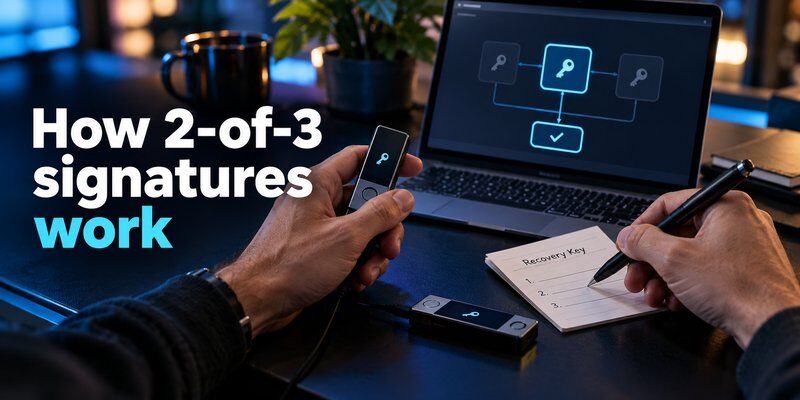
For example, a 2-of-3 wallet has three authorized keys but requires only two valid signatures to spend funds.
Example: How a 2-of-3 Multisig Wallet Works
Imagine three people managing a cryptocurrency wallet:
- Alice controls Key A.
- Bob controls Key B.
- Charlie controls Key C.
The wallet requires any two authorized keys to approve a transaction.
If Alice wants to transfer Bitcoin, she prepares and signs the transaction using Key A. Bob then reviews the transaction and adds a second signature using Key B.
Once the required signatures are collected, the completed transaction can be broadcast to the Bitcoin network.
Charlie does not need to participate because the wallet has already satisfied its two-signature threshold.
However, if Alice loses Key A, Bob and Charlie can still authorize transactions together.
This example demonstrates why a multi signature wallet can improve resilience against losing one signing key.
Read more: Biometric Banking in 2026: How It Works, Benefits, Risks, and Setup
Common Multisig Wallet Configurations
| Configuration | Required signatures | Common use case |
|---|---|---|
| 2-of-2 | Both keys | Joint approval between two participants |
| 2-of-3 | Any two keys | Personal backup resilience or small teams |
| 3-of-5 | Any three keys | Business treasury management |
| 4-of-7 | Any four keys | Larger organizations with distributed custody |
The appropriate configuration depends on the number of custodians, security requirements, and recovery procedures.
A higher number of required signatures does not automatically make a wallet safer. More signers can also introduce coordination problems and additional opportunities for configuration mistakes.
What Are the Benefits of a Multi Signature Wallet?
The main benefit of a multi signature wallet is that it reduces reliance on one private key for transaction authorization.
However, its security advantages depend on how independently the signing keys are generated, stored, and controlled.
Reduce Single-Key Compromise Risk
A traditional single-signature wallet can authorize spending with one valid private key.
If that key is stolen, an attacker may be able to transfer the wallet’s cryptocurrency.
A properly configured 2-of-3 multisig wallet requires at least two authorized signatures. Compromising only one signing key is therefore insufficient to spend funds.
This benefit becomes weaker when multiple keys are stored on the same compromised computer or cloud account.
Improve Protection Against Lost Keys
Another advantage of a multi signature wallet is its ability to tolerate certain key-loss scenarios.
With a 2-of-3 configuration, losing one signing key does not necessarily prevent access to funds because the remaining two keys can still authorize transactions.
However, losing two keys may make the funds inaccessible unless usable backups exist.
The wallet configuration and recovery information must also remain available.
Enable Shared Transaction Approval
Multisig wallets are useful when several people share responsibility for cryptocurrency assets.
For example, a company can require approval from both its finance manager and an executive before transferring funds.
This arrangement helps enforce internal authorization policies and reduces dependence on one individual.
However, multisig approval does not replace transaction monitoring, financial controls, or organizational security procedures.
Support Distributed Asset Custody
A multi signature wallet can distribute signing keys across different devices, physical locations, or trusted custodians.
For instance, one key may be stored on a hardware wallet at home, another in a secure secondary location, and a third with a designated recovery custodian.
This arrangement can reduce exposure to a single physical incident.
The protection depends on maintaining genuinely independent custody and reliable backups.
Each signer may have its own recovery phrase, depending on the wallet design. Learn what is a seed phrase to understand how recovery words relate to private keys and why they must be stored securely. In multisig, the recovery phrases alone may not be sufficient to reconstruct the exact wallet configuration.
Read more: How to Back Up Authenticator Codes Before You Change Phones
What Are the Disadvantages of a Multi Signature Wallet?
Although multisig can strengthen transaction authorization, it also introduces complexity.
Before adopting this wallet structure, consider the following limitations.
More Complicated Setup and Recovery
Setting up a multi signature wallet generally requires configuring multiple signing devices, establishing a signing threshold, and preserving the wallet’s public configuration information.
Some implementations require a wallet descriptor, extended public keys, derivation information, or other recovery metadata.
Even when the private keys remain available, missing configuration details can complicate restoration.
Additional Transaction Costs
Some multisig constructions require more blockchain data than comparable single-signature transactions.
On Bitcoin, this can increase transaction fees, depending on the script type, number of signatures, and network conditions.
Not every multisig implementation has the same fee structure.
Coordination Between Signers
A multisig transaction may require communication between several people or devices.
If a required signer is unavailable, a transaction can be delayed.
This can be inconvenient for organizations that need frequent or time-sensitive transfers.
Limited Compatibility
Not every cryptocurrency wallet, blockchain, or hardware signing device supports the same multisig features.
A setup designed for Bitcoin may not work on Ethereum or another blockchain.
Users should verify supported networks, signing policies, wallet software, and recovery procedures before depositing funds.
Multi Signature Wallet vs Single Signature Wallet: What’s the Difference?
When deciding what is a multi signature wallet best used for, it helps to compare multisig with a conventional single-signature wallet.
| Feature | Single-signature wallet | Multi-signature wallet |
|---|---|---|
| Transaction authorization | One private key | Multiple signatures according to a threshold |
| Setup difficulty | Generally simpler | Generally more complex |
| Single-key compromise | May allow unauthorized spending | One key alone may be insufficient |
| Lost-key recovery | Depends on available backup | Depends on threshold and backups |
| Shared approval | Not inherently supported | Supported through signing policy |
| Transaction fees | Often lower | May be higher |
| Best suited for | Everyday personal use | Shared custody or higher-value holdings |
A single-signature wallet can be appropriate for users who prioritize simplicity and understand how to protect their recovery phrase.
A multi signature wallet may be more suitable when independent approval, distributed custody, or tolerance of one lost key is important.
Neither approach is automatically secure without appropriate key management.
Read more: How to Back Up a Crypto Wallet: Complete Step-by-Step Guide
How to Set Up a Multi Signature Wallet Safely
Setting up a multi signature wallet requires careful preparation. The exact procedure depends on the blockchain, coordinator software, and signing devices.
The following example describes a general Bitcoin multisig workflow.
Step 1: Choose Compatible Wallet Software
Select reputable wallet software that supports the multisig configuration you intend to create.
Check the software’s official documentation for supported hardware devices, address formats, wallet descriptors, and recovery procedures.
Do not assume that every wallet advertising multisig supports the same implementation.
Step 2: Create Independent Signing Keys
Generate each signing key using a trusted device or supported hardware wallet.
For a 2-of-3 configuration, create three independent signing keys.
Avoid generating all keys on one potentially compromised device.
Each signer should control its own private key or recovery information.
Step 3: Configure the Signing Threshold
Use compatible coordinator software to establish the wallet’s signing policy.
For example, choose a 2-of-3 configuration requiring two valid signatures from three authorized keys.
Review the participating public keys, derivation information, and wallet configuration.
Step 4: Verify the Receiving Address
Before transferring cryptocurrency, verify the multisig wallet’s receiving address and policy using the documented verification process.
Where supported, confirm the configuration independently on the hardware signing devices.
Do not rely solely on an address displayed by an untrusted computer.
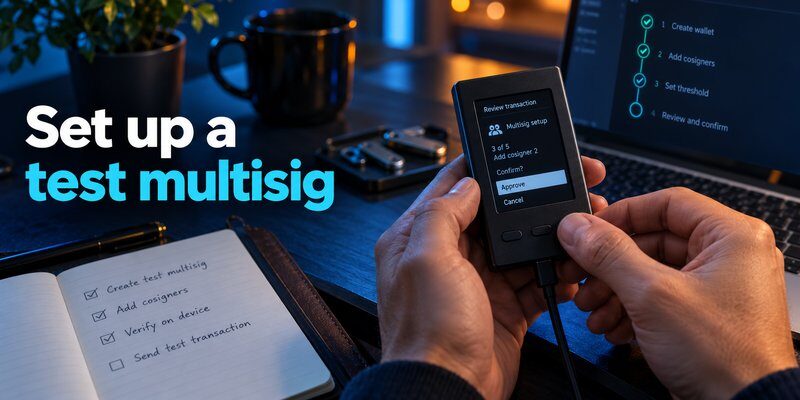
Step 5: Send a Small Test Transaction
Transfer a small amount of cryptocurrency to the newly created multisig wallet.
After confirming the deposit, prepare a small outgoing transaction.
Collect the required signatures and verify the destination address, amount, and network fee before broadcasting.
A successful deposit alone does not prove that you can spend or recover the funds.
Step 6: Back Up and Test Recovery
A secure multi signature wallet requires backups of the signing keys and the public wallet configuration needed for reconstruction.
Store recovery phrases offline in separate, secure locations.
Preserve the wallet descriptor or equivalent recovery metadata according to the software’s official instructions.
Test the restoration procedure before storing significant cryptocurrency.
Never enter a recovery phrase into an unsolicited website or share it with someone claiming to provide wallet support.
What Happens If You Lose a Key in a Multisig Wallet?
One important question about what is a multi signature wallet is whether it can protect funds when a private key becomes unavailable.
The answer depends on the wallet’s signing threshold and the number of remaining usable keys.
For example, in a 2-of-3 wallet:
- One key lost: The remaining two keys can generally authorize a transaction.
- Two keys lost: Spending is normally impossible without recovering at least one missing key.
- One key compromised: The attacker cannot normally spend with that key alone, but the wallet should be migrated to a fresh policy if compromise is suspected.
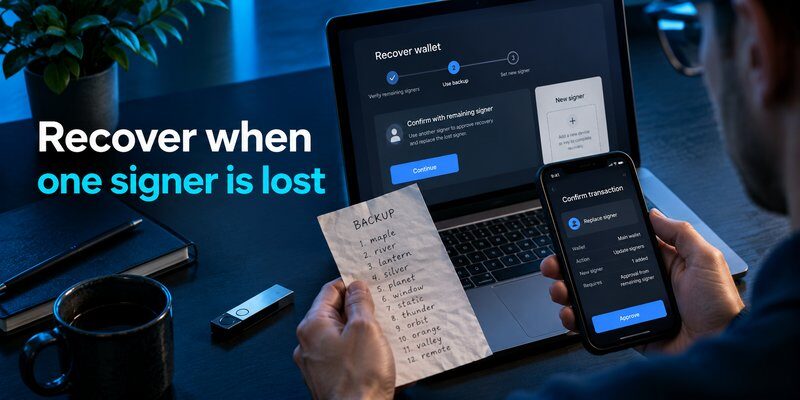
If one key is permanently lost, use the remaining authorized signers to create a replacement wallet and transfer funds after verifying the new configuration.
Replacing a signer usually involves moving funds to a new wallet policy rather than simply changing a key in the existing Bitcoin multisig arrangement.
For additional guidance, read how to recover a lost crypto wallet and how to protect your seed phrase.
Is a Multi Signature Wallet Safe?
A multi signature wallet can provide strong protection against certain key-compromise and custody risks, but it is not automatically safer in every situation.
Its security depends on independent key storage, correct transaction verification, compatible software, and a tested recovery process.
For example, a 2-of-3 wallet with three signing keys stored in one cloud account may provide little practical protection against account compromise.
Similarly, a team that cannot locate enough signing devices when needed may lose access despite using a technically secure wallet policy.
To improve multisig security:
- Store signing keys on independent devices or in separate secure locations.
- Use compatible hardware wallets where appropriate.
- Verify transaction details on trusted signing devices.
- Maintain accurate offline backups.
- Test signing and recovery procedures.
- Establish clear policies for compromised, lost, or unavailable keys.
You can also review how to secure a crypto wallet for additional wallet security practices.
Who Should Use a Multi Signature Wallet?
A multi signature wallet is most useful when distributing transaction authority provides a meaningful security or operational benefit.
Cryptocurrency Investors With Significant Holdings
Investors managing substantial cryptocurrency holdings may benefit from distributing signing keys across independent devices or locations.
However, they must be comfortable managing the additional recovery requirements.
Businesses and Crypto Treasury Teams
Organizations can use multisig to require multiple authorized individuals to approve transactions.
A 3-of-5 configuration, for example, can allow a treasury team to continue operating when some signers are unavailable.
The organization should document spending permissions, key custody, signer replacement, and emergency recovery procedures.
Families and Shared Custody Arrangements
Families may use multisig to distribute access to shared digital assets.
A properly planned configuration can support joint authorization and recovery arrangements.
However, succession planning requires more than simply distributing signing keys.
Beginners With Small Cryptocurrency Holdings
For beginners, a multi signature wallet may create unnecessary complexity.
A reputable hardware wallet with a securely stored recovery phrase may be easier to manage.
Before choosing multisig, users should understand wallet backups, private keys, transaction verification, and recovery.
Multi Signature Wallet vs Hardware Wallet: Which Is Better?
A multi signature wallet and a hardware wallet are not direct alternatives.
A hardware wallet is a physical signing device designed to protect private keys and authorize transactions.
Multisig is a transaction authorization arrangement that requires multiple signatures.
These technologies can work together.
For example, a 2-of-3 multisig setup may use three separate hardware wallets as independent signers.
This can combine hardware-based key protection with distributed transaction authorization.
However, three hardware devices do not automatically create a secure multisig arrangement. Users must still verify compatibility, configure the correct signing policy, and maintain independent backups.
For more information, see what is a hardware wallet and best hardware wallets for crypto.
Frequently Asked Questions
What Is a Multi Signature Wallet in Simple Terms?
A multi signature wallet is a cryptocurrency wallet that requires multiple authorized signatures to approve transactions. For example, a 2-of-3 wallet requires any two of three signing keys before funds can be spent.
How Many Signatures Does a Multisig Wallet Need?
The required number depends on the wallet’s configured threshold. Common arrangements include 2-of-2, 2-of-3, and 3-of-5. The wallet policy determines how many valid signatures are necessary.
Can a Multi Signature Wallet Be Hacked?
Yes. Multisig can reduce the impact of one stolen key, but attackers may still compromise enough signing keys, exploit vulnerable software, or trick authorized signers into approving malicious transactions.
Is a Multisig Wallet Better Than a Hardware Wallet?
They serve different purposes. A hardware wallet protects private keys on a dedicated device, while multisig distributes transaction authorization. Compatible hardware wallets can be used together in a multisig setup.
What Happens If One Multisig Signer Loses Their Private Key?
In a 2-of-3 wallet, the remaining two signers can generally continue authorizing transactions. Funds should be moved to a newly configured wallet if the lost key cannot be safely restored.
Is Multisig the Same as Two-Factor Authentication?
No. Multisig requires multiple cryptographic signatures for blockchain transactions. Two-factor authentication protects access to accounts using separate verification factors, such as a password and an authenticator-generated code.
Do All Cryptocurrencies Support Multisig Wallets?
No. Support depends on the blockchain and wallet implementation. Bitcoin supports established multisig constructions, while some other networks provide comparable functionality through smart contracts or account authorization mechanisms.
Protect Your Crypto Accounts With Authenticator App
A multi signature wallet helps control on-chain cryptocurrency transactions, but it does not replace the security measures required for exchange accounts and other online services.
For accounts that support time-based one-time passwords, Authenticator App can generate verification codes after you enroll the account using its official setup process.
Using an authentication app can add an additional verification step to supported online accounts.
Keep exchange recovery codes separate from wallet seed phrases, and never enter a self-custody recovery phrase into an authenticator application or an unfamiliar website.
Final Thoughts
Understanding what is a multi signature wallet helps cryptocurrency users decide whether distributed transaction authorization is worth the additional setup and recovery requirements.
A properly configured multisig wallet can reduce reliance on a single private key, support shared transaction approval, and improve resilience against certain key-loss scenarios.
However, multisig introduces additional responsibilities involving signer coordination, wallet configuration, backups, and recovery testing.
For individual beginners, a well-protected hardware wallet may be sufficient. For businesses, shared treasuries, and experienced cryptocurrency holders, multisig can provide valuable additional control when implemented carefully.