
Biometric Data Privacy Concerns: Risks, Laws, and Safety Tips
Published November 3, 2026
Quick answer: Biometric data privacy concerns arise because fingerprints, face templates, iris patterns, and similar identifiers can connect an identity to a person for years. Unlike a stolen password, you cannot easily replace your face or fingerprints. The safest approach is to prefer on-device matching, limit unnecessary collection, read retention policies, and keep an independent account-recovery method. Biometric verification can be useful, but its privacy depends on who collects the information, why they collect it, and where they store it.
Biometrics unlock phones, verify identities, and enable workplace access. Yet a phone fingerprint scanner differs from a service that uploads facial images to a provider. Understanding biometric data privacy concerns requires distinguishing these systems.
What Is Biometric Data and Why Is Privacy Different?
Biometric information is derived from measurable physical, physiological, or behavioral characteristics. Examples include fingerprints, facial geometry, iris patterns, voice characteristics, and sometimes typing rhythm. A photograph is not automatically a biometric template; technical processing and purpose matter.
For biometric data privacy concerns, distinguish a raw sample from a template. A sample may be a picture, fingerprint image, or recording. Software extracts features for later matching. Templates are not automatically anonymous: they may still identify someone.
Another distinction is one-to-one verification versus one-to-many identification. Your phone checks one enrolled reference; surveillance may search many records. The latter raises tracking and mistaken-match risks. These biometric privacy concerns extend beyond fooling a fingerprint reader.
Biometrics are hard to rotate. A leaked password can be replaced; a face or fingerprint generally cannot. Some derived templates can be revoked, depending on the system. Protect privacy before enrollment, not just after breaches.
The Biggest Biometric Data Privacy Concerns
1. Data breaches and long-lasting exposure
A breached database of face templates or fingerprint references can cause lasting worry because the original traits do not change. Harm depends on whether a template is reusable, encrypted, or linked to identities. A stolen template is not necessarily enough to unlock a modern phone, but leaks can still enable tracking and other misuse. These are central biometric data privacy concerns for cloud-based identity verification.
Questions about how can biometric data be misused should include identity correlation across databases, fraudulent enrollment in poorly designed systems, unauthorized sharing, and attempts to defeat weaker biometric checks. Avoid assuming that a single leaked selfie can bypass every modern depth-sensing system. Risk depends on the precise technology and safeguards.
2. Surveillance without meaningful choice
Face recognition may be used in stores, workplaces, or public settings where people have little opportunity to decline. A camera that silently identifies visitors raises different biometric data privacy concerns from a phone owner deliberately enabling a local fingerprint unlock. Individuals may not know when enrollment occurred, how long a record is kept, or whether the system searches other databases.
In a notable enforcement example, the US Federal Trade Commission alleged that Rite Aid used facial-recognition surveillance without reasonable safeguards and generated erroneous matches that harmed customers. In December 2023, the FTC announced a proposed five-year prohibition on the retailer’s use of facial recognition for surveillance as part of the case. This illustrates operational harm, not universal insecurity.
3. False matches, bias, and unfair outcomes
An inaccurate biometric match may lock out a legitimate user or mistakenly associate someone with another person’s record. Harm can be especially serious in hiring, policing, credit, or workplace-access decisions. Human review and a non-biometric alternative matter when an error could affect someone’s rights or opportunities. Accuracy depends on samples, demographics, sensors, and thresholds.
NIST’s 2025 Digital Identity Guidelines specify a false-match rate of 1 in 10,000 or better across demographic groups for biometric systems covered by the relevant authentication requirements. They also require presentation-attack detection for facial recognition. This is a standard’s threshold, not a measured success rate for every app. These statistics help frame biometric data privacy concerns without making unsupported comparisons.
4. Function creep and unclear retention
A scan collected to unlock an office door might later be proposed for attendance analytics or performance monitoring. That expansion is often called function creep. Other biometric privacy issues include excessive retention, sharing with vendors, or reusing identity-verification images for training. Good privacy notices address biometric data privacy concerns by explaining purpose, storage, sharing, deletion, and lawful justification.
Is Biometric Data Personal Data Under GDPR?
The answer to is biometric data personal data is yes when it meets the GDPR definition. Article 4(14) describes data produced through specific technical processing of physical, physiological, or behavioral characteristics that allows or confirms unique identification. The gdpr biometric data definition therefore focuses on both technical processing and identifiability. The official text is available on EUR-Lex.
If you search what is biometric data gdpr, there is a second distinction: Article 9 gives special-category protection to biometric data processed for the purpose of uniquely identifying a natural person. This means not every ordinary photo is automatically Article 9 biometric data. Once images are specially processed for identifying people, however, both the general personal-data rules and the relevant special-category requirements may apply.
A valid Article 6 lawful basis and an Article 9 condition are separate requirements. Explicit consent is one possible Article 9 condition, but not the only one. Organizations must assess whether a condition genuinely fits their purpose and whether other legal requirements apply. Employee consent cannot simply be assumed freely given.
For organizations, biometric data privacy concerns also involve minimization, retention, security, notices, and applicable access or erasure rights. High-risk processing may require a Data Protection Impact Assessment (DPIA). The UK’s Information Commissioner’s Office provides detailed biometric-recognition guidance, although UK GDPR rules and EU GDPR rules are distinct and UK guidance has been undergoing updates.
These biometric data privacy concerns also affect is biometrics personal data: labels alone are insufficient. Local phone templates and centrally collected visitor records involve different controllers, risks, and obligations.
US Biometric Privacy Laws: Virginia and Beyond

The United States does not have one comprehensive federal biometric privacy statute that applies identically to every commercial use. Instead, federal consumer-protection enforcement and state laws create overlapping requirements. As a result, biometric data privacy concerns deserve a state-specific review rather than a generic claim that all US biometric records are regulated the same way.
What Virginia’s law covers
The virginia biometric privacy law topic commonly refers to the Virginia Consumer Data Protection Act (VCDPA). Its current definition includes data produced by automatic measurement of biological characteristics and used to identify a particular individual. The statute expressly excludes certain materials, including ordinary photographs, videos and audio recordings, and information covered by specified health-care contexts.
The VCDPA treats processing biometric data for the purpose of uniquely identifying a person as sensitive data. For biometric data privacy concerns, this classification determines important compliance duties. Covered controllers generally must obtain a consumer’s consent before processing sensitive data, subject to the law’s scope and exceptions. Under § 59.1-578, they also have data-minimization, security, and notice duties. These biometric data privacy concerns have limits under Virginia law: its definition of a consumer generally excludes someone acting in a commercial or employment context, making workplace situations more complicated than a broad consumer-facing summary suggests.
Other US privacy protections
Illinois’s Biometric Information Privacy Act (BIPA), Texas’s biometric provisions, and Washington’s biometric identification law have their own definitions, notice, consent, and enforcement structures. They should not be treated as interchangeable with Virginia’s framework. The FTC can also challenge unfair or deceptive biometric practices under Section 5, as described in its biometric-information policy statement.
For anyone researching biometric data privacy concerns as an employer, developer, or service operator, check which rules apply to the specific collection and use, including any exemptions. This article summarizes principles rather than determining legal compliance for a particular business.
How Companies Collect, Store, and Use Biometrics
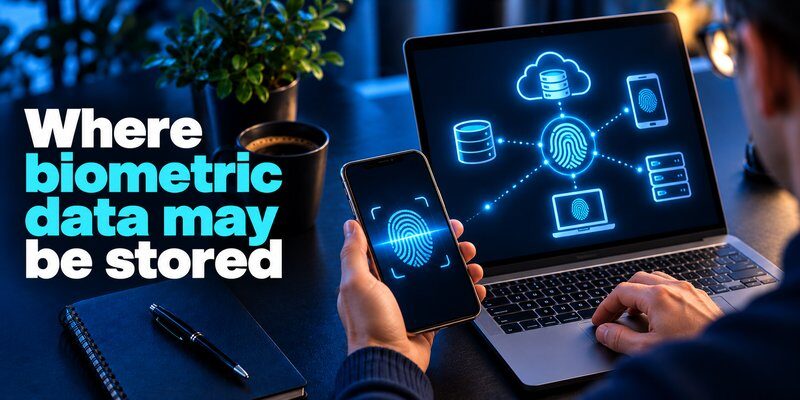
A useful privacy question is not simply is biometric data safe, but where does the matching happen? Some devices calculate and compare biometric representations locally. Others send images to a remote identity-verification provider or retain templates on a company-managed server. These architectures have different risks, and the privacy policy should make the distinction understandable.
On-device processing versus centralized storage
Apple says Face ID’s mathematical representations are encrypted, protected by the Secure Enclave, and do not leave the device or enter iCloud backups. Apple also reports a random false-match probability of less than 1 in 1,000,000 for one enrolled appearance, with important qualifications. That is an Apple-specific authentication statistic, not proof that every cloud face-scanning service has equivalent privacy protections.
For biometric data privacy concerns, local storage can reduce centralized repositories vulnerable to breaches or repurposing. It cannot prevent every device theft or weak recovery flow. Centralized systems especially need access controls, encryption, deletion schedules, audit trails, and limits on secondary uses.
What does X say about biometric information?
The search phrase x biometrics often concerns X, formerly Twitter. X’s privacy policy effective January 15, 2026 says it may collect and use biometric information based on consent for safety, security, and identification. Its additional processing disclosures discuss identity-verification selfies and ID images and describe retention periods for certain verification programs. The existence of this policy does not establish that X captures biometrics from every user. Check the program you actually enroll in before submitting a selfie or government ID.
Wherever you enroll, examine collection, processing, and deletion. These details make biometric data privacy concerns actionable.
How to Protect Your Biometric Data in Everyday Life
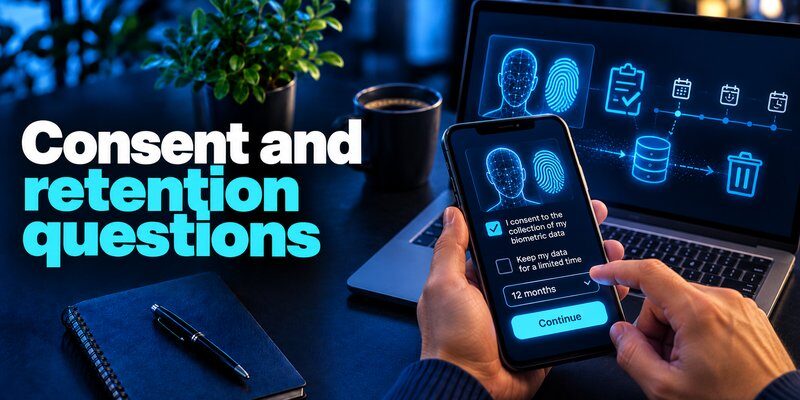
You cannot control every system around you, but you can reduce avoidable exposure. The dangers of biometric data grow when multiple services accumulate records indefinitely or repurpose them without clear limits. Use this practical checklist when deciding whether to opt in:
- Prefer trusted device biometrics. Use built-in Face ID, fingerprint, or Windows Hello controls for routine unlocking when available. They are not identical, but operating-system integration generally provides better-defined security boundaries than an unknown app requesting raw facial images.
- Ask what leaves the device. If an app wants a photo, video, or scan, look for an explanation of cloud processing, retention, sharing, and deletion. A biometric prompt that simply unlocks a local credential is different from uploading a selfie for remote identity proofing.
- Keep an alternative sign-in method. A strong passcode or security key matters if the sensor fails, you change devices, or you choose to disable biometrics. NIST’s authentication guidance calls for a non-biometric alternative in systems subject to its biometrics requirements.
- Limit enrollment. Avoid adding other people’s faces or fingerprints to personal devices and do not enroll in optional workplace or consumer programs without understanding their policies.
- Protect online accounts separately. A biometric screen unlock does not prevent phishing or an attacker from using a stolen session. Follow best account security practices and how to protect your online accounts.
- Know what to do after a suspected incident. Ask the provider what was exposed—raw images, templates, or credentials—and whether records were retained or shared. Our how to respond to a data breach guide covers broader account-recovery actions.
Do not assume that disabling face unlock erases information held by an outside identity-verification provider. Device settings and third-party deletion requests are separate processes. Reviewing both helps address biometric data privacy concerns.
Biometric Login vs Passkeys and 2FA
Biometric authentication answers whether the person using a device matches the enrolled reference. A passkey is a cryptographic credential unlocked with a face, fingerprint, or PIN. A time-based one-time password (TOTP) is generated from a shared secret. These mechanisms complement one another but use different information. That distinction matters when assessing biometric data privacy concerns for online authentication.
An authenticator app can provide verification codes without asking an online service to receive your fingerprint or face template. Depending on the product, a biometric check may simply lock the app’s interface so someone holding your phone cannot casually view stored codes. For further explanation, see two factor authentication app and Microsoft Authenticator passkeys.
Begamob’s iPhone authentication app lists TOTP code generation and optional Face ID, Touch ID, or PIN app lock in its App Store description. It can be useful when a participating service supports standard authenticator codes. Its app lock protects local access to codes; it does not eliminate biometric-data risks from unrelated facial identity services, or replace phishing-resistant passkeys where supported.
Protect your verification codes: Download authenticator app 2fa for iPhone on the App Store. Review current features, privacy terms, subscription options, and recovery choices before relying on any authentication tool for important accounts.
For people weighing biometric data privacy concerns, the goal is to minimize unnecessary data collection while selecting a login method that fits the threat. A strong device lock plus a suitable passkey or account-level verification method is often more practical than enrolling your biometrics with every website.
Frequently Asked Questions About Biometric Data Privacy
Can biometric data be changed after a breach?
Your underlying fingerprint or face cannot be reset like a password. Some systems can replace or revoke derived templates, but this depends on their technical design. Ask the provider what information was stolen and whether compromised records can be invalidated. Long-term identifiability is why biometric data privacy concerns deserve attention before a breach occurs.
Is every face photo considered biometric data under GDPR?
No. An ordinary photo is not automatically special-category biometric data. Processing that extracts or uses facial characteristics to uniquely identify someone may bring it within the GDPR’s biometric rules. Purpose and technical processing matter.
Are fingerprint locks safer for privacy than cloud face checks?
They may create less centralized exposure when matching stays on the device. But security depends on the implementation, and not every fingerprint system stores information locally. Compare architecture, privacy notices, and recovery rather than choosing solely by sensor type.
Can an employer require biometric attendance?
Possibly, but the answer depends on local law, necessity, proportionality, notice, valid legal basis, and whether employees have a meaningful alternative. Employment relationships can make consent difficult to rely upon. Seek jurisdiction-specific advice before implementing mandatory biometric monitoring.
Do biometrics replace passwords and two-factor authentication?
Not universally. Some passkeys use a biometric to unlock a cryptographic key; other websites still require a password and an additional code. A biometric match alone is not automatically an independent second factor. Choose the sign-in method a service actually supports.
What is the single best way to reduce biometric privacy risks?
Avoid submitting raw biometric samples unless necessary, prefer reputable on-device verification when available, and insist on clear purpose and deletion information. This is a practical starting point for managing biometric data privacy concerns across phones, workplaces, and online identity checks.
Download Authenticator App
Secure your accounts with fast, reliable two-factor authentication. Download now and protect your login in seconds.
