Crypto Wallet Scams: How to Spot and Stop Them
Published November 10, 2026
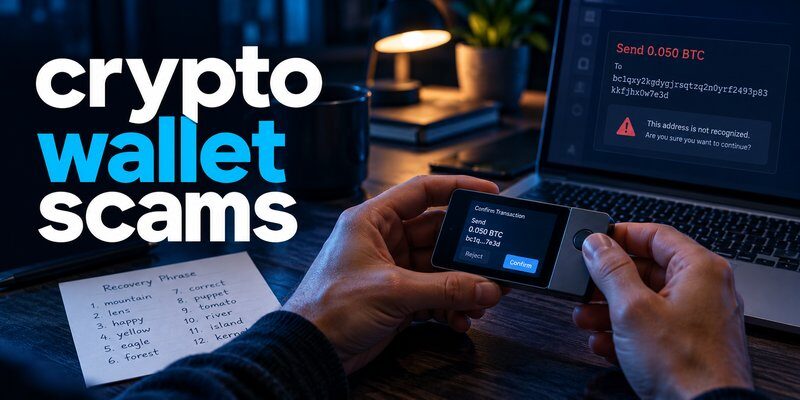
Crypto wallet scams are fraudulent schemes designed to steal cryptocurrency by tricking users into revealing recovery phrases, connecting to malicious websites, approving dangerous transactions, or sending funds to attacker-controlled addresses. Common examples include fake wallet apps, phishing websites, wallet drainers, fraudulent airdrops, and impersonated customer support.
Unlike traditional bank fraud, cryptocurrency theft can be difficult to reverse because blockchain transactions are generally irreversible once confirmed.
However, many wallet scams share recognizable warning signs. Learning how they work can help you protect your private keys, verify transaction requests, and respond quickly when something goes wrong.
This guide explains 10 common crypto wallet scams, how to identify suspicious activity, practical prevention strategies, and what to do if your wallet has been compromised.
What Are Crypto Wallet Scams?
Crypto wallet scams are deceptive activities that target cryptocurrency wallets, private keys, recovery phrases, or transaction authorization.
Scammers may impersonate legitimate wallet providers, create fraudulent websites, distribute malicious applications, or manipulate users into approving blockchain transactions.
The objective is usually to obtain unauthorized control over cryptocurrency or convince the owner to transfer funds voluntarily.
How Do Crypto Wallet Scams Work?
Most crypto wallet scams use one or more of three methods:
- Stealing recovery information: Attackers obtain a seed phrase or private key and use it to access the wallet.
- Manipulating transaction approvals: Victims approve malicious transfers, token allowances, or signatures.
- Deceiving users into sending funds: Scammers impersonate trusted services or create false investment and recovery opportunities.
Some attacks involve malware or compromised devices, while others rely entirely on social engineering.
Understanding these methods is the first step toward preventing cryptocurrency wallet theft.
Why Are Crypto Wallet Scams Dangerous?
Self-custody cryptocurrency wallets rely on private keys to authorize blockchain transactions.
If someone obtains sufficient recovery information, they may be able to reconstruct the wallet without the original device.
Similarly, a user who signs a malicious transaction may authorize an irreversible transfer or grant a contract permission to spend certain tokens.
Traditional account recovery procedures generally cannot reverse valid blockchain transactions.
That makes prevention and careful transaction verification especially important.
Read more: Keep Seed Phrase Safe: Offline Backup and Recovery
Secure your accounts with fast, reliable two-factor authentication. Download now and protect your login in seconds.Download Authenticator App
10 Common Crypto Wallet Scams You Should Know
Crypto wallet scams take many forms, but the following 10 categories represent important threats to cryptocurrency users.
Seed Phrase Phishing Scams
Seed phrase phishing occurs when an attacker tricks a user into revealing the recovery words associated with a cryptocurrency wallet.
Scammers often create fake wallet verification pages or impersonate customer support representatives.
A fraudulent message might claim:
“Your wallet must be verified immediately to prevent suspension.”
The linked website then requests the wallet’s recovery phrase.
Once the victim submits the words, the attacker may be able to restore the wallet and transfer its assets.
Warning signs:
- A website requests your complete recovery phrase.
- Someone claims a wallet must be synchronized or validated.
- An unsolicited support representative asks for backup information.
- A message creates urgency around an alleged security problem.
How to avoid it: Never enter your recovery phrase into an unsolicited website, chat, email, or support form. Only use recovery information through a trusted wallet restoration procedure.
Learn more about how to protect your seed phrase.
Fake Crypto Wallet Apps
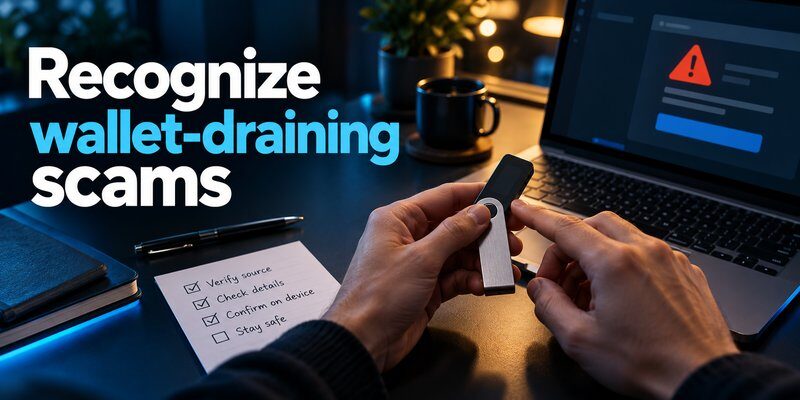
Fake wallet applications imitate legitimate cryptocurrency products to steal private keys, recovery phrases, or funds.
These applications may copy recognizable logos, interfaces, and product descriptions.
Some are distributed through fraudulent websites, advertisements, or unofficial download channels.
A malicious application may request an existing recovery phrase during setup and transmit it to an attacker.
Warning signs:
- The download link comes from an unsolicited message.
- The developer or publisher does not match the legitimate provider.
- The application requests unusual permissions.
- The setup process requires a recovery phrase without a legitimate restoration purpose.
How to avoid it: Navigate to the wallet provider’s official website independently and follow its verified installation instructions.
Avoid installing wallet software from unfamiliar download pages.
Read more: Biometric Banking in 2026: How It Works, Benefits, Risks, and Setup
Wallet Drainer Scams
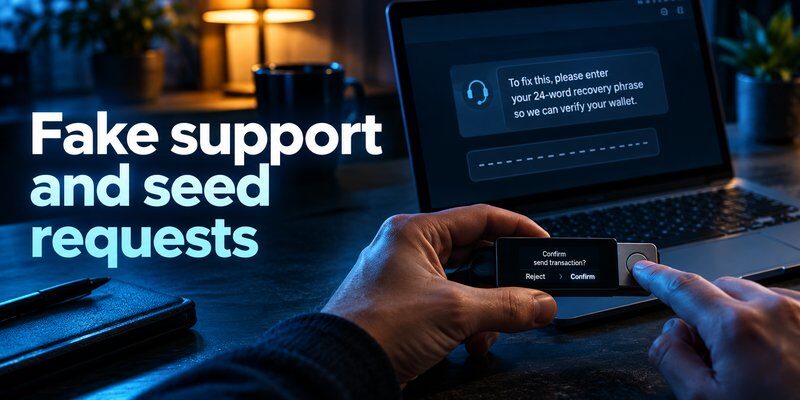
Wallet drainers are malicious websites or applications that attempt to obtain transaction approvals or signatures allowing cryptocurrency to be transferred.
A drainer may appear as a legitimate NFT mint, token claim, decentralized application, or promotional website.
The attacker may not need to know the victim’s recovery phrase.
Instead, the victim is tricked into authorizing a dangerous transaction or permission.
For example, a website may request an unlimited token allowance disguised as a routine verification step.
Warning signs:
- Unexpected requests to approve token spending.
- Unusually broad permissions.
- Transaction details that do not match the advertised action.
- Pressure to sign immediately to claim a reward.
How to avoid it: Review the asset, contract, allowance, network, and transaction details before approving.
Do not sign requests you cannot understand.
Fake Airdrop and Giveaway Scams
Fraudulent airdrops promise free cryptocurrency, NFTs, or exclusive rewards to attract victims.
Scammers may promote fake campaigns through social media, advertisements, or compromised accounts.
The fraudulent website often asks users to connect a wallet and sign a transaction.
Some schemes request an upfront payment to unlock the supposed reward.
Example: A user receives a message claiming they have qualified for a valuable token distribution. The linked website requests wallet access and an unfamiliar approval.
How to avoid it: Verify promotions through the project’s official communication channels and independently confirm the destination website.
Never assume that a wallet signature is harmless because the website advertises a free reward.
Fake Crypto Wallet Customer Support
Customer support impersonation is one of the most common social engineering methods used in cryptocurrency scams.
Attackers pretend to represent legitimate wallet manufacturers, exchanges, or blockchain projects.
They may contact victims through:
- Social media direct messages.
- Fake support accounts.
- Messaging applications.
- Search advertisements.
- Fraudulent customer service websites.
Scammers may claim they can resolve transaction problems, recover lost funds, or unlock wallets.
They then request recovery information, remote device access, or a payment.
How to avoid it: Open the provider’s official support page yourself. Do not trust unsolicited representatives or share your recovery phrase.
Legitimate support personnel do not need your seed phrase to troubleshoot ordinary wallet problems.
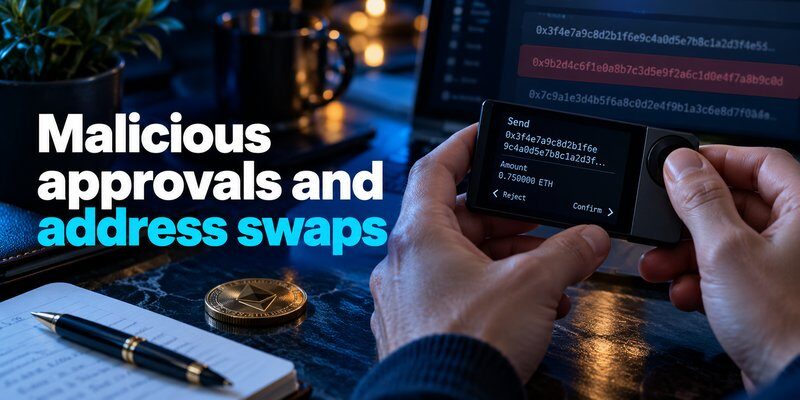
Address Poisoning and Clipboard Replacement Scams
Address manipulation attacks attempt to redirect cryptocurrency transfers to attacker-controlled wallets.
In address poisoning, scammers may send small transactions or create misleading transaction-history entries using addresses that resemble legitimate destinations.
The goal is to trick users into copying the wrong address from their transaction history.
Clipboard malware can also replace a copied cryptocurrency address with an attacker-controlled address.
Warning signs:
- Unfamiliar addresses appear in transaction history.
- A copied address changes unexpectedly.
- The receiving address differs from the intended destination.
- The address shares only the beginning or ending characters with a known address.
How to avoid it: Verify the complete destination address through a trusted channel and use hardware-wallet address verification when supported.
Do not rely solely on matching the first and last few characters.
Malicious Smart Contract Approval Scams
Some crypto wallet scams exploit token permissions rather than directly stealing private keys.
On supported blockchain networks, users can authorize smart contracts to spend specified tokens.
A malicious application may request an excessive allowance or use misleading prompts to obtain approval.
Once authorized, the contract or an authorized spender may be able to transfer affected tokens within the granted permissions.
Warning signs:
- Unlimited token allowances without a clear reason.
- Unknown contracts requesting spending permissions.
- Approval requests unrelated to the action you initiated.
- Transaction prompts with unclear or opaque details.
How to avoid it: Limit allowances where supported, review contract permissions, and use trusted wallet tools or blockchain explorers to inspect existing approvals.
Remember that disconnecting a website from your wallet does not necessarily revoke previously granted on-chain permissions.
Read more: How to Back Up Authenticator Codes Before You Change Phones
Fake Hardware Wallet and Recovery Scams
Hardware wallet scams target users who believe a physical device automatically guarantees security.
Attackers may sell tampered devices, distribute fake setup instructions, or include a prewritten recovery phrase in the packaging.
A victim who imports the supplied phrase may unknowingly deposit funds into a wallet already controlled by the attacker.
Other scams use fake firmware update websites to request recovery words.
Warning signs:
- A new device arrives with recovery words already provided.
- Setup instructions direct you to an unfamiliar website.
- A supposed firmware update requests your seed phrase.
- A seller offers a wallet that has already been initialized.
How to avoid it: Purchase through official or authorized channels, follow genuine-device verification procedures, and generate fresh recovery information through the manufacturer’s trusted setup process.
For more guidance, see how to set up a hardware wallet.
Crypto Recovery Service Scams
Recovery scams often target people who have already lost cryptocurrency.
Fraudsters promise to retrieve stolen funds, reverse blockchain transactions, or recover inaccessible wallets.
They may demand advance payments, identity documents, wallet access, or recovery phrases.
Some impersonate investigators, blockchain experts, or law enforcement representatives.
Warning signs:
- Guaranteed recovery of stolen cryptocurrency.
- Requests for upfront fees before providing evidence of a legitimate service.
- Claims that blockchain transactions can always be reversed.
- Requests for wallet secrets or remote device access.
How to avoid it: Be skeptical of unsolicited recovery offers. Preserve transaction evidence and report suspected fraud through appropriate official channels.
Recovery may be possible in limited circumstances, but it is never guaranteed.
Investment and Impersonation Scams
Some cryptocurrency scams involve fake investment platforms, impersonated influencers, fraudulent trading opportunities, or romantic relationships used to build trust.
Victims may be encouraged to connect wallets, deposit funds, or transfer cryptocurrency to supposedly profitable accounts.
A fraudulent platform may display fabricated investment gains while preventing withdrawals.
Warning signs:
- Promises of guaranteed cryptocurrency returns.
- Pressure to deposit more money before withdrawing.
- Requests to send cryptocurrency to personal wallet addresses.
- Unverified claims of celebrity or company endorsement.
- Attempts to move conversations to private messaging channels.
How to avoid it: Independently verify the organization, platform, and payment destination. Avoid transferring funds based on promises of guaranteed returns.
Crypto Wallet Scams: Warning Signs Checklist
Many crypto wallet scams share recognizable patterns.
| Warning sign | Possible threat | Recommended action |
|---|---|---|
| Website requests recovery phrase | Seed phrase phishing | Close the page |
| Unexpected token approval | Wallet drainer | Reject and investigate |
| Unsolicited support message | Impersonation scam | Use official support channels |
| Free token offer requires payment | Fake giveaway | Do not send funds |
| Wallet address changes after copying | Clipboard malware | Verify destination independently |
| Unknown contract requests unlimited spending | Approval scam | Review or reject permissions |
| Device arrives with a printed seed | Hardware wallet scam | Do not use that seed |
| Recovery agent guarantees stolen funds | Recovery scam | Avoid unsolicited services |
| Urgent security upgrade from a message | Phishing or malware | Navigate to official software sources |
| Investment platform blocks withdrawals | Investment fraud | Stop additional payments and preserve evidence |
Important: A legitimate-looking website, verified-looking social media account, or professional support message is not proof that a transaction request is safe.
Read more: Best Cold Wallet for Crypto in 2026: Top Picks, Safety Tips and How to Choose
How to Avoid Crypto Wallet Scams: 8 Security Tips
Protecting your cryptocurrency requires a combination of secure wallet management, careful transaction review, and awareness of social engineering.
Never Share Your Seed Phrase
Your recovery phrase is one of the most sensitive pieces of information associated with a self-custody wallet.
Store it offline and never share it with strangers, unsolicited support representatives, or unknown websites.
If the phrase is exposed, changing the wallet’s PIN does not invalidate it.
Use Official Wallet Software
Download cryptocurrency wallet applications from official sources.
Verify the developer, website domain, and supported setup instructions.
Be especially cautious of advertisements that imitate legitimate wallet providers.
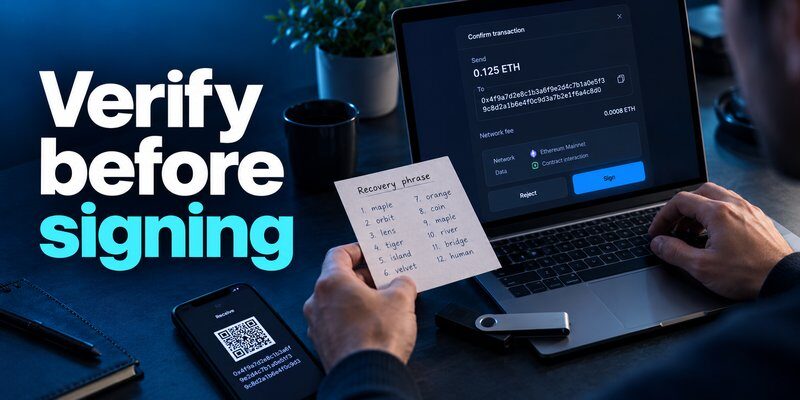
Review Every Transaction Before Signing
Read the transaction details before approving a wallet request.
Check the recipient, cryptocurrency, network, amount, and contract permissions.
For hardware wallets, verify supported details on the device’s trusted display.
Do not approve unclear signing requests simply because a website says they are necessary.
Use a Hardware Wallet for Long-Term Holdings
A hardware wallet can reduce the exposure of private keys to compromised computers and mobile devices.
However, it cannot prevent every scam.
Users can still lose funds through stolen recovery phrases or malicious transactions they approve.
For a detailed comparison, read hardware wallet vs software wallet.
Separate Long-Term Funds From Everyday Activity
Maintain a limited balance in a wallet used for frequent decentralized application interactions.
Keep long-term cryptocurrency holdings in a separate, more isolated wallet arrangement.
This can limit the funds directly exposed to certain online activities, although it does not eliminate every risk.
Learn more about cold wallet vs hot wallet.
Review Smart Contract Permissions
Use trusted wallet features or blockchain explorers to inspect token allowances.
Revoke permissions that are no longer necessary.
Remember that revoking an approval is itself a blockchain transaction that may require network fees.
Review the revocation request carefully before signing.
Keep Your Devices Updated
Maintain current operating system, browser, and wallet software versions.
Remove unfamiliar extensions and avoid installing applications from unverified sources.
Device security is particularly important for software wallets that manage private keys in connected environments.
Verify Websites and Messages Independently
Do not rely on links supplied through unsolicited messages.
Navigate to trusted websites through independently verified addresses or existing bookmarks.
Be cautious of lookalike domains, fake search advertisements, and accounts impersonating legitimate cryptocurrency organizations.
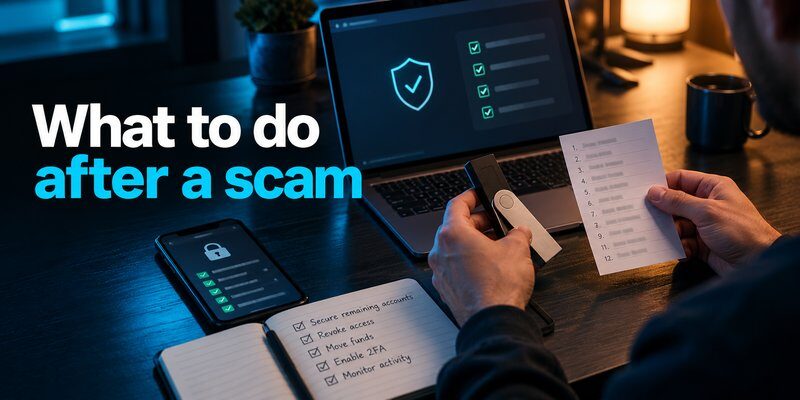
What to Do If You Fall for a Crypto Wallet Scam
The correct response depends on whether your recovery phrase was exposed, a malicious transaction was approved, or an exchange account was compromised.
Step 1: Identify What Was Compromised
Determine whether you:
- Shared your seed phrase or private key.
- Approved an unfamiliar smart contract.
- Signed a suspicious transaction.
- Sent funds to an attacker-controlled address.
- Installed malicious wallet software.
- Lost access to an exchange account.
Different incidents require different recovery actions.
Step 2: If Your Seed Phrase Was Exposed, Create a New Wallet
If someone obtained your recovery phrase, assume the affected wallet may be compromised.
Generate a new wallet with a fresh recovery phrase using trusted software or hardware.
Transfer remaining assets to the verified new wallet as safely and promptly as possible.
Do not reuse the compromised recovery phrase.
Step 3: If You Approved a Malicious Contract, Review Permissions
If your recovery phrase remains secure but you granted suspicious token allowances, use a trusted wallet interface or blockchain explorer to inspect and revoke the affected approvals.
However, revocation does not reverse completed transfers.
If the wallet’s broader security is uncertain, consider moving remaining assets to a new wallet.
Step 4: If an Exchange Account Was Compromised, Secure the Account
If an attacker accessed your exchange account, change your password through the official website or application.
Review active sessions, connected devices, API keys, and withdrawal settings.
Enable or update supported multifactor authentication and contact the exchange through its verified support channels.
Step 5: Preserve Evidence and Report the Scam
Record relevant information, including:
- Blockchain transaction hashes.
- Wallet addresses.
- Fraudulent website domains.
- Screenshots of suspicious messages.
- Dates and amounts of transfers.
- Communication with the suspected scammer.
Report the incident to the relevant exchange, platform, or appropriate authorities.
Avoid sharing recovery phrases while reporting.
Step 6: Avoid Secondary Recovery Scams
Scammers sometimes contact victims after an initial loss and promise guaranteed fund recovery.
Do not pay unsolicited recovery agents or provide additional wallet secrets.
Blockchain transfers are generally irreversible, and recovery depends on circumstances outside the victim’s control.
Can You Recover Crypto Stolen From a Wallet Scam?
Recovering cryptocurrency after a scam is often difficult.
Once a blockchain transaction is confirmed, it generally cannot be reversed by the wallet provider.
However, the available response depends on the type of incident.
| Scam situation | Possible response | Important limitation |
|---|---|---|
| Seed phrase exposed | Move remaining funds to a new wallet | Already stolen funds may not be recoverable |
| Malicious token approval | Revoke remaining permissions | Completed transfers are not reversed |
| Funds sent to scam address | Preserve evidence and report | Transfers are generally irreversible |
| Exchange account compromised | Contact official exchange support | Recovery depends on account and platform controls |
| Fake wallet app installed | Stop using the app and secure remaining assets | Device and seed may already be compromised |
| Fraudulent investment platform | Report fraud and preserve records | Displayed balances may be fabricated |
If you have lost access to a wallet rather than experienced theft, read how to recover a lost crypto wallet.
Are Hardware Wallets Safe From Crypto Wallet Scams?
Hardware wallets provide an important security benefit by keeping private keys isolated from ordinary connected applications.
This can make direct private-key theft through computer malware more difficult.
However, hardware wallets cannot automatically prevent phishing, fraudulent transfers, or malicious smart contract approvals.
For example, a user may still authorize a dangerous transaction after being deceived by a fake website.
Similarly, someone who obtains a hardware wallet’s recovery phrase may be able to reconstruct the wallet elsewhere.
Hardware wallet security therefore depends on both the device’s protections and the owner’s ability to verify transactions.
For additional guidance, see how to secure a crypto wallet.
Frequently Asked Questions
What Are the Most Common Crypto Wallet Scams?
Common crypto wallet scams include seed phrase phishing, fake wallet applications, wallet drainers, fraudulent airdrops, fake customer support, address poisoning, malicious token approvals, and recovery scams.
How Do Crypto Wallet Scammers Steal Money?
Scammers may steal recovery phrases, trick users into approving malicious transactions, distribute malware, or persuade victims to send cryptocurrency directly to attacker-controlled addresses.
Can Someone Scam You by Connecting Your Wallet?
Connecting a wallet does not necessarily authorize a cryptocurrency transfer. However, a malicious website may subsequently request dangerous signatures or token approvals. Review every request before signing.
Can a Crypto Wallet Be Drained Without a Seed Phrase?
Yes. On supported networks, malicious smart contract permissions or signed transactions may allow attackers to transfer certain assets without learning the recovery phrase.
Can a Hardware Wallet Prevent Crypto Scams?
A hardware wallet can reduce certain private-key theft risks, but it cannot prevent all scams. Users may still approve malicious transactions or expose their recovery phrases.
What Should I Do If I Shared My Seed Phrase?
Treat the wallet as compromised. Create a new wallet with fresh recovery information using trusted software or hardware, then move remaining assets after verifying the destination.
Can You Reverse a Crypto Wallet Scam Transaction?
Confirmed blockchain transactions are generally irreversible. Reporting the incident may support investigations, but recovering stolen funds is uncertain.
How Can I Tell If a Crypto Wallet Website Is Fake?
Look for suspicious domains, unsolicited links, recovery phrase requests, unexpected signing prompts, and claims of guaranteed rewards. Independently verify the website through the legitimate provider’s official channels.
Does Two-Factor Authentication Protect Against Crypto Wallet Scams?
Two-factor authentication can protect supported exchange and online account logins. It does not prevent an attacker from using a stolen self-custody recovery phrase or executing a malicious blockchain transaction that the user authorized.
Final Thoughts
Crypto wallet scams can involve phishing, malicious applications, fraudulent approvals, fake support representatives, and deceptive investment opportunities.
The most effective protection is understanding how these attacks work and verifying every sensitive wallet action before proceeding.
Never share your recovery phrase, avoid untrusted wallet software, review transaction permissions carefully, and keep long-term cryptocurrency holdings separate from routine online activity.
If your wallet becomes compromised, identify the type of exposure quickly, secure remaining assets, preserve evidence, and avoid fraudulent recovery services.
Strong wallet security combines technical protections with informed decisions at every step.