What Is Zero Knowledge Encryption? How It Works & Benefits
Published October 9, 2026 · Updated October 21, 2026
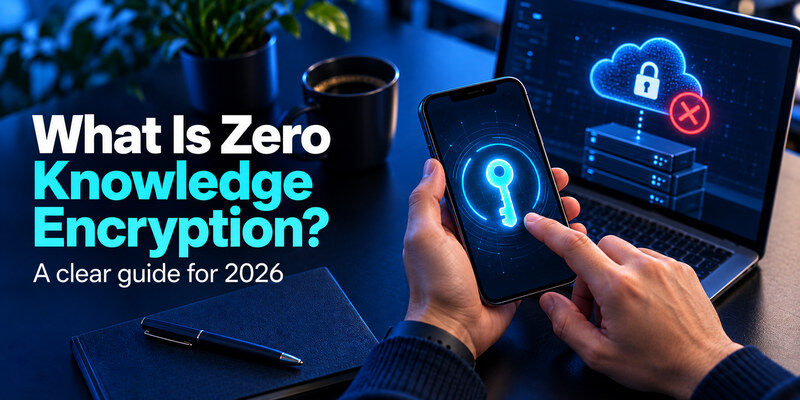
What is zero knowledge encryption, and how does it protect your data? Zero knowledge encryption is a security approach designed to prevent service providers from accessing your encrypted information, even when it is stored on their servers. Commonly used in password managers and secure cloud services, this approach helps users maintain control over their sensitive data. In this guide, we’ll explain how zero knowledge encryption works, its key benefits and limitations, and why it matters for online privacy and security.
1. Follow one password from entry to sync
Suppose you add a login for a bookstore. You type its URL, username, and password into the manager. In a zero-knowledge vault design, the client encrypts protected fields on your device using keys the service should not have. It sends encrypted data to a sync service, which stores and relays it to your other authorized devices. The other device obtains the necessary key material through the product’s sign-in design and decrypts the vault locally. Understanding client-side encryption is useful, but everyday security also depends on how you create, store, and retrieve your credentials. Our guide on how to use a password manager explains password generation, autofill, secure vault access, and practical recovery planning.
The provider’s role
The service can operate accounts, deliver encrypted blobs, and coordinate sync without being able to display the protected password itself. It may still process your account email, billing details, device events, and some metadata. What it can see differs between products and must be checked in their documentation.
Your device’s role
The device holds decryption capability while the vault is unlocked. That is why malware, a compromised browser extension, or an attacker using an unlocked device is outside the simple promise “the provider cannot read the vault.” A strong storage design does not replace device security.
Even a well-encrypted password vault can expose readable information when malware or an attacker controls an unlocked device. Our guide on how to protect your online accounts covers secure sign-in habits, device protection, multi-factor authentication, and ways to reduce everyday account risks.
Think of the vault as a locked case mailed through a sorting center. The center can route the case without the key, but it may still know the sender, destination, and delivery time. The analogy is imperfect: a real provider may encrypt some metadata as well, and digital keys can be copied or derived through different mechanisms. It is useful only to separate the protected contents from the operational information needed to run the service.
Secure your accounts with fast, reliable two-factor authentication. Download now and protect your login in seconds.Download Authenticator App
2. Encryption keys and master passwords are related but distinct
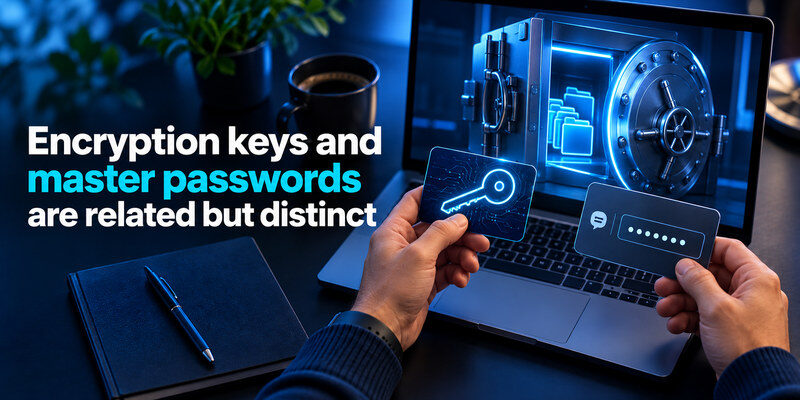
A master password is a human-entered secret in many vault designs. The application can use a password-based key-derivation process and additional account material to unlock keys protecting the data. Details differ: 1Password uses a Secret Key as part of its account security model, and Bitwarden documents its own account encryption and key handling. Do not assume every provider takes the raw master password and simply encrypts each entry with it.
Why a long master passphrase matters
If an attacker obtains encrypted vault data, a weak master secret can be a target for guessing under the specific design. A long, unique passphrase makes such attempts harder. Online multifactor authentication helps protect sign-in to a live account, but it does not retroactively strengthen a copied encrypted backup against offline guessing. Follow the provider’s own guidance for its account design.
Because attackers may attempt to guess a weak vault password after obtaining encrypted data, your master secret deserves special attention. Our guide on how to create a strong master password explains how to build a memorable, unique passphrase and avoid predictable patterns that weaken vault protection.
Why recovery can be difficult
If the company cannot derive your key, it may be unable simply to email you a replacement master password and restore your vault. Some products offer family or administrator recovery, recovery keys, or other arrangements set up in advance. Those mechanisms must be inspected on their own terms; “zero knowledge” does not dictate one universal recovery flow.
The recovery design may introduce an additional trusted party or a separately protected key, with conditions that differ by account type. Read what the recovery helper can access during normal use, what happens after an approval, and whether the old secret remains necessary. Test the process with a second device while your first remains available. A strong cryptographic promise paired with an unprepared owner can produce permanent lockout after a phone loss.
If you’re uncomfortable with the recovery limitations of a cloud-synced password vault, consider the trade-offs of other storage methods before switching. Our guide to alternatives to using a password manager compares browser storage, passkeys, offline encrypted files, and physical records, including their backup and device-loss risks.
3. What the claim does not cover
| Claim you might hear | More accurate reading |
| “The provider knows nothing” | Protected vault contents may be unreadable, but account and service metadata can remain visible |
| “A breach cannot matter” | Stolen encrypted data, metadata, and weak master secrets still require risk analysis |
| “The phone is safe when unlocked” | The client necessarily handles decrypted data during use |
| “Support can restore anything” | Recovery may require prearranged keys or trusted contacts |
| “Zero knowledge equals open source” | Code visibility and key custody are separate properties |
This distinction is important when comparing security pages. Bitwarden says its team cannot see vault data, including certain URL data it encrypts. Another provider may make a different metadata choice. Ask exactly what fields are encrypted and what a server stores, not merely whether its homepage says “zero knowledge.”
4. Is it the same as end-to-end encryption?
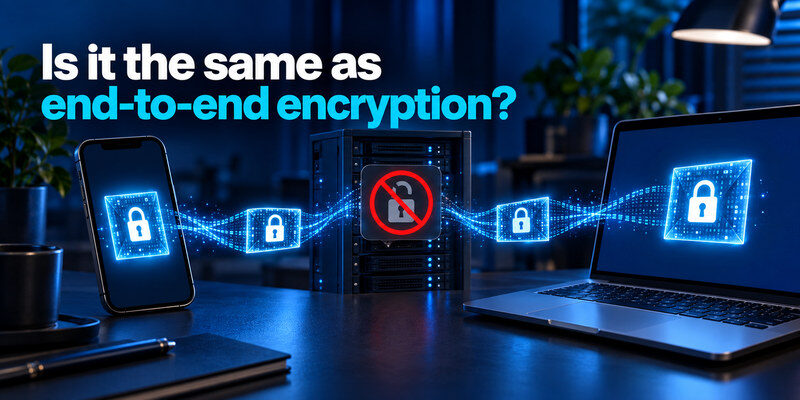
The terms often overlap in product descriptions. End-to-end encryption emphasizes that data is encrypted at one endpoint and decrypted at another authorized endpoint, rather than on an intermediate server. Zero knowledge emphasizes the service provider’s inability to access the keys or protected content under the intended design. A product may describe both. The precise account recovery and sharing implementation can complicate a short slogan, so read the technical documentation.
A shared vault needs a way to grant access
If you share a credential with a family member, that member must receive a way to decrypt the shared item. Products may use cryptographic key exchange, organization keys, or another documented mechanism. This does not necessarily require the provider to see the plaintext, but permissions and recovery roles matter. A family organizer may be able to help recover an account without having ordinary access to its private vault; confirm the product’s exact rules.
A local vault also has a trust boundary
KeePassXC encrypts a KDBX database file you control. There may be no sync provider involved at all. That does not by itself answer how the file is backed up, which mobile app opens it, or whether a cloud drive stores a copy. The question is who can obtain the encrypted file and who has the means to decrypt it.
If you copy the database into a shared cloud folder, the drive service may not read the encrypted contents, but it can observe a file and its updates. Other folder members may obtain a copy and try to guess the secret offline. If you add a key file stored in the same folder, you may defeat the intended separation. A local database is a custody choice; zero-knowledge-like protection still depends on the password, key material, and the devices opening it.
5. What if a server is breached?

An attacker might obtain encrypted vault blobs, account data, or metadata depending on the breach. The provider’s encryption design, key derivation, and your master secret affect the resulting risk. LastPass’s 2022 disclosure is a concrete reminder: the company said a backup of customer vault data was copied, with encrypted sensitive fields and some unencrypted information such as website URLs. Do not project that specific format onto every other manager, but do not dismiss encrypted backup theft as irrelevant.
Online and offline attacks differ
Multifactor authentication and account rate limits can slow or block unauthorized online sign-in. If an attacker has a copy of encrypted data, the relevant risk includes offline attempts against that copy under the product’s cryptographic scheme. Your second factor may not be consulted in that scenario. This is why a strong unique master password remains important even when you use a hardware key for account login.
Incident response still has tasks
Read the provider’s disclosure for what data was obtained and what actions it recommends. Review master-password strength, account sessions, and high-value underlying credentials. Changing the manager’s account password does not automatically change the password at your email or bank. Handle each external service as a separate secret.
Keep a dated inventory of affected account names and completed changes without recording passwords in that list. Prioritize accounts that can reset others: primary email, cloud identity, domain registrar, and financial services. If an incident involved only service metadata rather than vault contents, the response may differ. The disclosure’s scope and your account history should drive action; generic advice to rotate everything immediately can produce lockouts and stale entries.
6. What about a malicious provider update?
The intended design assumes the client software performs encryption honestly. If an attacker controls an update or a malicious extension runs while your vault is unlocked, a zero-knowledge server claim alone does not save you. Install official builds, keep software updated, avoid untrusted extensions, and use device security. Open source code and independent audits can add evidence about implementation, but neither proves every distributed build and every future update is flawless.
Verify the scope of an audit
An audit can examine a defined version, component, or time period. Find its date, scope, findings, and remediation. “Audited” without those details is an incomplete answer. Security changes continually, and your decision should combine published evidence with a practical recovery plan.
Do not ignore the endpoint
Vault contents appear in memory and on screen during legitimate use. Lock the device, use trusted browser extensions, and watch for phishing pages. If a manager does not suggest a login on a suspicious domain, pause instead of manually copying the password into it.
7. A buyer’s checklist for a zero-knowledge claim
- Which fields are encrypted before they leave the device, including URLs and notes?
- Where are the keys created and stored, and what protects them on a new device?
- What can the company see as account or operational metadata?
- What happens if you forget the master secret or lose every trusted device?
- How does sharing give another person access without exposing private entries?
- Are technical documentation and independent audits available with scope and date?
These questions make the term testable. Bitwarden’s encryption documentation and 1Password’s security model describe different details. Dashlane and Proton Pass publish their own security material. Do not infer that their recovery, metadata, and sharing are identical because they use similar language.
For example, look up whether a provider encrypts URLs as well as password fields. A URL can reveal which services you use even when the secret is protected. Then check how a new phone obtains keys and whether a family organizer can initiate recovery. You have turned one vague badge into three concrete properties: protected fields, enrollment, and delegated access. This is the level of detail needed before deciding that one provider’s zero-knowledge claim fits your threat model.
8. Secure the account around the encryption
Generate unique passwords for every external service, use a strong master secret, and protect the vault account with the available second factor. Preserve recovery codes away from the phone you might lose. Passkeys and security keys can reduce phishing exposure when supported. A time-based authenticator code is another barrier, but can be relayed by a phishing site.
Authenticator App generates TOTP codes for supported accounts and is separate from a password manager’s encrypted vault. Its product details are at and the supplied iPhone listing is . Decide where those codes and their backup paths should live; do not treat the zero-knowledge label as a recovery plan for them.
9. Frequently Asked Questions
Can the password-manager company read my vault?
In a correctly implemented zero-knowledge model under normal operation, the provider should not have the keys to read protected contents. Inspect the specific product’s design and metadata boundaries. An unlocked or compromised client remains a different risk.
Does zero knowledge mean no data is on a server?
No. A server may store encrypted vault data and account metadata for sync. “No cloud storage” is a separate product choice.
Is zero knowledge a mathematical zero-knowledge proof?
The marketing phrase “zero-knowledge encryption” usually describes provider key custody and unreadable vault contents. It is not automatically a claim that a formal zero-knowledge proof protocol is used for every login or sync operation.
Can support reset my password?
The provider may have account recovery processes, but it may not be able to decrypt the old vault from a forgotten master secret. Check the configured recovery route before a device is lost.
Is open source required?
No. Open source makes code inspectable; zero knowledge describes a key-access property. A proprietary product can claim the latter, while an open source product still needs a correct implementation and safe release process.
10. Final Thoughts
Zero knowledge encryption is a useful design goal: protected vault contents are encrypted on the client and the provider lacks the keys to read them. Its limits are equally important. Review metadata, account recovery, incident behavior, and the security of your unlocked device, then choose a manager whose complete workflow you can maintain.
Ask a provider what is encrypted, who can recover access, and what remains visible during sync. These specific answers make a stronger decision than a security badge. Finally, rehearse recovery before the only trusted device disappears.