
Free VPN vs Paid VPN: Which Plan Is Worth It?
Published October 30, 2026
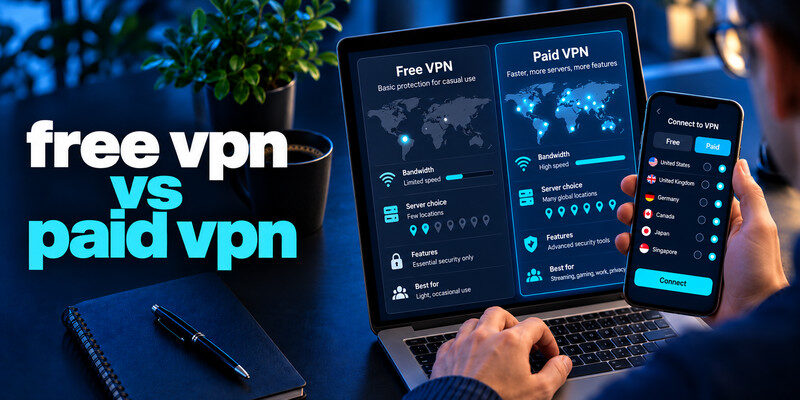
Quick answer: A reputable free VPN is enough for occasional browsing and basic protection on unfamiliar Wi-Fi. A paid VPN is usually worth it when you need specific server locations, consistent performance, streaming support, or several simultaneous connections. Paying does not automatically make a VPN more private: a transparent, independently reviewed free service can be safer than an unknown paid provider.
The free vpn vs paid vpn debate is really about trade-offs, not a simple contest between unsafe and safe. Both types can encrypt traffic between your device and a VPN server and replace your visible IP address. What changes is how the service funds itself, what limits apply, and whether its operator can be trusted.
This guide compares published plan limits, credible privacy evidence, and the situations where upgrading makes sense.
1. Free VPN vs Paid VPN: Quick Comparison
Here is the free vpn vs paid vpn comparison most readers need before choosing a plan.
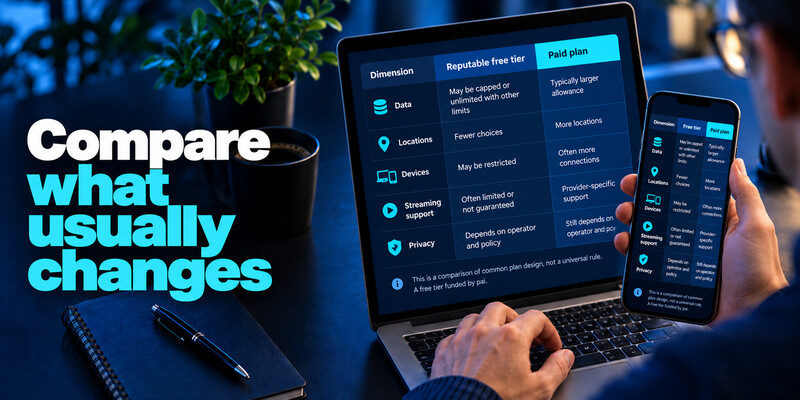
| Feature | Reputable free VPN | Reputable paid VPN |
|---|---|---|
| Encryption | Can use the same secure protocols as paid plans | Usually strong encryption and modern protocols |
| Monthly data | Unlimited or capped, depending on provider | Usually unlimited under fair-use terms |
| Speed | May be affected by congestion or lower priority | Often more capacity and server choice |
| Server locations | Restricted or automatically assigned | Broader country and city selection |
| Streaming | Can work, but often inconsistent | More specialized support; not guaranteed |
| Simultaneous connections | Often one or otherwise restricted | Commonly several devices |
| Privacy policy | Varies greatly by company | Also varies; payment is not proof of trust |
| Price | $0 | Recurring subscription or prepaid access |
The deciding question is not “Which one is free?” but “Does the plan meet my needs without asking me to trust an unsuitable provider?”
The free vpn vs paid vpn difference becomes especially noticeable when you stream regularly, need an IP address from a particular country, or protect multiple household devices. For occasional browsing, a credible free tier may already do enough.
🧭 Explore Guides: VPN vs Proxy in 2026: Which Is Better for Privacy, Security, and Speed?
2. How Free and Paid VPN Services Work
A virtual private network creates an encrypted connection from your device to a VPN server. The server forwards requests to websites, which generally see the VPN server’s public IP address rather than your normal network address.
Both free and paid VPNs can use technologies such as WireGuard and OpenVPN. Encryption quality depends on the actual implementation, protocol, and settings—not the subscription price printed on a checkout page.
Why would a company offer a free VPN?
There are three common business models. A freemium model provides a limited free tier funded by subscriptions. An advertising-supported model earns money from ads and sometimes analytics. A company may also offer a trial that expires or requires billing information; this is not the same as a permanent free plan.
Proton VPN says its paid subscriptions fund its unlimited-data free service. Windscribe offers a restricted free tier alongside paid plans. Their limitations are published rather than hidden, making the trade-offs easier to evaluate.
The free vpn vs paid vpn distinction therefore describes how access is funded and packaged; it does not establish whether a company’s logging practices are trustworthy.
What a VPN cannot do
Neither tier makes you completely anonymous. Websites can recognize you through logins, cookies, browser fingerprints, and details you voluntarily provide.
The Electronic Frontier Foundation explains that a VPN shifts trust from your internet provider to the VPN operator. This remains true whether you pay monthly or use a free account. If anonymity is your primary goal, evaluate tools and behaviors beyond a conventional VPN.
3. Free VPN vs Paid VPN: Privacy and Security
Privacy is the most important part of any free vpn vs paid vpn evaluation, and it is also where oversimplified recommendations can mislead readers.
Free does not automatically mean insecure
A credible free tier can provide encrypted traffic, DNS leak protection, a kill switch, and a no-logs policy. Proton VPN states that the same core no-logs and encryption protections apply to both its free and paying users. Its policy was examined in a fifth consecutive annual external no-logs audit announced in 2026.
An audit has a defined scope and cannot guarantee flawless future operation.
Paid does not automatically mean private
A subscription gives a company a clear revenue stream, but it does not prove it avoids tracking, protects payment information, or follows its published policy. Read the privacy statement and look for actual audit reports, transparent ownership, and incident disclosures.
The U.S. Federal Trade Commission warned that a study of nearly 300 VPN apps identified potential issues, including some apps not encrypting traffic and some sharing data with third parties. This is a historical study cited in FTC guidance, not a newly measured 2026 failure rate.
The free vpn vs paid vpn safety question should be answered provider by provider, not with the assumption that a price tag is a security certificate.
Five checks before installing
- Logging: Does the provider explain what activity, DNS, and connection metadata it retains?
- Verification: Is there an independent audit, and what exactly was tested?
- Protection: Does the app offer modern protocols, DNS handling, and a kill switch?
- Business model: Can you identify how the company funds operations?
- Permissions: Does the app request information unrelated to operating a VPN?
Choose a trusted free provider over an obscure paid service with vague policies. Likewise, do not choose an unknown free app because it promises unlimited anonymity.
4. Free VPN vs Paid VPN: Speed, Data Limits, and Streaming
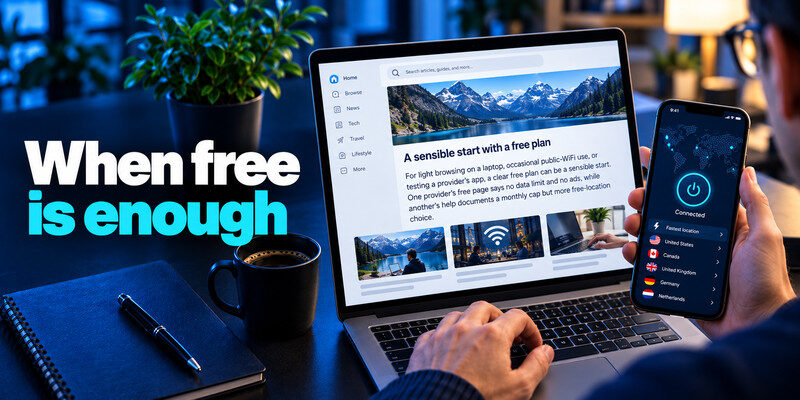
For many people, the most visible free vpn vs paid vpn difference is how much they can use the connection before reaching a restriction.
Data allowances vary dramatically
Proton VPN Free publishes unlimited monthly data with one simultaneous connection and access to servers in 10 countries through automatic selection. Windscribe Free offers 2GB monthly by default or 10GB after email confirmation. PrivadoVPN offers 10GB of full-speed data per 30-day period, then restricts the connection to 1 Mbps according to its published plan details.
Confirm current conditions before installation.
A useful calculation comes from Netflix: its help center says HD streaming can consume up to 3GB per hour, while 4K can consume up to 7GB per hour. That means a 10GB full-speed VPN allowance corresponds to roughly 3 hours and 20 minutes of HD or about 1 hour and 26 minutes of 4K at those maximum rates. Actual use varies, and streaming access is not guaranteed.
Why paid VPNs can perform better
A paid tier may offer more servers, reduced congestion, additional locations, and specialized streaming support. However, there is no universal rule that every paid VPN is faster than every free VPN.
Distance, Wi-Fi quality, network congestion, device performance, and protocols affect actual speed.
When testing free vpn vs paid vpn, use the same device, connection, time window, and comparable server locations. Check latency, video reliability, and disconnection behavior—not just headline download speed.
Streaming and downloads
Streaming services may block particular VPN endpoints or restrict regional catalogs. Paid plans frequently advertise better compatibility, but no provider can guarantee access forever. Some free tiers also restrict P2P or offer fewer download-friendly servers.
If you regularly stream high-resolution video or download large files, plan limits may justify upgrading more than encryption does.
📘 Find the Right Guide: Best VPN for Privacy in 2026: 5 Most Private VPNs Compared
5. What Do You Actually Get When You Pay for a VPN?
A paid subscription should provide a measurable benefit. The free vpn vs paid vpn value calculation becomes clearer when you compare features you will actually use.
More server choice
A provider with broad country coverage can help when you need a specific region for work or travel. By contrast, a free plan may assign an available server rather than letting you select the exact country.
For example, Proton’s plan documentation lists 10 eligible free countries through automatic selection, versus 140+ countries and more extensive choices on VPN Plus at the time of review.
Multiple devices
A one-connection limit can be frustrating when switching between phone, laptop, and tablet. Premium plans commonly offer several active connections. Proton VPN Plus advertises up to 10 simultaneous devices, compared with one on its free tier.
Added security and support features
Paid plans may include multihop routing, split tunneling, additional tracker blocking, advanced configuration, or priority support. Their value depends on your actual needs.
The free vpn vs paid vpn comparison should not be reduced to a checklist of maximum features. Pay only for capabilities that solve a real limitation.
Subscription pricing and renewal traps
Mullvad offers a simple €5 monthly rate, including VAT, without a cheaper long-term lock-in. Other services may advertise a low introductory monthly equivalent but bill an entire year or two up front.
Compare the total amount due today, renewal price, refund terms, and cancellation process. A nominal $3 monthly deal billed annually is a different commitment from paying $5 month to month.
6. Three Free VPN Plans Worth Considering in 2026

If you are evaluating free vpn vs paid vpn before subscribing, start with established free plans whose restrictions are public.
| Provider | Published free allowance | Meaningful limitation |
|---|---|---|
| Proton VPN Free | Unlimited data | One active device; restricted location choice |
| Windscribe Free | 2GB/month, or 10GB with confirmed email | Data cap and fewer locations |
| PrivadoVPN Free | 10GB/30 days at full speed | Slows to 1 Mbps afterward; one connection |
Proton VPN Free is a practical first option for continuous basic browsing because its unlimited data is unusually generous. The provider’s publicly documented 2026 no-logs review provides additional evidence for evaluating its privacy promises.
Windscribe Free is appealing when you want more direct control over eligible free server locations. Its allowance is more restrictive for people who watch video or download large files.
PrivadoVPN Free offers a full-speed allowance suitable for occasional use, with a lower-speed continuation described in its support documentation.
This shortlist reflects published terms, not original speed tests. In the free vpn vs paid vpn decision, first test whether a trustworthy free tier covers your ordinary activity before paying for unused features.
7. Who Should Use a Free VPN—and Who Should Upgrade?
A realistic free vpn vs paid vpn recommendation depends on your usage pattern, not on whether you consider yourself a beginner or an expert.
Choose a free VPN if you…
- Mainly browse websites, read news, or check messages.
- Need occasional protection on public networks.
- Can accept a restricted selection of servers.
- Use only one device at a time or do not require constant location switching.
- Have selected a transparent provider with suitable safeguards.
A trustworthy free service is a reasonable long-term choice if it meets those requirements.
Consider paying if you…
- Need a specific country or city regularly.
- Stream or download large amounts of data.
- Connect multiple devices simultaneously.
- Depend on stable access while traveling or working remotely.
- Need advanced settings or more responsive technical support.
For a household with multiple active devices, the free vpn vs paid vpn calculation may favor a subscription even when individual family members only browse occasionally.
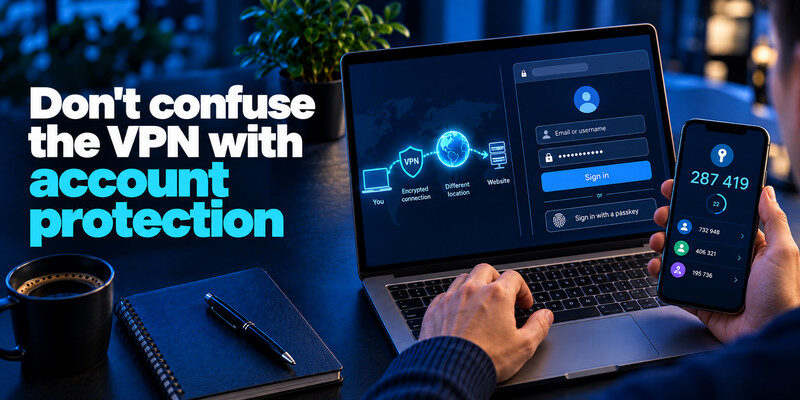
Remember that a VPN is not account security
A VPN protects part of your network connection; it does not stop phishing or make stolen passwords useless. Protect important accounts with strong credentials and multi-factor authentication. For a practical introduction, see what an authenticator app is and SMS vs. authenticator app.
When assessing whether a verification tool is trustworthy, this guide to authenticator app safety covers another layer of account protection. For organization-managed VPN accounts, see Google Authenticator with OpenVPN for a related authentication topic; actual configurations vary.
8. How to Choose a VPN Without Wasting Money
Before deciding free vpn vs paid vpn, run a short, practical test.
First, define the goal. Is it public-Wi-Fi privacy, choosing a regional server, remote work, video streaming, or general browsing? Your answer determines which limits matter.
Second, evaluate trust. Read privacy policies, check independent audits, examine app permissions, and look for a clear explanation of how the business makes money.
Third, verify technical behavior. Download the official application, connect, and compare your public IP address before and after. Check DNS routing where practical and test whether the kill switch prevents accidental exposure during disconnections.
Fourth, test the free tier against real usage. A limited account may work well for short sessions but fail after several hours of video. A trial should include the apps and networks you normally use.
Fifth, review paid terms only if a limitation appears. Compare total billing, renewal, country choice, simultaneous connections, refund policies, and support options. Avoid paying upfront solely because an offer has a countdown timer.
The free vpn vs paid vpn winner is the plan that satisfies your actual requirements with a provider you have good reason to trust.
9. Free VPN vs Paid VPN FAQs and Final Verdict
Are paid VPNs safer than free VPNs?
Not inherently. Some reputable free plans provide the same core encryption and logging protections as paid tiers. Conversely, a paid app can still mishandle data. Compare policies and verification rather than prices alone.
Does a free VPN sell my browsing data?
Some free services use advertising or share information with third parties, but not all free VPNs do. Review the provider’s privacy policy and funding model. The FTC has warned about questionable practices among certain VPN apps without claiming every free provider behaves that way.
Is a paid VPN always faster?
No. Premium plans can offer broader server access and capacity, but network conditions dominate actual performance. Compare the same server region and run repeated tests before making a speed-based decision.
Can I use a free VPN for Netflix?
Sometimes, but compatibility changes. Data allowances are equally important: Netflix estimates that HD streaming can use up to 3GB per hour. A 10GB full-speed free allowance therefore covers only a few hours at that maximum usage level.
Is paid vpn vs free mainly about encryption?
Usually not when comparing credible providers. The biggest differences are commonly data allowances, location choice, simultaneous devices, and premium functionality. Always verify the particular plan because providers package features differently.
Can a VPN replace antivirus or two-factor authentication?
No. VPN tunneling does not disinfect downloads, prevent fraudulent websites from asking for credentials, or stop someone signing in with stolen passwords. Use software updates, cautious browsing, and strong account authentication alongside a VPN.
Is an unlimited free VPN really unlimited?
Unlimited data means the provider does not impose a fixed VPN traffic quota under the stated plan, but it does not remove your internet provider’s data caps. Server selection, speeds, usage policies, and device limits may still apply.
Final verdict: Should you pay for a VPN?
Choose a reputable free VPN if you need occasional browsing protection and can accept fewer locations or devices. Choose a paid VPN if those limits interfere with your daily use. Neither tier offers complete anonymity, and payment alone does not guarantee a better privacy policy.
The smartest free vpn vs paid vpn choice is to verify the provider first, test your real usage second, and upgrade only when the additional features justify the cost.