
What Is Zero Trust Security? How It Works, Benefits & Best Practices
Published November 11, 2026
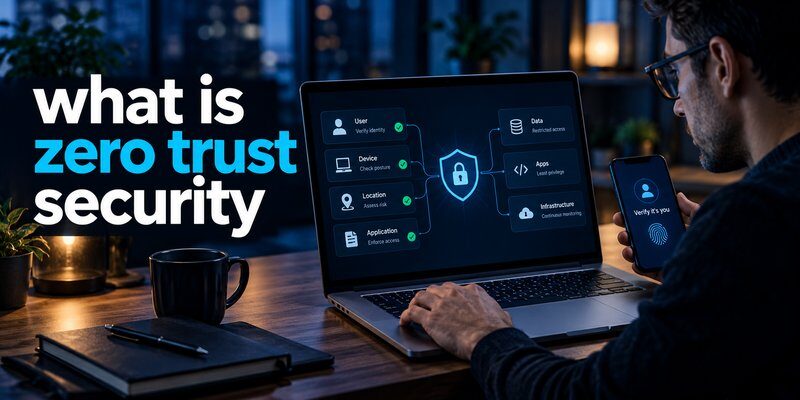
What is zero trust security? Zero Trust is a cybersecurity strategy that requires users, devices, and applications to be explicitly verified before accessing protected resources, regardless of whether they are inside or outside an organization’s network.
Unlike traditional security models that often trust users after they enter a corporate network, Zero Trust follows the principle of “never trust, always verify.”
This means that every access request must satisfy appropriate authentication, authorization, and security policies.
The main goal of Zero Trust is to prevent unauthorized access, reduce the impact of compromised accounts, and limit attackers’ ability to move through a network.
For example, an employee accessing a company database may need to verify their identity, use an approved device, and meet additional security requirements before receiving access.
According to the National Institute of Standards and Technology (NIST), Zero Trust shifts cybersecurity from protecting network boundaries toward protecting individual resources.
Meanwhile, IBM’s Cost of a Data Breach Report 2025 found that the global average cost of a data breach reached $4.44 million, highlighting the financial importance of effective cybersecurity.
This guide explains what is zero trust security, how the architecture works, its benefits, and how organizations can implement it effectively.
1. What Is Zero Trust Security? Definition and Meaning
The simplest answer to what is zero trust security is that no user, device, or application receives automatic trust simply because it belongs to an organization or connects from a familiar network.
Access must be evaluated according to defined security policies.
This approach is particularly important for businesses using cloud platforms, remote employees, mobile devices, and third-party applications.
Understanding the Zero Trust Security Definition
The what is zero trust in cyber security question often arises when organizations compare modern security strategies with traditional network protection.
Historically, many businesses relied on firewalls and network boundaries to separate trusted internal systems from potentially dangerous external traffic.
Once users connected to the internal network, they sometimes received broad access to resources.
Zero Trust challenges this assumption.
According to NIST Special Publication 800-207: Zero Trust Architecture (2020), network location and asset ownership alone should not establish trust.
Instead, organizations should evaluate identity, device security, access permissions, and other relevant information.
Zero Trust focuses on protecting resources rather than automatically trusting network connections.
What Does Zero Trust Security Mean?
To answer what does zero trust security mean, consider an employee working remotely.
Even after signing in to the company network, the employee should not automatically access every application.
A Zero Trust architecture may require the employee to demonstrate that:
- Their identity has been authenticated.
- Their device satisfies security requirements.
- They have permission to access the requested resource.
- The requested action meets organizational policies.
- The session remains within acceptable risk conditions.
This helps ensure that access decisions reflect the actual security context.
What Is a Zero Trust Security Model?
The question what is a zero trust security model refers to an architecture in which trust is not automatically granted and access is controlled through continuous policy enforcement.
Three important principles guide this approach:
1. Verify explicitly: Authenticate and authorize access using relevant identity, device, and contextual information.
2. Apply least-privilege access: Provide only the permissions necessary to complete an approved task.
3. Assume breach: Design systems to limit damage if an account, device, or application becomes compromised.
These principles form the foundation of Zero Trust architecture.
Understanding what is zero trust security requires recognizing that it is a security strategy, not simply a single product or application.
Download Authenticator App
Secure your accounts with fast, reliable two-factor authentication. Download now and protect your login in seconds.
2. How Does Zero Trust Security Work?

Zero Trust operates by evaluating access requests before allowing users or devices to interact with protected systems.
Instead of assuming that internal traffic is safe, organizations use identity controls, device checks, access policies, and monitoring to determine whether access should be permitted.
Step-by-Step Zero Trust Authentication Process
Step 1: A user requests access
An employee attempts to open a corporate application, cloud service, or confidential database.
The system identifies the requested resource and applicable security requirements.
Step 2: The system verifies identity
The employee authenticates through an approved identity provider.
Authentication may include passwords, passkeys, security keys, or multi-factor authentication (MFA).
For compatible services, an Authenticator app can generate time-based verification codes as an additional authentication factor.
Step 3: Device security is evaluated
The organization may evaluate whether the device is managed, updated, encrypted, or compliant with endpoint security requirements.
A device that fails mandatory checks may be denied access.
Step 4: Access permissions are checked
The system determines whether the employee has permission to use the requested resource.
For example, a marketing employee may access campaign reports but not confidential payroll records.
Step 5: The access policy makes a decision
A policy decision component evaluates relevant signals and determines whether the request should be approved, denied, or subjected to additional authentication.
Step 6: Access is enforced
A policy enforcement component allows or blocks the connection according to the decision.
Step 7: Security conditions are monitored
Organizations may reassess active sessions when risks change, such as when a device becomes noncompliant or suspicious activity is detected.
Continuous verification does not mean asking users to enter passwords every few seconds. It means maintaining appropriate security checks and re-evaluating access when necessary.
This process demonstrates what is zero trust security in practice: access depends on verified identity, approved permissions, and relevant security conditions.
Why Is Continuous Verification Important?
A successful login does not guarantee that a session will remain safe indefinitely.
An attacker may steal session tokens, compromise a device, or exploit an application after the initial authentication.
Continuous monitoring helps organizations detect unusual activity and respond to changing risks.
For additional information about protecting user accounts, review our guide on best account security practices.
3. The Five Core Pillars of Zero Trust Security
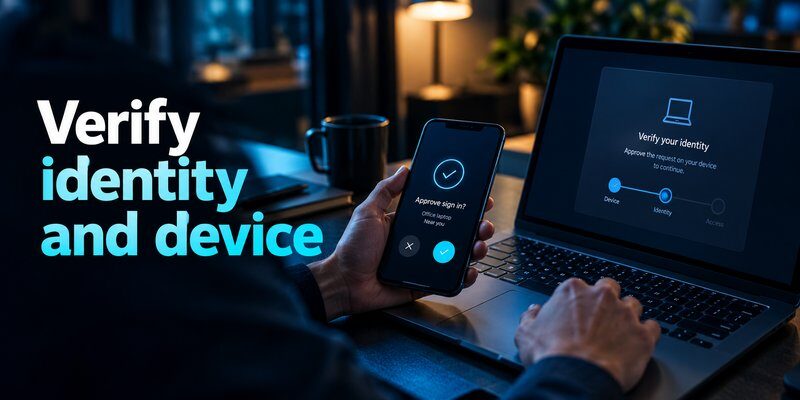
Understanding what is zero trust security also requires examining the major components involved in a complete architecture.
The Cybersecurity and Infrastructure Security Agency (CISA) identifies five pillars in its Zero Trust Maturity Model Version 2.0 (2023).
These pillars help organizations structure their security modernization efforts.
1. Identity Security
Identity is central to Zero Trust because access decisions depend on verifying who or what is requesting a resource.
Organizations should use strong authentication, centralized identity management, and appropriate access policies.
Common identity controls include:
- Multi-factor authentication
- Single sign-on
- Role-based access controls
- Privileged access management
- Account lifecycle management
MFA can help reduce the risk associated with stolen passwords.
For example, organizations using Microsoft identity services can learn more about microsoft multi factor authentication.
Identity verification is essential, but it is only one component of Zero Trust.
2. Device Security
Zero Trust evaluates the security condition of devices requesting access.
A legitimate employee using a compromised device may still present significant risk.
Organizations can evaluate operating system updates, endpoint protection, encryption, and device management status.
Access policies may restrict sensitive resources when devices do not meet security requirements.
3. Network Security
Network security remains important, but Zero Trust reduces reliance on broad network-level trust.
Microsegmentation can limit communication between workloads and systems.
For example, a compromised workstation should not automatically communicate with every database inside the organization.
Microsegmentation helps reduce lateral movement, which occurs when attackers move from one compromised system to another.
4. Applications and Workloads
Organizations must protect applications, APIs, services, and workloads across cloud and on-premises environments.
Zero Trust policies can restrict application access based on identities, permissions, and workload security requirements.
Application logging, vulnerability management, and secure configuration also contribute to protection.
5. Data Security
What is zero trust data security? It is the application of Zero Trust principles to protecting sensitive information through controlled access, classification, encryption, and monitoring.
For example, a company may allow employees to view customer information while preventing unauthorized exports.
Data protection measures may include:
- Data classification
- Encryption in transit and at rest
- Access restrictions
- Data loss prevention
- Monitoring of sensitive operations
CISA also identifies cross-cutting capabilities, including visibility and analytics, automation and orchestration, and governance.
Together, these components explain what is zero trust security as a complete organizational approach rather than an isolated network feature.
4. Benefits of Zero Trust Security for Businesses

Organizations exploring what is zero trust security often want to understand whether the model provides measurable business value.
Zero Trust can improve access control, strengthen cloud security, and reduce exposure to compromised identities.
However, its effectiveness depends on implementation quality and the organization’s existing security controls.
1. Reduced Unauthorized Access
Traditional network models may allow excessive access after users connect to internal systems.
Zero Trust limits access according to verified identities and defined permissions.
Even if an attacker steals an employee’s credentials, additional controls may prevent access to sensitive systems.
2. Stronger Protection Against Credential Theft
Phishing remains a major cybersecurity concern.
The Verizon 2025 Data Breach Investigations Report analyzed more than 22,000 security incidents, including 12,195 confirmed data breaches.
It identified credential abuse as an initial access vector in 22% of breaches, while vulnerability exploitation accounted for 20%.
These figures demonstrate why identity protection and vulnerability management should remain central security priorities.
Organizations can strengthen authentication and improve employee awareness of what is phishing.
3. Limited Lateral Movement
When an attacker compromises one device, broad internal network permissions can increase the potential damage.
Zero Trust uses segmentation and least-privilege controls to restrict unnecessary connections.
For example, compromising an employee laptop should not automatically provide access to production servers.
Reducing unnecessary connectivity can limit the impact of a security incident.
4. Better Cloud and Remote Work Security
Employees increasingly access applications outside traditional corporate networks.
Zero Trust allows organizations to apply consistent access policies to office-based and remote users.
Security decisions can consider identity, device compliance, and application sensitivity rather than relying solely on physical location.
5. Improved Security Visibility
Centralized access monitoring can help security teams identify suspicious patterns.
For example, administrators may investigate repeated authentication failures, unusual access requests, and attempts to reach restricted resources.
These capabilities can support incident detection and response.
6. Reduced Business Risk
IBM’s Cost of a Data Breach Report 2025 reported an average global data breach cost of $4.44 million, down from $4.88 million in 2024.
The report also found that the average breach lifecycle reached 241 days across the organizations studied.
These figures illustrate the importance of prevention, detection, and response capabilities.
They do not establish that implementing Zero Trust alone produces a specific financial saving.
When evaluating what is zero trust security, businesses should consider risk reduction alongside implementation costs and operational complexity.
5. Zero Trust Security Platforms, Software, and Solutions
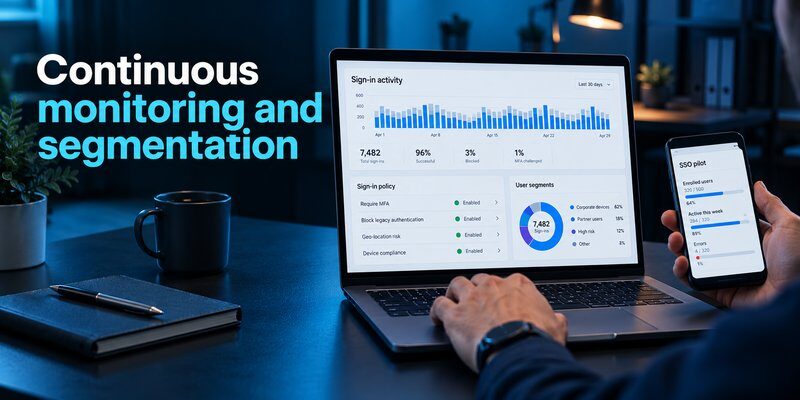
Implementing Zero Trust usually requires multiple technologies working together.
A zero trust security platform may combine identity controls, device security, access policy enforcement, traffic inspection, and security monitoring.
However, no single product automatically creates a complete Zero Trust architecture.
Common Zero Trust Security Solutions
Organizations can combine several categories of zero trust security solutions depending on their requirements.
Identity and Access Management (IAM)
IAM systems help authenticate users, manage identities, and enforce access permissions.
Zero Trust Network Access (ZTNA)
ZTNA technologies can provide policy-controlled access to specific applications without automatically granting broad network access.
Endpoint Detection and Response (EDR)
EDR tools monitor devices for suspicious behavior and can support endpoint protection and incident response.
Secure Access Service Edge (SASE)
SASE architectures combine networking and security capabilities, potentially including ZTNA, secure web gateways, and cloud access controls.
Data Loss Prevention (DLP)
DLP technologies help identify and restrict unauthorized handling or movement of sensitive information.
What to Look for in Zero Trust Security Software
When choosing zero trust security software, organizations should evaluate:
- Identity integration: Compatibility with existing identity providers and authentication systems.
- Device security: Ability to use device compliance signals in access decisions.
- Policy management: Support for granular, resource-specific access requirements.
- Application compatibility: Coverage for cloud, on-premises, and hybrid applications.
- Visibility: Logging and monitoring capabilities that support investigations.
- Scalability: Ability to support organizational growth without excessive operational complexity.
Common vendors in the broader Zero Trust market include Microsoft, Cisco, Zscaler, Cloudflare, and Palo Alto Networks.
Their capabilities differ across identity security, network access, endpoint protection, and cloud infrastructure.
Organizations should evaluate individual product features and integration requirements rather than assuming that every product provides all Zero Trust capabilities.
Understanding what is zero trust security helps businesses choose a security architecture before selecting specific technologies.
6. Zero Trust vs Traditional Network Security and MFA
Zero Trust is often compared with traditional perimeter security, VPNs, and multi-factor authentication.
These technologies are related, but they serve different purposes.
Zero Trust vs Traditional Perimeter Security
Traditional perimeter security often focuses on separating internal networks from external threats.
Zero Trust emphasizes verifying access to specific resources regardless of where the request originates.
| Feature | Traditional Security | Zero Trust |
|---|---|---|
| Trust assumption | Often based on network location | No automatic trust |
| Access control | Frequently network-oriented | Resource-specific |
| Identity verification | Often concentrated at login | Policy-driven and risk-aware |
| Device security | May vary by network | Can be part of every access decision |
| Lateral movement | Depends on segmentation | Designed to limit unnecessary access |
Zero Trust does not eliminate firewalls or network security tools.
Instead, it changes how organizations combine these technologies and make access decisions.
Zero Trust vs VPN
A virtual private network creates an encrypted connection between a device and a remote network.
However, VPN connectivity does not automatically provide granular authorization for every application.
Zero Trust Network Access can limit users to specific authorized resources.
A company may use both VPN and Zero Trust technologies, depending on its applications and infrastructure.
Zero Trust vs Multi-Factor Authentication
MFA verifies identity through multiple authentication factors.
Zero Trust is a broader strategy that also considers devices, applications, permissions, network conditions, and sensitive data.
For example, an employee may authenticate using a password and a verification code from a compatible authenticator application.
That verification supports Zero Trust identity security, but it does not replace device assessments or least-privilege authorization.
Users can learn about authentication methods through our how to use authenticator app guide.
For Apple-related verification options, see apple authenticator, while Mac users can review google authenticator for mac.
TOTP-based verification can strengthen account security, but it is not fully phishing-resistant and does not establish a complete Zero Trust architecture.
This distinction is essential when answering what is zero trust security accurately.
7. How to Implement Zero Trust Security Successfully

Understanding what is zero trust security is the first step toward designing a stronger access control strategy.
Implementation should be gradual, measurable, and aligned with the organization’s most important risks.
Step 1: Identify Critical Resources
Start by identifying sensitive applications, databases, systems, and business workflows.
Determine which resources require stronger protection and who needs access.
Critical resources may include customer databases, financial platforms, administrator consoles, and intellectual property.
Step 2: Build an Identity and Device Inventory
Organizations should understand which employees, contractors, service accounts, and devices access protected resources.
Unknown identities and unmanaged devices create significant security challenges.
An accurate inventory provides the foundation for effective policy enforcement.
Step 3: Strengthen Authentication
Require appropriate MFA for business accounts and prioritize phishing-resistant authentication for privileged or high-risk access.
For compatible TOTP-enabled services, employees can Download authenticator app to generate time-based verification codes.
Authenticator App by Begamob supports TOTP verification for compatible accounts.
However, an authenticator application is not a complete Zero Trust platform, and organizations must verify compatibility with their identity providers.
Step 4: Apply Least-Privilege Access
Grant users only the permissions needed to perform their duties.
For example, customer support employees may need to view customer records without receiving permission to change financial information.
Access permissions should be reviewed when employees change roles or leave the organization.
Step 5: Secure Devices
Use device management, endpoint security, encryption, and software updates to reduce risk.
Organizations can restrict access to sensitive applications when devices fail essential security requirements.
Step 6: Segment Applications and Networks
Separate sensitive systems and restrict unnecessary communication.
Apply application-level access controls wherever practical.
For example, development environments should not automatically have unrestricted access to production databases.
Step 7: Monitor Access and Security Events
Collect relevant authentication, endpoint, application, and network logs.
Monitor for suspicious behavior and investigate unauthorized access attempts.
Organizations should define clear processes for responding to compromised accounts and devices.
Step 8: Measure and Improve
Zero Trust is an ongoing security program.
Businesses can track:
- Percentage of critical applications covered by access policies
- MFA adoption among privileged users
- Number of unmanaged devices accessing protected resources
- Excessive permissions identified and removed
- Time required to detect and respond to security incidents
These measurements help organizations evaluate progress without relying on unsupported claims of complete security.
For additional account protection guidance, review best account security practices.
A successful implementation of what is zero trust security principles depends on consistent policy enforcement, employee training, and regular improvement.
8. Frequently Asked Questions About Zero Trust Security
What Is Zero Trust Security in Simple Terms?
What is zero trust security in simple language? It means that users and devices must prove they meet security requirements before accessing protected resources.
Being inside a company network does not automatically make an access request trustworthy.
What Is Zero Trust Security Model?
The question what is zero trust security model refers to an approach where access is explicitly verified, permissions are limited, and security decisions are based on defined policies.
The model assumes that threats may exist both inside and outside an organization’s network.
Is Zero Trust Better Than Traditional Security?
Zero Trust can improve access control and reduce unnecessary trust relationships.
However, its effectiveness depends on how well organizations implement authentication, authorization, segmentation, and monitoring.
Traditional tools such as firewalls remain useful as components of a broader security architecture.
Does Zero Trust Replace VPNs?
Not necessarily.
Zero Trust Network Access can provide application-specific access, while VPNs establish encrypted network connections.
Organizations may use both technologies depending on their infrastructure and security requirements.
Is Zero Trust Only for Large Businesses?
No. Small businesses can also apply Zero Trust principles.
For example, they can enable MFA, restrict administrator permissions, protect devices, and limit access to confidential information.
Implementation complexity should match the organization’s size and risk level.
Can Zero Trust Prevent Every Cyberattack?
No cybersecurity architecture guarantees complete protection.
Zero Trust can reduce exposure and limit the impact of compromised identities or systems, but it cannot eliminate every vulnerability.
Regular patching, incident response, backups, and employee training remain essential.
Does Zero Trust Require Multi-Factor Authentication?
MFA is an important identity security control commonly used in Zero Trust architectures.
However, MFA alone does not establish Zero Trust.
Organizations also need appropriate authorization, device protections, resource-specific access policies, and monitoring.
Why Is Zero Trust Important for Cloud Security?
Cloud applications are frequently accessed from different devices and locations.
Zero Trust helps organizations evaluate access based on security requirements rather than assuming that a particular network location is trustworthy.
This approach can support secure hybrid work and cloud adoption.
Is Zero Trust a Product or a Security Strategy?
Zero Trust is a cybersecurity strategy implemented through policies, processes, and technologies.
Although vendors offer Zero Trust products, purchasing one platform does not automatically satisfy every Zero Trust principle.
What Is the Main Goal of Zero Trust?
The primary goal is to protect resources by preventing implicit trust, enforcing appropriate access controls, and reducing the impact of compromised identities or systems.
The organization should verify requests, limit unnecessary privileges, and monitor relevant security conditions.
Conclusion
What is zero trust security? It is a modern cybersecurity approach that requires explicit verification and appropriate authorization before allowing access to protected resources.
Unlike traditional perimeter-focused models, Zero Trust does not automatically trust users, devices, or applications based on network location.
Instead, it combines identity verification, least-privilege access, device security, segmentation, and continuous monitoring to reduce cybersecurity risks.
Organizations can begin implementing Zero Trust by protecting critical accounts, enforcing MFA, reviewing permissions, and strengthening device security.
The most effective Zero Trust strategy is a continuous process of verifying access, reducing unnecessary privileges, and improving security controls as risks evolve.
Download Authenticator App
Secure your accounts with fast, reliable two-factor authentication. Download now and protect your login in seconds.
