
Keep Seed Phrase Safe: Offline Backup and Recovery
Published November 10, 2026
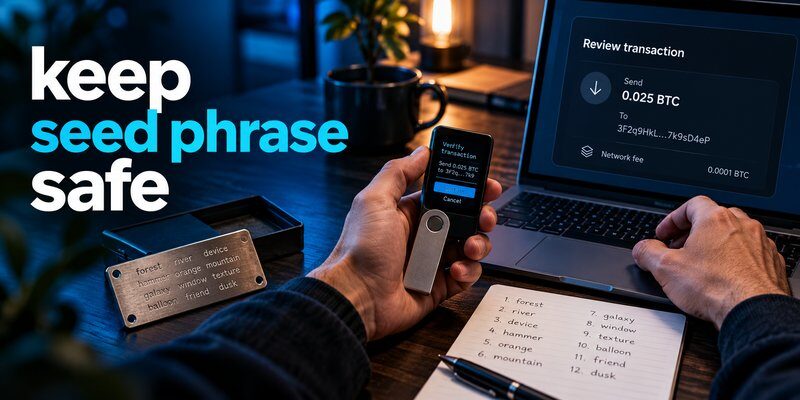
To keep seed phrase safe, write down your recovery words in the correct order, store them offline in a secure location, protect them from theft and physical damage, and never share them with anyone. Avoid screenshots, cloud storage, emails, and websites requesting your recovery phrase. Anyone who obtains the complete seed phrase, along with any required passphrase, may be able to access your cryptocurrency without your original wallet device.
A seed phrase is one of the most important security elements of a self-custody crypto wallet. Losing it can make recovery impossible, while exposing it can allow an attacker to steal your funds.
In this guide, you’ll learn how to keep seed phrase safe using 10 practical security tips, compare the best storage methods, understand common mistakes, and know what to do if your recovery phrase is lost or compromised.
How to Keep Seed Phrase Safe: Quick Checklist
The safest seed phrase storage strategy protects against two major risks: unauthorized access and permanent loss.
Use this checklist to protect your cryptocurrency recovery information.
| Security practice | Recommended action | Why it matters |
|---|---|---|
| Record accurately | Write every word in the correct order | Prevents recovery errors |
| Store offline | Use paper or a durable physical backup | Reduces online exposure |
| Avoid digital copies | Do not photograph or upload the phrase | Prevents unnecessary digital exposure |
| Choose secure locations | Use private, access-controlled storage | Reduces theft risk |
| Protect against damage | Consider fire and water exposure | Preserves long-term readability |
| Maintain backup redundancy | Use separate secure locations when appropriate | Reduces single-location failure |
| Keep the phrase private | Never share it with support or strangers | Prevents unauthorized recovery |
| Verify recovery | Follow the wallet’s official backup-check procedure | Confirms the backup is usable |
| Protect optional passphrases | Maintain a separate recovery plan | Prevents inaccessible hidden wallets |
| Prepare for emergencies | Document a secure recovery procedure | Supports future access |
Quick answer: The best way to keep seed phrase safe is to maintain an accurate offline backup in a secure physical location, avoid exposing it to internet-connected devices, and verify that your recovery procedure works before storing significant cryptocurrency.
Secure your accounts with fast, reliable two-factor authentication. Download now and protect your login in seconds.Download Authenticator App
What Is a Seed Phrase and Why Is It Important?
A seed phrase, also called a recovery phrase or wallet backup phrase, is a sequence of words used to recover access to supported cryptocurrency wallets.
Many wallets use 12 or 24 recovery words, although other formats and backup arrangements exist.
These words encode information used to derive wallet keys and restore access to cryptocurrency accounts.
Unlike a password for an online service, a seed phrase can provide direct control over self-custody wallet assets.
Why Must You Protect Your Seed Phrase?
Your cryptocurrency is recorded on a blockchain rather than physically stored inside your wallet application or hardware device.
The wallet manages the private keys used to authorize transactions.
A seed phrase can recreate those keys through the wallet’s supported recovery process.
If an attacker obtains sufficient recovery information, they may be able to reconstruct the wallet and transfer funds.
This is why learning how to keep seed phrase safe is essential for anyone using a self-custody cryptocurrency wallet.
Seed Phrase vs Private Key: What’s the Difference?
A private key is a cryptographic secret used to authorize transactions.
A seed phrase is a human-readable representation of recovery information that can generate multiple private keys in supported hierarchical deterministic wallets.
One seed phrase may therefore control access to multiple cryptocurrency accounts.
For a more detailed explanation, read what is a seed phrase.
Read more: How to Protect Your Seed Phrase: 10 Essential Tips
10 Best Ways to Keep Seed Phrase Safe
The following security practices help protect recovery information against theft, accidental exposure, physical damage, and permanent loss.
Write Down Your Seed Phrase Correctly
The first step to keep seed phrase safe is recording every recovery word accurately during trusted wallet setup.
Follow the wallet manufacturer’s official instructions.
Make sure you:
- Record all recovery words.
- Preserve the exact word order.
- Check spelling and numbering.
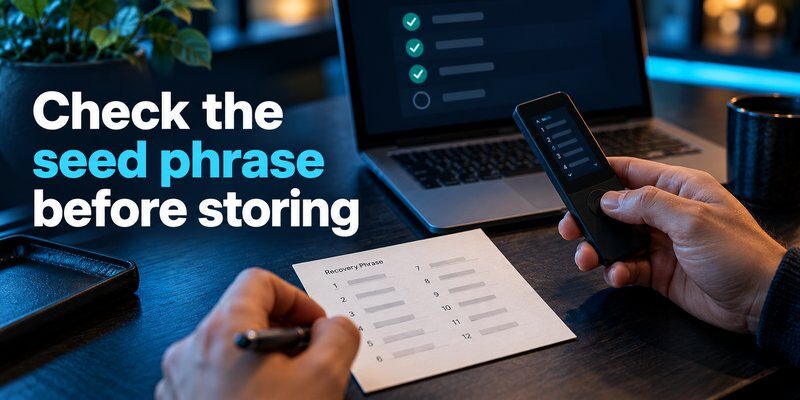
- Confirm the phrase using the wallet’s official backup verification process.
- Avoid using recovery words supplied by a seller or another person.
An incorrect word or missing recovery information may prevent successful restoration.
Never rely on memory alone for long-term cryptocurrency recovery.
Store Your Seed Phrase Offline
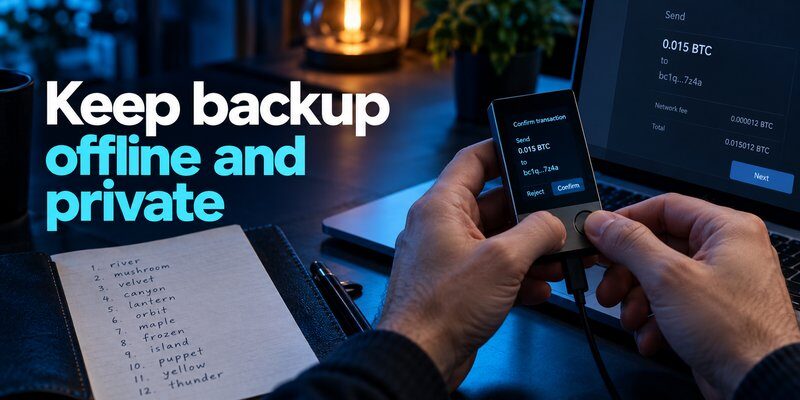
Offline storage is one of the most effective ways to reduce unnecessary exposure to online threats.
Write the recovery phrase on paper or use a dedicated physical backup method.
Keep it away from devices and services that automatically synchronize information to the internet.
Avoid storing recovery words in:
- Cloud notes or online documents.
- Email accounts.
- Messaging applications.
- Unencrypted computer files.
- Smartphone photo galleries.
- Browser-based storage services.
Even a password-protected digital file may introduce additional risks if the device or account becomes compromised.
For most users, a secure physical backup is a simpler starting point.
Read more: How to Secure a Crypto Wallet: 10 Steps to Keep Your Crypto Safe
Use a Secure Physical Storage Location
Choosing where to store your recovery phrase is just as important as recording it accurately.
A suitable location should protect against unauthorized access, accidental disposal, and environmental damage.
Possible options include:
- A properly secured home safe.
- A secure bank safe deposit box, where available.
- Another private, access-controlled location.
- Separate protected locations for authorized backup copies.
Each option has tradeoffs involving access, privacy, theft, fire, flooding, and emergency recovery.
Avoid obvious locations that visitors, cleaners, or unauthorized individuals could easily access.
The best location is one you can access when needed without making the recovery phrase available to others.
Consider a Metal Seed Phrase Backup
Paper backups are inexpensive and easy to create, but they can be damaged by fire, water, or deterioration.
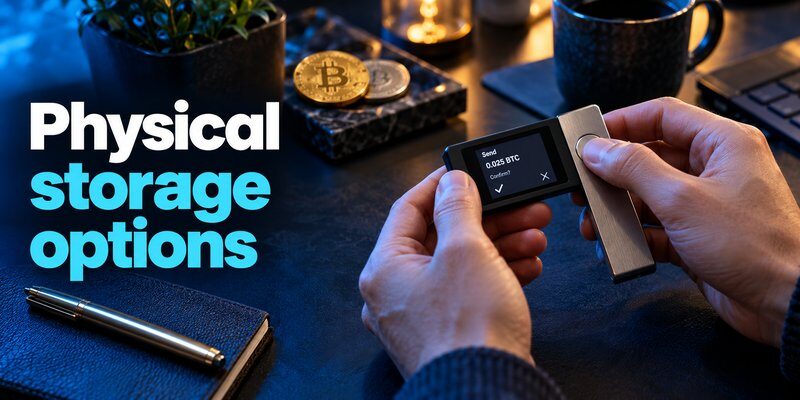
A metal backup can offer greater resistance to certain environmental hazards.
Metal seed storage systems typically allow users to engrave, stamp, or arrange recovery words on durable materials.
However, durability varies by material and product design.
A metal backup is not automatically theft-proof, and transcription mistakes can still make it unusable.
Best practice: Choose a reliable physical backup method, record the phrase accurately, and verify that the stored information can be read correctly.
Never Share Your Recovery Phrase
One of the most important rules to keep seed phrase safe is never revealing it to someone who does not need authorized recovery access.
Legitimate wallet support teams do not need your recovery phrase to troubleshoot ordinary account issues.
Be suspicious of anyone claiming that you must provide your seed phrase to:
- Verify wallet ownership.
- Unlock a frozen cryptocurrency account.
- Synchronize a wallet.
- Claim an airdrop or reward.
- Fix a failed transaction.
- Complete a security upgrade.
- Recover cryptocurrency through an unsolicited service.
These requests are common warning signs of phishing or wallet theft attempts.
Never enter your seed phrase into an unfamiliar website or send it through email, chat, or social media.
Avoid Screenshots and Digital Photos
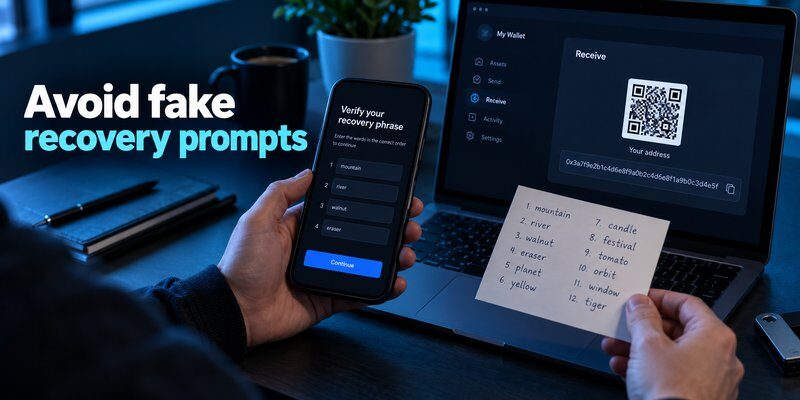
Photographing a recovery phrase may seem convenient, but it can create additional copies outside your control.
Photos may be synchronized to cloud accounts, included in device backups, or accessed through compromised applications.
Screenshots can create similar risks.
Even deleting a photo does not guarantee that every synchronized or backed-up copy has been removed.
To keep seed phrase safe, avoid creating digital images of your recovery words unless a specific trusted recovery design explicitly requires a different procedure that you fully understand.
For conventional self-custody wallets, offline physical recording is generally preferable.
Read more: Ledger vs Trezor: Which Hardware Wallet Should You Choose?
Maintain Secure Backup Redundancy
A single backup stored in one location may be vulnerable to fire, flooding, theft, or accidental disposal.
Maintaining another protected copy in a separate location can reduce the risk of permanent loss.
However, every complete backup copy is also a secret that could be stolen.
Before creating additional copies, consider:
- Whether each location is independently secure.
- Who can access the storage.
- Whether the backup could be discovered accidentally.
- How you will track authorized copies.
- How the recovery process will work during an emergency.
Do not create unnecessary copies simply because more backups seem safer.
A well-planned backup arrangement balances availability with confidentiality.
Protect Optional Wallet Passphrases
Some cryptocurrency wallets support an additional passphrase that changes the wallet derived from the recovery phrase.
This is sometimes described as an extra word or hidden-wallet passphrase.
An optional passphrase can provide an additional security boundary, but it also increases recovery complexity.
If the passphrase is forgotten, the recovery phrase alone may restore a different wallet.
When using this feature:
- Choose a passphrase according to the wallet’s official guidance.
- Understand how it affects wallet recovery.
- Maintain a secure recovery plan for the passphrase.
- Avoid storing the passphrase carelessly alongside the seed.
- Test recovery before transferring substantial funds.
Do not enable advanced passphrase features until you understand their consequences.
Test Your Seed Phrase Recovery
A backup is useful only if it can successfully restore the intended wallet.
Testing recovery helps identify incorrect words, missing information, or misunderstandings about wallet configuration.
Use the wallet manufacturer’s official backup-check or recovery verification procedure.
Where possible, perform the check through a trusted hardware device or other documented secure process.
Never enter your recovery phrase into an unsolicited website or online phrase checker.
Before moving significant cryptocurrency, verify that you understand:
- The supported recovery format.
- The correct word order.
- Any required additional passphrase.
- The relevant wallet configuration.
- How to access the intended cryptocurrency accounts after restoration.
A successful recovery check provides greater confidence that the backup can be used when necessary.
Read more: Best Hardware Wallet for Crypto in 2026: Top Picks, Safety Guide and How to Choose
10. Prepare a Long-Term Recovery Plan
To keep seed phrase safe over time, consider what happens if your wallet device is lost, damaged, or becomes inaccessible.
A recovery plan should account for:
- Device replacement.
- Physical storage damage.
- Changes in wallet software.
- Loss of access to a backup location.
- Authorized inheritance or succession.
- The ability to identify the correct wallet recovery procedure.
Keep general recovery instructions separate from the recovery secret itself.
Avoid documenting sensitive information in an ordinary note that unauthorized people could access.
For long-term cryptocurrency holdings, periodically review whether the backup remains secure and usable.
Best Ways to Store a Seed Phrase: Storage Methods Compared
Different seed phrase storage methods provide different levels of durability, accessibility, and exposure.
| Storage method | Advantages | Main risks | Recommendation |
|---|---|---|---|
| Paper backup | Affordable and simple | Fire, water, deterioration | Suitable with secure storage |
| Metal backup | Greater physical durability | Theft, recording errors | Useful for long-term storage |
| Home safe | Convenient controlled access | Theft, disasters, weak safe protection | Depends on safe quality |
| Bank safe deposit box | Off-site physical protection | Restricted access, institutional risks | Consider as part of a backup plan |
| Multiple offline copies | Reduces single-location loss | More copies to protect | Use carefully |
| Cloud storage | Easy remote access | Account compromise and synchronization | Avoid for conventional seed backups |
| Smartphone screenshot | Convenient to create | Digital exposure and automatic backups | Avoid |
| Email or messaging | Easy to retrieve | Account compromise and message retention | Avoid |
Best overall approach: Use an accurate offline physical backup, protect it in a secure location, and consider carefully planned redundancy when the risk of losing one copy is significant.
No storage method guarantees complete protection.
Where Should You Store Your Seed Phrase?
Choosing a location to keep seed phrase safe depends on your living situation, access requirements, and the amount of cryptocurrency at risk.
At Home in a Secure Safe
A home safe can provide convenient access to recovery information.
However, its protection depends on construction, installation, access control, and resistance to relevant hazards.
A safe should not be assumed to protect against every fire, flood, or burglary.
In a Bank Safe Deposit Box
A safe deposit box can provide off-site storage and controlled physical access.
However, availability, access hours, legal arrangements, and institutional policies vary.
It may not be appropriate as the only recovery location for someone who requires immediate access.
In Separate Secure Locations
For higher-value holdings, distributing independent backup copies across secure locations can reduce the impact of a single physical disaster.
However, each copy must remain protected against unauthorized access.
Avoid placing multiple complete copies in locations controlled by the same vulnerable account, person, or storage arrangement.
Should You Split Your Seed Phrase?
Manually dividing recovery words into fragments can create serious recovery risks.
For example, storing half the words in one location and half elsewhere may make recovery impossible if either part is lost.
It can also provide less security than expected.
If your wallet supports a standardized threshold backup scheme, such as an appropriate SLIP39 implementation, follow its official instructions and test the recovery process.
Do not invent your own cryptographic backup method.
What Should You Never Do With a Seed Phrase?
Knowing what to avoid is essential when learning how to keep seed phrase safe.
| Unsafe practice | Why it is dangerous |
|---|---|
| Taking screenshots | Creates potentially accessible digital copies |
| Uploading to cloud storage | Exposes recovery data to account compromise |
| Sending through email | May leave copies in multiple systems |
| Sharing with wallet support | Allows unauthorized wallet restoration |
| Entering into unknown websites | May immediately expose the recovery secret |
| Using a seller-provided seed | Seller may already know the wallet keys |
| Storing only on one device | Device failure may prevent recovery |
| Ignoring word order | May make restoration fail |
| Inventing a backup splitting method | Can create irreversible recovery problems |
| Skipping recovery verification | Leaves backup errors undiscovered |
Remember that a recovery phrase is not an ordinary password.
Changing a wallet application PIN or account password does not invalidate an exposed seed phrase.
What to Do If Your Seed Phrase Is Compromised
If you suspect that someone has obtained your recovery phrase, treat the wallet as potentially compromised.
An attacker with sufficient recovery information may be able to transfer funds without accessing your original device.
Step 1: Stop Using the Exposed Wallet for New Deposits
Avoid transferring additional cryptocurrency into a wallet whose recovery information may have been stolen.
Do not share the phrase with anyone offering unsolicited recovery assistance.
Step 2: Create a New Wallet
Use trusted wallet software or a genuine hardware device to generate a completely new recovery phrase.
Do not reuse the compromised seed.
Verify the new wallet’s receiving address through a trusted method.
Step 3: Transfer Remaining Funds
If funds remain accessible, move them to the newly created wallet as promptly and safely as possible.
Verify the cryptocurrency, network, destination address, and transaction details before confirming.
For wallets with multiple assets or smart contract positions, recovery may require additional care.
Step 4: Secure the New Recovery Information
Create an accurate offline backup of the new seed phrase.
Review the original cause of exposure and change the relevant storage or security practices.
Do not assume that changing the old wallet’s PIN protects funds associated with a leaked recovery phrase.
What Happens If You Lose Your Seed Phrase?
Losing a seed phrase does not necessarily mean your cryptocurrency is immediately lost.
The outcome depends on whether you still have access to the wallet and whether another valid recovery method exists.
If You Still Have Access to Your Wallet
If the original wallet remains usable, consider creating a new wallet with a securely backed-up recovery phrase.
After verifying the new wallet, transfer funds to its receiving address.
Do not wait until the original device fails.
If You Lose Both the Wallet and Recovery Phrase
If you lose access to the signing device and have no valid recovery information, your cryptocurrency may be permanently inaccessible.
Blockchain networks generally cannot reset private keys or reverse ownership rules.
Be cautious of recovery services promising guaranteed access without the necessary credentials.
For additional guidance, read how to recover a lost crypto wallet.
Does a Hardware Wallet Keep Your Seed Phrase Safe?
A hardware wallet can help protect private keys by keeping signing operations within a dedicated device.
However, hardware wallets do not automatically protect recovery phrases stored outside the device.
If someone steals a usable recovery phrase, they may be able to reconstruct the wallet using another compatible device or application.
This is why seed phrase security remains essential even when using a hardware wallet.
For more information, read what is a hardware wallet and hardware wallet vs software wallet.
Frequently Asked Questions
What Is the Safest Way to Store a Seed Phrase?
The safest practical approach for many users is to record the seed phrase accurately, store it offline in a secure physical location, and verify the recovery procedure. Additional protected backups may reduce the risk of losing the only copy.
Should I Store My Seed Phrase on Paper or Metal?
Paper is inexpensive and easy to use, while metal backups can offer greater resistance to certain environmental hazards. Both require secure physical storage and accurate recording.
Is It Safe to Store a Seed Phrase in Google Drive or iCloud?
Cloud storage introduces risks from account compromise, synchronization, and unintended access. For conventional self-custody wallet recovery phrases, offline physical storage is generally preferable.
Can Someone Steal My Crypto With My Seed Phrase?
Yes. Anyone with sufficient recovery information may be able to reconstruct the wallet and authorize cryptocurrency transactions. An additional wallet passphrase, if configured, may also be required.
Can I Change My Seed Phrase?
A recovery phrase is generally tied to the wallet’s underlying key material. To use a new phrase, create a new wallet and transfer funds to its verified address.
Is It Safe to Take a Picture of My Seed Phrase?
Taking a picture creates a digital copy that may be exposed through cloud backups, compromised devices, or unauthorized application access. Avoid photographing conventional wallet recovery phrases.
Should I Keep Multiple Copies of My Seed Phrase?
Multiple secure offline copies can reduce the risk of losing recovery information to a single accident. However, each additional copy creates another potential exposure point.
What Happens If I Forget My Seed Phrase?
If you still have access to your wallet, you may be able to transfer funds to a newly created wallet with a verified backup. Without a usable device, recovery phrase, or alternative recovery mechanism, access may be permanently lost.
Does Two-Factor Authentication Protect My Seed Phrase?
No. Traditional account-based two-factor authentication does not prevent someone from restoring a self-custody wallet using a stolen recovery phrase. It protects supported online accounts rather than the blockchain’s private-key authorization process.
Final Thoughts
Learning how to keep seed phrase safe is one of the most important responsibilities of cryptocurrency self-custody.
A reliable recovery strategy combines accurate recording, offline storage, physical protection, secure backup management, and verified recovery procedures.
Never share your recovery phrase, upload it to unfamiliar services, or assume that a hardware wallet can protect funds after its recovery information has been exposed.
Whether you use a hot wallet or cold wallet, protecting your seed phrase helps preserve your ability to recover cryptocurrency while reducing the risk of unauthorized access.