
What Is VPN Encryption? How It Works and How Safe It Is in 2026
Published October 30, 2026
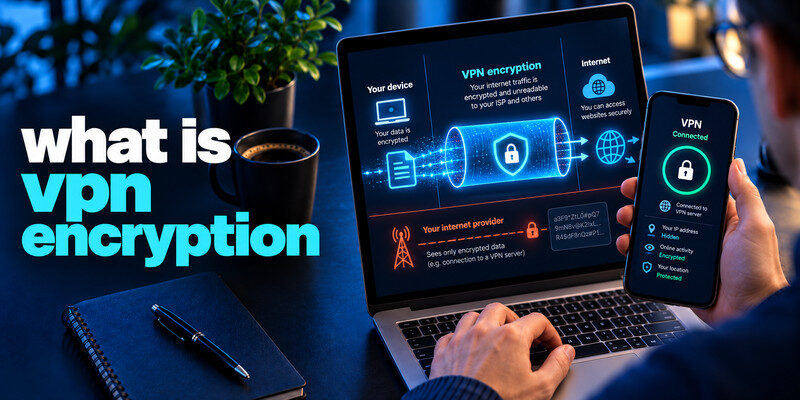
Quick answer: VPN encryption converts traffic between your device and a VPN server into unreadable ciphertext, using cryptographic keys and a secure tunnel. A properly configured VPN helps stop a local Wi-Fi operator or internet provider from reading the contents of that tunnel. It does not make you anonymous, replace HTTPS, or encrypt traffic indefinitely after it reaches the VPN server.
If you are asking what is vpn encryption, think of it as placing your outgoing network packets inside a locked container. Your device locks the container, the VPN server unlocks it, and the server forwards the traffic toward its destination. The reverse happens for replies. Local observers can see the connection but not its encrypted payload.
This guide offers vpn encryption explained through technical standards from NIST, the IETF, WireGuard, and the EFF.
1. What Is VPN Encryption? A Simple Definition
The basic vpn encryption definition is the use of cryptographic algorithms to protect network data while it travels between a VPN client and a VPN endpoint. The endpoints may be your phone and a commercial VPN server or workplace gateway.
If you ask what is vpn encryption at its simplest, start with the data itself. Encryption changes readable information, called plaintext, into ciphertext. Anyone intercepting the ciphertext should be unable to understand it without the appropriate key. Decryption reverses that process at an authorized endpoint.
For readers researching what is vpn encryption, the key distinction is scope: a conventional VPN protects a particular network path, rather than every stage of an online transaction. Its app typically routes multiple applications through the tunnel, but split tunneling or incorrect settings can exclude traffic.
The Three Pieces of an Encrypted VPN
A secure tunnel depends on a protocol to establish and manage the connection, an encryption algorithm to protect data, and cryptographic keys shared or derived securely by the endpoints. Modern designs also authenticate packets so an attacker cannot silently alter protected traffic.
On airport Wi-Fi, a configured VPN hides individual tunnel destinations from the local network, which instead sees a connection to the VPN server. The VPN provider, however, becomes a party you must trust.
What is vpn encryption in everyday terms? It is protection against inspection on the path to the VPN server—not an invisibility cloak for your entire online identity.
2. How Does VPN Encryption Work Step by Step?

The short answer to how does vpn encryption work is that the client first establishes protected keys, encrypts outgoing packets, and sends them through a tunnel to a server that can authenticate and decrypt them.
Step 1: Your Device Contacts a VPN Server
You select a location or press Connect. The VPN client contacts the selected server through your existing internet connection. Your internet provider still carries those packets, so it can generally observe that your device is communicating with a particular VPN endpoint.
Step 2: The Endpoints Authenticate and Establish Keys
Modern VPNs perform a handshake; WireGuard uses public-key cryptography to derive symmetric keys. The symmetric keys protect the bulk traffic after setup, because symmetric encryption is efficient for ongoing data transfer.
The handshake matters too; poor implementation can undermine strong algorithms. WireGuard’s official cryptography description identifies Curve25519 for key agreement and regularly renewed session keys.
Step 3: The Client Encrypts Network Packets
Before routed packets leave through the VPN interface, the client encrypts and authenticates their contents. A device between the client and server receives ciphertext and some necessary routing metadata, not the original payload in readable form.
During browsing, what is vpn encryption actually protecting? The requests carried inside the tunnel, not the outer connection metadata.
Step 4: The VPN Server Forwards the Traffic
The VPN server authenticates and decrypts packets before forwarding traffic. The VPN tunnel normally ends at the VPN server. When the destination uses HTTPS, a separate TLS connection continues protecting website content beyond that point.
Step 5: Replies Travel Back Through the Tunnel
Responses reach the VPN server, which encrypts them for delivery back to your client. The client authenticates, decrypts, and delivers the resulting traffic to your application.
Understanding what is vpn encryption also means understanding failure conditions: if the tunnel drops and the system falls back to an ordinary route, your device may expose traffic unless a suitable kill switch blocks it.
3. VPN Encryption Algorithms: AES-256 and ChaCha20
One reason the question what is vpn encryption is confusing is that providers mix up algorithms, key sizes, and protocols in advertisements. AES-256 is a cipher, while WireGuard is a VPN protocol that uses a particular set of cryptographic components.
AES-128 and AES-256
The U.S. National Institute of Standards and Technology (NIST) specifies three AES key sizes: 128, 192, and 256 bits. All three process data in 128-bit blocks. These figures come from the updated FIPS 197 AES standard, published in 2023.
AES-256 has a larger key space than AES-128, but that does not mean it makes a real VPN twice as secure. Both are considered strong when correctly implemented. Handshakes, software vulnerabilities, weak credentials, and traffic leaks can matter more than the difference in key size.
You may see names such as AES-256-GCM. GCM is an authenticated-encryption mode that combines confidentiality with a mechanism to detect unauthorized packet changes. NIST describes GCM in SP 800-38D.
ChaCha20-Poly1305
ChaCha20 is a modern stream cipher frequently used with Poly1305 authentication. In the IETF’s RFC 8439, ChaCha20 uses a 256-bit key, and Poly1305 supplies an authentication tag. Together they support authenticated encryption.
ChaCha20 can perform well on devices without specialized AES acceleration, although actual speed depends on hardware and software. There is no universal winner in the AES versus ChaCha20 comparison for every device.
| Technology | Concrete specification | Practical takeaway |
|---|---|---|
| AES-128 | 128-bit key; 128-bit block | Strong with a modern authenticated mode |
| AES-256 | 256-bit key; 128-bit block | Larger key size, not a substitute for sound implementation |
| ChaCha20-Poly1305 | 256-bit ChaCha20 key with packet authentication | Modern authenticated option used by WireGuard |
The central lesson about what is vpn encryption is simple: trust the complete protocol and its implementation, not a single impressive number.
4. WireGuard vs OpenVPN vs IKEv2: Which Encrypts Better?
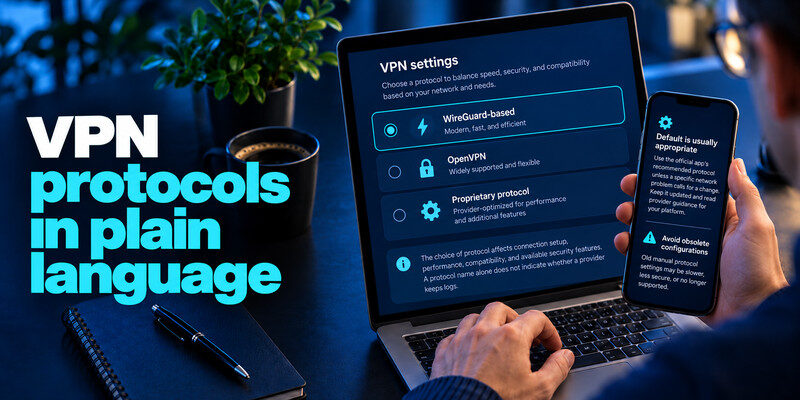
Protocols define how a VPN establishes a secure connection and carries traffic. When evaluating what is vpn encryption, users should check the actual protocol selected in their application rather than relying on labels like “military-grade security.”
WireGuard
To answer what is vpn encryption for WireGuard users, examine the full protocol, not just its cipher. WireGuard uses a deliberately defined cryptographic suite: ChaCha20 for encryption, Poly1305 for authentication, Curve25519 for key agreement, and additional primitives for hashing and key derivation. Its design favors a relatively small, auditable implementation.
WireGuard does not negotiate a broad menu of legacy ciphers. This simplifies configuration, although providers still need correct authentication, account handling, server security, and privacy policies.
OpenVPN
OpenVPN is a mature, flexible protocol that commonly uses TLS for control-channel security. Modern configurations can negotiate AES-256-GCM, AES-128-GCM, or ChaCha20-Poly1305. The OpenVPN 2.6 manual lists these as its usual default data-cipher options when supported.
Because OpenVPN is configurable, exact protection depends on server and client settings. Avoid treating every historical OpenVPN configuration as equally secure.
Organizations may combine OpenVPN-based access with multi-factor authentication. For a related authentication example, see Google Authenticator OpenVPN. An authentication code verifies access; it is not the cipher that encrypts the tunnel.
IKEv2/IPsec
IKEv2 is used to establish security associations for IPsec. It is popular in mobile and enterprise deployments because implementations can support reconnection and network changes effectively. Its actual algorithms depend on negotiated settings and platform support.
| Protocol | Typical cryptographic approach | Key consideration |
|---|---|---|
| WireGuard | ChaCha20-Poly1305, Curve25519 | Consistent modern suite |
| OpenVPN | TLS control channel; AES-GCM or ChaCha20-Poly1305 | Configuration flexibility |
| IKEv2/IPsec | Negotiated IPsec encryption and integrity | Verify actual negotiated algorithms |
What is vpn encryption when comparing protocols? It is the protection the active tunnel provides, which depends on both the selected algorithms and how the entire connection is implemented.
5. VPN Encryption vs HTTPS and End-to-End Encryption
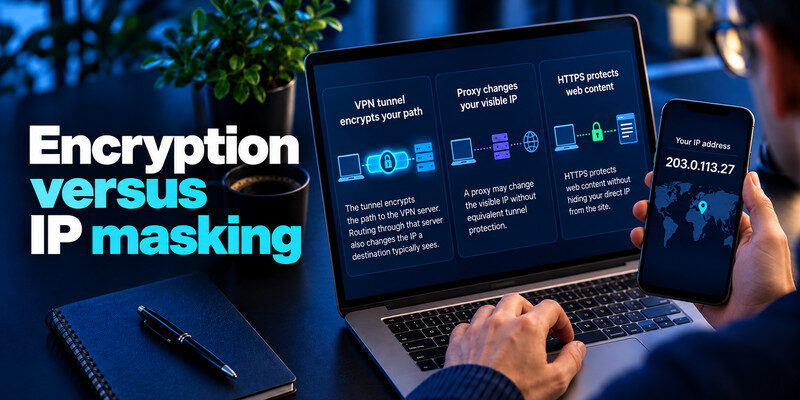
A frequent misunderstanding is that VPNs replace HTTPS. They do not. The question what is vpn encryption becomes clearer when the different endpoints are separated.
VPN encryption protects the device-to-VPN-server path. HTTPS protects the browser-to-website connection, usually through TLS. You can use both at once, and they solve related but distinct problems.
Imagine sending a message to an HTTPS website while connected to a VPN:
- Your browser establishes an encrypted HTTPS connection with the website.
- The VPN wraps the routed traffic in another protected tunnel.
- Your internet provider generally sees the VPN connection, not the website requests inside it.
- The VPN server removes its tunnel layer, while the HTTPS layer remains protected until the website terminates TLS.
This is why the question what is vpn encryption must not be answered with claims of permanent protection across the entire internet. The VPN server is an endpoint of the VPN tunnel, not necessarily the destination of the website’s TLS connection.
End-to-end encryption has another meaning: only the communicating endpoints can decrypt protected content. Some messaging services offer this for messages, subject to their design. A VPN by itself does not provide end-to-end content encryption between you and every website.
The EFF’s encryption guide explicitly explains that a VPN can shift visibility and trust from a local network or ISP to the VPN operator. HTTPS and end-to-end protections remain important, even while a VPN is active.
6. What Does VPN Encryption Protect—and What Does It Not?
The most useful response to what is vpn encryption includes its limitations. Encryption is powerful, but it addresses only certain threats.
What It Can Help Protect
On public Wi-Fi, VPN tunneling can prevent an operator or attacker watching the local network from reading protected traffic sent through the tunnel. It can also reduce the visibility of individual internet destinations to your ISP, subject to routing and leak behavior.
For remote work, an enterprise VPN can securely connect employees to approved internal resources. It does not automatically prove that the connecting device is healthy or that the user has permission to access every system.
What It Does Not Automatically Protect
A VPN generally does not prevent phishing, malware, tracking cookies, browser fingerprinting, or account recognition after login. Your network provider can still identify the VPN endpoint and observe timing and traffic volume. The VPN company may observe destination-related metadata and must be evaluated as a trusted operator.
A strong cipher cannot fix a stolen password. Protect accounts with MFA, updates, and cautious browsing. If you are unsure what account authentication adds, see what is authenticator app and SMS vs authenticator app.
For readers still asking what is vpn encryption, the realistic answer is confidentiality and integrity for a defined network path, not complete personal anonymity.
7. How to Check Whether Your VPN Is Encrypting Traffic

You cannot prove that an entire VPN service is trustworthy by looking at a green Connected badge. However, you can perform practical checks before relying on a connection.
Verify the Active Protocol
Open your VPN app’s connection details and identify WireGuard, OpenVPN, or IKEv2/IPsec. Where supported, inspect the negotiated cipher. Be cautious with obsolete protocols or unknown custom encryption systems.
If you are researching what is vpn encryption to select an app, a transparent protocol name is more meaningful than an unsupported “256-bit protection” slogan.
Check Routing and DNS Behavior
Record your public IP address before connecting. After connecting, check whether it changes to the VPN server’s apparent address. Then run a reputable DNS leak test. A WebRTC check can also help assess how your browser handles addresses.
These checks test observable routing behavior, not the provider’s no-logs policy or the cryptographic correctness of its code.
Test an Unexpected Disconnection
If your app has a kill switch, enable it and test reconnecting after a network change. Make sure traffic does not silently bypass the tunnel when protection is interrupted. Results may vary by operating system and app settings.
For organizational VPNs, follow your administrator’s approved configuration. The best response to what is vpn encryption in a corporate environment is often to verify the exact configured tunnel rather than assuming a consumer checklist covers it.
8. How to Choose a VPN With Strong Encryption
If two services both advertise AES-256, which should you choose? The answer to what is vpn encryption extends beyond the algorithm itself.
Prioritize a reputable protocol, reliable kill switch, DNS handling, transparent ownership, and a comprehensible privacy policy. Check whether the provider publishes security assessments, explains data retention, and maintains current software.
A free VPN can implement strong encryption; a paid VPN can still operate carelessly. Subscription price does not determine cryptographic quality. Compare real plan limitations, such as server selection or simultaneous connections, separately from encryption claims.
Also consider device compatibility. A mobile app should reconnect predictably when changing networks. A laptop VPN should not silently exclude applications unless you have deliberately enabled split tunneling.
If the provider lets you select protocols, WireGuard or a modern OpenVPN configuration are reasonable mainstream choices. Choose IKEv2/IPsec when it meets organizational requirements and uses appropriate algorithms. Avoid manually weakening encryption merely to solve a connectivity problem without understanding the change.
One practical lesson from what is vpn encryption is that security is a system property. A strong cipher, badly configured client, opaque logging policy, and unreliable connection protection do not add up to trustworthy privacy.
9. VPN Encryption FAQs and Final Verdict

What Is the VPN Encryption Meaning in Simple Words?
It means scrambling traffic between your device and a VPN server using secret cryptographic keys. Someone intercepting that tunnel should not be able to read its protected contents without the necessary keys.
Is AES-256 the Best VPN Encryption?
AES-256-GCM is a strong modern option, but AES-128-GCM and ChaCha20-Poly1305 are also widely respected when correctly implemented. There is no universal winner across every device, protocol, and threat model.
Can an ISP Break VPN Encryption?
A properly configured VPN using established modern cryptography is designed to resist ordinary network interception. Your ISP can generally still see that you connect to a VPN endpoint, along with timing and volume metadata. Encryption is not invisibility.
Does a VPN Encrypt Everything on My Device?
Not necessarily. Split tunneling, excluded apps, local-network traffic, or connection failures can leave some traffic outside the tunnel. Check your device settings and test what actually routes through the VPN.
What Is VPN Encryption Doing When I Already Use HTTPS?
HTTPS protects the browser-to-website connection independently of the VPN tunnel. Use HTTPS and do not ignore browser certificate warnings.
Is VPN Encryption the Same as Two-Factor Authentication?
No. Encryption protects traffic in transit; two-factor authentication verifies account access. For related account-security considerations, see is authenticator app safe.
Final Verdict: What Is VPN Encryption and Why Does It Matter?
VPN encryption protects data traveling between your device and the VPN server by turning it into authenticated ciphertext. Modern protocols commonly use AES-GCM or ChaCha20-Poly1305 and establish keys through secure handshakes.
When someone asks what is vpn encryption, the most accurate takeaway is this: it helps protect a network connection, but its security depends on sound configuration, trustworthy software, and the provider operating the server. Keep HTTPS enabled, protect your accounts with MFA, and verify which traffic your VPN actually carries.
- NIST FIPS 197 — Advanced Encryption Standard (updated 2023). AES key sizes and block size.
- NIST SP 800-38D — GCM and GMAC. Authenticated-encryption mode.
- WireGuard — Protocol and Cryptography. Handshake and cryptographic primitives.
- IETF RFC 8439 — ChaCha20 and Poly1305. Algorithm specifications and authentication tags.
- OpenVPN 2.6 Manual. Data-channel cipher negotiation and protocol settings.
- EFF — What Should I Know About Encryption?. Privacy and trust boundaries.
- Mozilla — What Is a VPN?. Consumer-level explanation of VPN tunneling.
