
Best VPN for Streaming in 2026: 6 Top Picks Compared
Published October 30, 2026
Short answer: NordVPN is a strong overall choice for streaming in 2026, ExpressVPN is particularly convenient for smart TVs and beginners, and Surfshark offers excellent value for households with multiple devices. Proton VPN is worth considering for privacy-focused users, while Windscribe Free can work for occasional viewing within its monthly data allowance.
However, the best vpn for streaming depends on the streaming services you subscribe to, your location, your internet speed, and the devices you use.
No VPN can guarantee uninterrupted access to every streaming platform. Netflix, Disney+, Hulu, and other services may detect VPN connections or restrict content based on licensing agreements.
In recent independent comparisons, NordVPN and ExpressVPN performed strongly, although rankings differed between publications. This guide compares their reported results, official features, limitations, and practical setup options to help you choose without relying on advertising claims.
1. Best VPN for Streaming in 2026: Quick Comparison
Finding the best vpn for streaming involves more than choosing the provider with the largest server network. A useful VPN needs reliable speeds, compatible apps, clear pricing, and consistent performance with your preferred services.
Here are six options worth considering.
| VPN | Best For | Main Advantage | Main Limitation |
|---|---|---|---|
| NordVPN | Overall streaming performance | Fast connections and SmartPlay | Not every streaming service accepts VPN traffic |
| ExpressVPN | Beginners and TV devices | Simple apps and broad device support | Subscription value depends on plan |
| Surfshark | Families and multiple devices | Unlimited simultaneous connections | Streaming compatibility varies |
| Proton VPN | Privacy-focused viewers | Strong privacy features and paid streaming support | Free plan is not designed for reliable streaming |
| CyberGhost | Users seeking a simple streaming setup | Streaming-oriented server options | Some platforms fail even on labeled servers |
| Windscribe Free | Occasional free streaming | Up to 10 GB monthly with verified email | Data allowance limits viewing time |
Our overall editorial pick: NordVPN.
This recommendation reflects a balance of published streaming performance, speed, device support, and usability—not a claim that it works with every platform.
For readers researching best vpn for streaming 2026, the most important distinction is between a VPN that works in one test and one that remains reliable across repeated sessions.
Published results are snapshots. VPN detection systems, server IP addresses, applications, and licensing agreements can change without warning.
What Do Recent Streaming Tests Show?
A Gizmodo streaming comparison published in October 2026 ranked NordVPN first and reported that NordVPN and ExpressVPN accessed all 14 services in its test setup.
A separate 01net comparison reported a 7.8% average speed loss for both providers in its measured server tests. Surfshark recorded 9.6%, and Proton VPN recorded 10.2% in that comparison.
These numbers describe the reviewers’ specific connections, devices, locations, and testing periods.
They are not guaranteed speed reductions or success rates for all subscribers.
Other publications, including Tom’s Guide, have reported different streaming rankings. That disagreement matters: it demonstrates why checking recent evidence for your particular platform is more useful than trusting a permanent universal winner.
2. 6 Best VPNs for Streaming Reviewed
The following recommendations combine recent third-party testing with documented product capabilities.
Editorial methodology: We reviewed published comparisons, official VPN documentation, device compatibility, and streaming-platform restrictions. We did not independently conduct new VPN speed tests for this article.
1. NordVPN — Best Overall for Streaming
NordVPN is our first recommendation for readers who want a capable VPN for several streaming devices.
Its main strengths are a broad server network, modern VPN protocols, straightforward applications, and a feature called SmartPlay.
SmartPlay combines VPN routing with DNS-related functionality to support secure streaming. According to NordVPN’s official documentation, it operates automatically within the VPN application.
You do not need to activate a separate streaming mode.
Key advantages:
- Supports up to 10 simultaneous device connections.
- Offers applications for major desktop and mobile operating systems.
- Includes SmartPlay in supported VPN connections.
- Provides a range of server locations.
- Performed strongly in October 2026 independent comparisons.
NordVPN is especially appealing if you regularly switch between a laptop, smartphone, streaming stick, and television.
For many households, the best vpn for streaming is a service that is convenient across all those devices rather than one optimized for a single browser.
Potential drawback: Some streaming services detect VPN connections regardless of provider. A successful test on one server does not guarantee a successful connection from another.
Best for: Regular streamers who want a versatile paid VPN with broad device support.
2. ExpressVPN — Best for Beginners and Smart TVs
ExpressVPN is another leading option, particularly for users who prefer uncomplicated software.
Its applications emphasize simple connection controls, while the provider also supports a variety of television and router configurations.
For Apple TV users, ExpressVPN offers a native app for devices running tvOS 17 or later.
Its official Apple TV setup guide explains how to install and connect the service directly.
ExpressVPN also offers MediaStreamer, a DNS-based option for certain devices that cannot run VPN applications.
Important: MediaStreamer is not an encrypted VPN. It does not provide the same privacy protections or location-changing functionality as a full VPN connection.
Key advantages:
- Easy-to-navigate applications.
- Support for Apple TV and other compatible television devices.
- Router setup options for more complicated home networks.
- Strong results in several recent third-party streaming comparisons.
- Customer support and troubleshooting documentation.
ExpressVPN may be the best vpn for streaming if your priority is straightforward setup across different operating systems.
However, simplicity should not be confused with guaranteed access.
Netflix or another platform may still limit content when it detects a VPN connection.
Potential drawback: Subscription costs and available features vary by plan. Compare renewal prices and device allowances before purchasing.
Best for: Beginners, Apple TV owners, and people who value simple applications.
3. Surfshark — Best for Multiple Devices and Families
Surfshark stands out because it allows unlimited simultaneous VPN connections on supported subscription plans.
According to Surfshark’s official support documentation, a single subscription can cover multiple household devices without a fixed connection limit.
This makes Surfshark attractive for families that use several phones, tablets, computers, and smart TVs.
Its device compatibility includes major desktop and mobile platforms, as well as supported television systems.
Key advantages:
- Unlimited simultaneous connections.
- Apps for common operating systems.
- Useful for households with many devices.
- Competitive long-term subscription options.
- Modern protocols and security features.
The service performed well in several 2026 streaming comparisons, although different reviewers reported inconsistent results for certain platforms.
That inconsistency is important if Netflix libraries or Prime Video compatibility are your main purchasing reasons.
For larger households, the best vpn for streaming may be the one that covers every device at a reasonable total cost.
Potential drawback: Unlimited connections do not guarantee unlimited streaming performance. Actual speeds still depend on your internet connection, VPN server load, and network conditions.
Best for: Families, shared households, and users with many devices.
4. Proton VPN — Best for Privacy-Focused Streaming
Proton VPN is an attractive option for users who want streaming functionality alongside an emphasis on online privacy.
Its apps offer VPN encryption, modern connection options, and additional privacy-oriented features.
However, Proton makes an important distinction between free and paid subscriptions.
According to the official Proton VPN streaming guide, streaming support is included in paid plans. The free tier is not intended to provide reliable access to major streaming services.
Paid subscribers can use supported applications on smartphones, computers, and compatible television devices.
Key advantages:
- Privacy-focused product design.
- Free plan available for general VPN use.
- Paid streaming support.
- Applications for major platforms.
- Additional security and routing options.
Proton VPN may be the best vpn for streaming for viewers who prioritize privacy features alongside entertainment.
In October 2026 comparisons, it performed competitively, though some reviewers reported inconsistent compatibility with individual streaming services.
Potential drawback: Features designed for additional privacy, such as multi-hop routing, may introduce latency or reduce throughput. Proton itself does not recommend Secure Core servers for optimal streaming performance.
Best for: Users who value privacy and are willing to choose a paid plan for regular streaming.
5. CyberGhost — Best for Straightforward Streaming Setup
CyberGhost offers a user-friendly approach and streaming-oriented server selections.
Instead of requiring users to compare dozens of locations manually, its interface can help identify servers marketed for particular streaming activities.
That can simplify initial setup.
However, server labels should be treated as guidance rather than promises.
In the October 2026 comparison discussed earlier, CyberGhost did not successfully access every tested service, including some attempts involving streaming-specific servers.
Key advantages:
- Streaming-oriented server selection.
- Desktop and mobile applications.
- Straightforward connection controls.
- Multiple subscription options.
- Useful for viewers who prefer a guided setup.
CyberGhost could be the best vpn for streaming for someone who values a simple interface and primarily watches services that work in their region.
Before committing to a long subscription, check compatibility with the exact platform and device you intend to use.
Potential drawback: A server advertised for a streaming platform can still be detected or blocked.
Best for: Users who prioritize straightforward setup over extensive customization.
6. Windscribe Free — Best for Occasional Free Streaming
Windscribe is one of the more practical free VPN options for users who watch online video occasionally.
According to Windscribe’s official pricing documentation, free accounts receive 2 GB of monthly data by default, increasing to 10 GB with a confirmed email address under its stated conditions.
Windscribe provides access to selected server locations, with more locations and capacity available through paid subscriptions.
Key advantages:
- A genuine free subscription tier.
- Up to 10 GB monthly data with a verified email.
- Desktop and mobile applications.
- An opportunity to evaluate the service before paying.
- Suitable for light usage.
Windscribe is worth considering when searching for the best vpn for streaming, but its data limits make it difficult to recommend for regular movie nights.
A single 4K movie could consume most of the monthly allowance.
Potential drawback: Free-server availability, streaming compatibility, and data allowances restrict practical use.
Best for: Occasional viewers who do not need unlimited monthly streaming.
3. Which VPN Works Best With Popular Streaming Platforms?
Choosing the best vpn for streaming requires checking the specific streaming services you use, not just general VPN marketing claims.
Different platforms apply different licensing rules, location checks, and VPN restrictions.
Netflix: Check the Official VPN Policy
Netflix operates in more than 190 countries, but its catalog differs between markets.
Its official VPN guidance explains that users connecting through a VPN may see only globally licensed titles. Netflix also states that VPNs are not supported for live events or ad-supported experiences.
This is an important limitation that many VPN comparison articles overlook.
Even if a VPN connects successfully, the service may display fewer titles than expected.
For Netflix users, the best vpn for streaming should be evaluated for connection stability, video quality, and compatibility with their actual subscription—not promises to unlock every regional library.
Disney+: VPN Detection Can Trigger Errors
Disney+ uses location-related restrictions and may identify VPN or proxy connections.
Its official help documentation explains that Error Code 73 can occur when the service detects an unsupported location or VPN-related connection.
Disney+ recommends disabling the VPN when that error appears.
A VPN that works with the service in one country may not work in another.
Avoid buying a long-term plan based exclusively on a provider’s advertised Disney+ compatibility.
Hulu: Location and Household Restrictions Matter
Hulu applies geographic and subscription restrictions, including requirements related to U.S. access.
Its official international-access guidance states that anonymizers and proxy services are not supported.
Hulu + Live TV also has location and household-related requirements.
A VPN cannot guarantee that an account will satisfy these restrictions.
Users should check the applicable service terms rather than assume that changing an IP address makes an unsupported subscription usable.
Prime Video, BBC iPlayer, and Other Platforms
Prime Video, BBC iPlayer, and regional broadcasters may also apply geographic rights, account eligibility, or network restrictions.
Testing results frequently differ by platform, server, and country.
Before subscribing to a VPN, identify the exact services you plan to watch and consult their current official requirements.
Streaming compatibility is not a permanent product feature. It can change as providers update network systems and content licensing policies.
4. How to Choose the Best VPN for Streaming
If you are wondering which vpn for streaming should i choose, begin with your actual viewing habits.
The following factors are more useful than choosing a provider solely because it appears at the top of a comparison page.
Streaming Speed and 4K Performance
The best vpn for streaming should maintain enough stable bandwidth for your preferred video quality.
Netflix publishes the following internet speed recommendations:
| Video Quality | Netflix Recommended Speed |
|---|---|
| HD (720p) | 3 Mbps or higher |
| Full HD (1080p) | 5 Mbps or higher |
| Ultra HD (4K) | 15 Mbps or higher |
Source: Netflix Recommended Internet Speeds.
These are Netflix’s connection recommendations, not VPN-specific speed guarantees.
A VPN adds routing and encryption overhead. The effect depends on server distance, network congestion, connection protocol, and your internet provider.
For 4K viewing, having more bandwidth than the minimum gives you room for fluctuations and other household devices.
A useful evaluation is to compare your speed with and without the VPN using the same device and network.
Test at the time you normally stream. Evening congestion may produce different results from a morning benchmark.
Server Locations and Connection Stability
A larger server network can provide flexibility, but server count alone does not determine quality.
A nearby, lightly loaded VPN server may outperform a distant server from a provider with thousands of locations.
When testing the best vpn for streaming, focus on stable playback rather than the highest single speed-test result.
Watch for buffering, unexpected disconnections, delayed video startup, and sudden quality reductions.
Device Compatibility
Before paying, confirm that the VPN supports the device you actually use.
A provider may offer excellent Windows software but require additional setup for a Samsung TV, Roku, or game console.
Native VPN applications are usually simpler than router-based configurations.
If several family members will use the subscription, also check the simultaneous connection limit.
Privacy and Security Features
Streaming performance should not be the only consideration.
Look for reputable encryption, modern VPN protocols, transparent privacy policies, and independently reviewed security practices.
A kill switch can help prevent ordinary traffic from continuing outside the VPN tunnel after certain connection failures.
However, a kill switch may interrupt streaming when a connection drops.
VPN encryption also does not prevent websites from identifying you after you sign into an account.
For a clearer explanation, read our guide on how to browse the internet privately.
Subscription Cost and Renewal Terms
The cheapest advertised monthly figure is not necessarily the lowest-cost option.
Long-term VPN deals commonly require advance payment and may renew at a different rate.
Review the total checkout cost, plan duration, refund eligibility, device allowance, and renewal conditions.
Choose based on the features you will use, not the largest promotional discount.
5. Free vs Paid VPNs for Streaming: Which Is Worth It?
A common question is whether the best vpn for streaming needs to be a paid service.
For occasional browsing or short video sessions, a reputable free VPN may be adequate.
For regular HD or 4K streaming, paid plans are generally more practical because free services can impose bandwidth limits, fewer server choices, and reduced streaming support.
People searching for best vpn for streaming free should pay particular attention to monthly data allowances.
How Long Does 10 GB Last?
Netflix estimates that viewing at its highest-quality settings can consume up to 3 GB per hour in HD and up to 7 GB per hour in 4K.
Source: Netflix Data Usage Guide.
Using those upper-end estimates:
| Streaming Quality | Data Used Per Hour | Approximate Viewing With 10 GB |
|---|---|---|
| HD | Up to 3 GB | About 3.3 hours at that rate |
| 4K | Up to 7 GB | About 1.4 hours at that rate |
Actual consumption varies by quality setting, content, device, and compression.
This explains why a 10 GB free VPN plan may be enough for brief sessions but unsuitable for watching several movies every week.
Are Free VPNs Safe?
Not all free VPNs are unsafe, and paid services are not automatically trustworthy.
Evaluate the operator’s reputation, privacy policy, security documentation, business model, and app permissions.
Avoid unfamiliar services that promise unlimited streaming without explaining how they fund their operations.
Also distinguish between a permanently free plan, a limited trial, and a paid subscription with a refund period.
These options have different costs and obligations.
Recommendation: Use a reputable free VPN for light usage and choose a paid service only when your streaming requirements justify the expense.
6. How to Set Up a VPN for Streaming on Different Devices
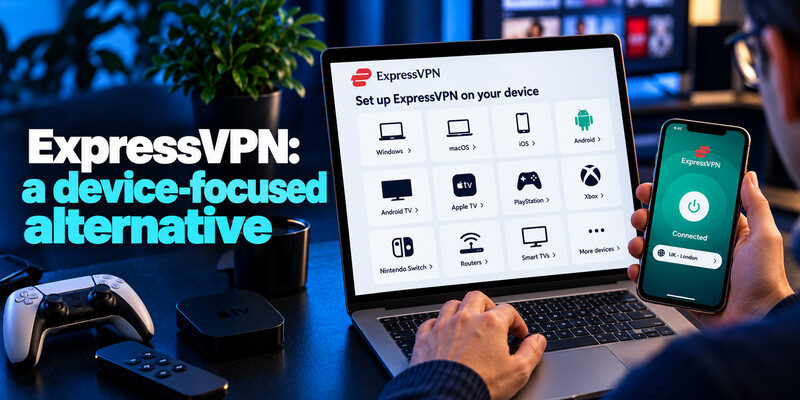
After choosing the best vpn for streaming, correct installation matters just as much as the provider itself.
A VPN may work on your laptop while your television continues using a separate, unprotected connection.
Follow the method appropriate for each device.
Windows and Mac
For most computers, setup is straightforward:
- Download the VPN application from the official provider.
- Install it and sign into your account.
- Choose a suitable server, preferably near your physical location when privacy is the main goal.
- Connect to the VPN.
- Confirm the connection status.
- Open your streaming service and test playback.
Start with a supported automatic protocol setting unless you have a reason to change it.
If streaming fails, follow the provider’s troubleshooting instructions and the platform’s official policies.
iPhone and Android
Install the VPN from the official app marketplace or a verified provider link.
Sign in, approve the operating system’s VPN configuration request, and connect.
Then open your streaming application.
If playback becomes unstable, compare performance using Wi-Fi rather than mobile data.
Mobile networks can have variable throughput, especially while moving between coverage areas.
For account security, use strong authentication and avoid reusing your streaming password.
You can learn more about additional login protection in our two-factor authentication app guide.
Apple TV, Android TV, and Fire TV
Many modern streaming devices support native VPN applications.
For example, supported Apple TV models running tvOS 17 or later can install compatible VPN apps.
Android TV and certain Fire TV devices also support VPN applications from participating providers.
To use the best vpn for streaming on a television, first verify the exact TV operating system rather than assuming every smart TV supports the same apps.
Check installation guides before subscribing.
Samsung TV, LG TV, and Other Unsupported Devices
Some televisions do not support native VPN clients.
Depending on your equipment, possible alternatives include connecting through a compatible VPN-enabled router or using a computer configured to share a VPN connection.
These approaches can be more complicated than installing a native app.
Some providers also offer Smart DNS services for streaming compatibility.
Smart DNS is not equivalent to a VPN. It generally does not encrypt your traffic or provide the full privacy protections of a VPN tunnel.
For this reason, use a full VPN connection when privacy is your primary objective.
7. Why Is Your VPN Not Working With Streaming Services?
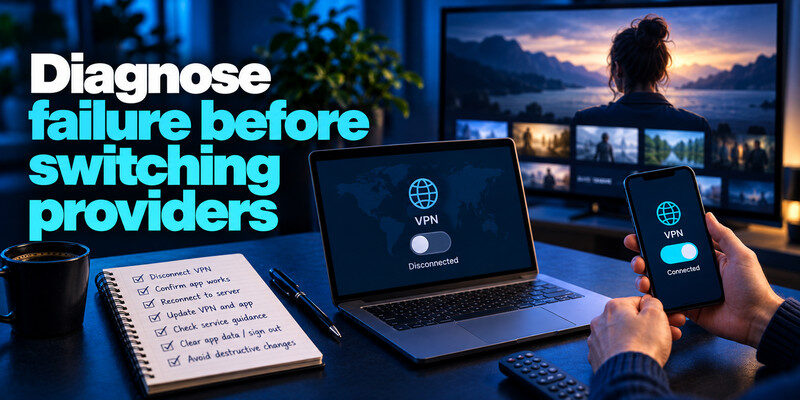
Even the best vpn for streaming can encounter playback errors.
A streaming platform may identify a VPN server, the application may retain outdated location information, or your connection may be unstable.
Before changing your subscription, identify the problem.
Problem 1: VPN or Proxy Detected
Streaming providers may block known VPN IP addresses.
Netflix, Disney+, and Hulu document different forms of VPN or proxy restrictions.
If the platform asks you to disable the VPN, follow its official guidance.
Do not assume the error means your subscription is faulty.
Problem 2: Video Buffers Constantly
Buffering can result from insufficient bandwidth, network congestion, or an overloaded VPN server.
Try a nearby server, switch to a provider-supported protocol, and test your ordinary connection speed.
If your non-VPN connection also buffers, the problem may have nothing to do with the VPN.
Problem 3: Streaming App Shows the Wrong Region
Applications may use cached account information, system location settings, or other regional indicators.
Review your account’s registered location and the platform’s travel restrictions.
Changing a VPN server does not necessarily change the location associated with your streaming subscription.
Problem 4: VPN Works on Phone but Not TV
Your television may use a different network route or DNS configuration.
Confirm whether the VPN is actually installed on the TV or whether only your phone is connected.
If you use casting, check whether the phone and receiving device can still communicate on the local network.
Problem 5: VPN Connection Drops During Playback
Unstable Wi-Fi, device sleep settings, and server changes can interrupt a connection.
Check the VPN’s status, update the app, restart the device, and contact the provider if the issue continues.
A reliable best vpn for streaming evaluation should include repeated viewing sessions, not merely whether a video starts once.
8. Frequently Asked Questions
What Is the Best VPN for Streaming in 2026?
NordVPN is our overall editorial choice because of its streaming-focused features, device compatibility, and strong results in recent independent comparisons.
ExpressVPN is an excellent alternative for users who value straightforward TV setup, while Surfshark is particularly attractive for households with many devices.
The best vpn for streaming ultimately depends on the service, country, device, and connection you use.
Is There a Completely Free VPN for Streaming?
Yes. Windscribe offers a limited free VPN plan, while some other providers offer free accounts or time-limited trials.
However, free VPNs may have limited data allowances, server choices, or streaming support.
For occasional viewing, a free tier may be sufficient. Regular HD and 4K viewing is usually more practical with a suitable paid plan.
Can a VPN Improve Streaming Speed?
Sometimes, but not reliably.
If your internet provider applies particular traffic-management practices, VPN routing may affect your connection differently.
However, encryption and longer network routes can also reduce speed.
Do not purchase a VPN expecting it to make every streaming connection faster.
Will a VPN Work With Netflix and Disney+?
It depends on the service’s current policies, the account, and the VPN connection.
Netflix may restrict users to globally licensed titles when a VPN is detected. Disney+ may show a location-related error.
No VPN guarantees full streaming-library access across every country.
Do I Need a VPN for Netflix?
No. Netflix works without a VPN in supported regions.
A VPN is optional and may be useful for separate network-privacy goals. It is not required for ordinary streaming, and Netflix may limit playback or available titles when a VPN is used.
Is a VPN Legal for Streaming?
VPN use is lawful in many jurisdictions, but local laws and streaming-service terms differ.
A VPN does not grant rights to copyrighted content or override subscription restrictions.
Use legitimate streaming accounts and follow applicable laws and platform policies.
Is a VPN Enough to Protect My Streaming Accounts?
No. VPN encryption protects network traffic between your device and the VPN server, but it does not prevent all phishing, credential theft, or unauthorized account access.
Use unique passwords and enable stronger sign-in methods where available.
For practical advice, see how to choose a password manager.
Final Verdict: Which Streaming VPN Should You Choose?
The best vpn for streaming in 2026 is not necessarily the fastest VPN in a single test or the cheapest subscription advertised online.
Choose NordVPN for a strong overall balance, ExpressVPN for straightforward streaming-device support, Surfshark for unlimited connections, Proton VPN for privacy-focused features, or Windscribe Free for occasional use within its limits.
Before purchasing, verify device compatibility, platform policies, current pricing, and available support.
Most importantly, remember that a VPN improves certain aspects of network privacy but does not guarantee access to regional streaming catalogs.
Choose a service that supports your actual viewing habits and provides a reliable experience at a cost you understand.
