
Microsoft Authenticator for Mac: Download & Setup Guide
Published August 14, 2026 · Updated October 20, 2026
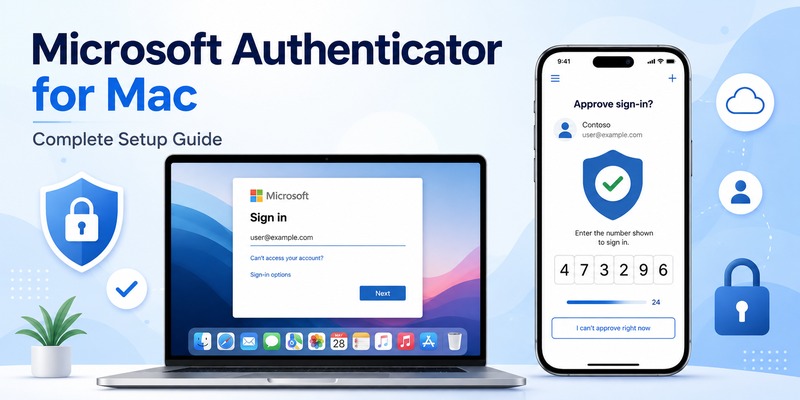
Looking for Microsoft Authenticator for Mac to protect your Microsoft account, Outlook, Microsoft 365, or other online services? Whether you use a MacBook Air, MacBook Pro, iMac, or Mac mini, you can use Microsoft Authenticator to complete secure sign-ins while working on macOS.
However, there is an important difference between using Microsoft Authenticator with a Mac and installing the application directly on macOS.
Quick Answer: Microsoft does not offer an official Microsoft Authenticator app for Mac. There is no native macOS download, DMG installer, or Mac App Store version of the official application. To use Microsoft Authenticator when signing in on a Mac, install the app on a supported iPhone or Android phone, register your account, and approve sign-in requests or enter verification codes. If you want to generate TOTP codes directly on macOS, Apple Passwords or a trusted third-party authenticator may be suitable alternatives.
This guide explains Microsoft Authenticator download Mac availability, setup instructions, MacBook compatibility, phone-free alternatives, and common authentication problems.
Can You Download Microsoft Authenticator for Mac?
No. Microsoft Authenticator is not available as an official native application for macOS.
Microsoft distributes the application for supported Android and iOS devices.
According to Microsoft’s official Authenticator download documentation, the app is designed for smartphones rather than desktop computers.
Although you cannot install the official Microsoft Authenticator app directly on a Mac, you can use it to protect accounts accessed through Safari, Chrome, Microsoft Edge, and other supported applications.
🧭 Explore Guides: Microsoft Authenticator: Complete Setup, Login, Backup & Troubleshooting Guide
Is Microsoft Authenticator Available in the Mac App Store?
Microsoft does not provide an official Microsoft Authenticator desktop application through the Mac App Store.
If you search for Microsoft Authenticator for Mac and find similarly named applications, check the developer carefully.
Third-party authenticator apps may offer compatible TOTP functionality, but they are not the official Microsoft Authenticator application.
Avoid assuming that an application is legitimate simply because it includes the Microsoft Authenticator name.
Microsoft Authenticator Download Mac: Official Options
The supported way to use Microsoft Authenticator with a Mac is to install the mobile application.
For iPhone:
- Open the Apple App Store.
- Search for Microsoft Authenticator.
- Verify that Microsoft Corporation is the developer.
- Install the application.
- Open it and follow the setup instructions.
For Android:
- Open Google Play Store.
- Search for Microsoft Authenticator.
- Confirm the official developer.
- Install the application.
- Open it and prepare to add your accounts.
The application is free for standard authentication features.
You can also begin from the official Microsoft download page.
For additional information, see our Microsoft Authenticator for iPhone guide.
Avoid Fake Microsoft Authenticator Mac Downloads
Some websites advertise unofficial Microsoft Authenticator Mac downloads as DMG, PKG, ZIP, or other installer files.
These downloads should not be confused with Microsoft’s official application.
Warning signs include:
- Websites promising a native Microsoft Authenticator DMG installer.
- Applications requesting your Microsoft password outside an official sign-in flow.
- Downloads requiring you to disable macOS security protections.
- Browser extensions claiming to be the official Microsoft Authenticator desktop app.
- Requests to upload authenticator QR codes or secret keys.
- Modified mobile application packages.
Never enter recovery codes or authentication secrets into an untrusted application.
If your goal is to protect your accounts on macOS, use the official mobile app or a reputable authenticator that supports your required authentication method.
Secure your accounts with fast, reliable two-factor authentication. Download now and protect your login in seconds.Download Authenticator App
How to Set Up Microsoft Authenticator on Mac
You can configure Microsoft Authenticator from a Mac browser even though the app itself runs on your phone.
The setup process depends on whether you use a personal Microsoft account, a work or school account, or a third-party service.
Step 1: Install Microsoft Authenticator on Your Phone
Download the official Microsoft Authenticator app on your iPhone or Android device.
Before adding accounts:
- Update your phone to a supported operating system.
- Set a strong device passcode.
- Enable notifications for sign-in approvals.
- Allow camera access when scanning setup QR codes.
- Make sure your phone’s date and time are correct.
Keep your phone nearby during the setup process.
Step 2: Open Microsoft Account Security Settings on Mac
On your Mac, open Safari, Chrome, or Microsoft Edge.
For a personal Microsoft account:
- Visit https://account.microsoft.com/security.
- Sign in to your account.
- Open the security settings for sign-in methods.
- Choose the option to add Microsoft Authenticator.
- Follow the displayed enrollment instructions.
For a Microsoft work or school account:
- Visit https://mysignins.microsoft.com/security-info.
- Sign in using your organization account.
- Select Add sign-in method.
- Choose Microsoft Authenticator if available.
- Follow the instructions provided by your organization.
Your organization’s security policies may determine which authentication methods are permitted.
Step 3: Scan the QR Code Using Microsoft Authenticator
During setup, your Mac may display an authentication QR code.
On your phone:
- Open Microsoft Authenticator.
- Tap Add account.
- Choose Personal account, Work or school account, or Other account.
- Select the QR code scanning option when prompted.
- Scan the code displayed on your Mac.
- Complete any additional registration steps.
Do not share the QR code or manual setup key with anyone.
A setup QR code may contain an authentication secret that could allow another person to generate verification codes for your account.
Step 4: Complete the Verification Test
After registering the account, Microsoft may ask you to verify the setup.
Depending on the authentication method, you may need to:
- Approve a notification.
- Complete number matching.
- Enter a temporary verification code.
- Unlock Microsoft Authenticator using your phone’s passcode or biometrics.
Once verification succeeds, your account is ready to use Microsoft Authenticator for supported Mac sign-ins.
For a more detailed walkthrough, see our how to use Microsoft Authenticator guide.
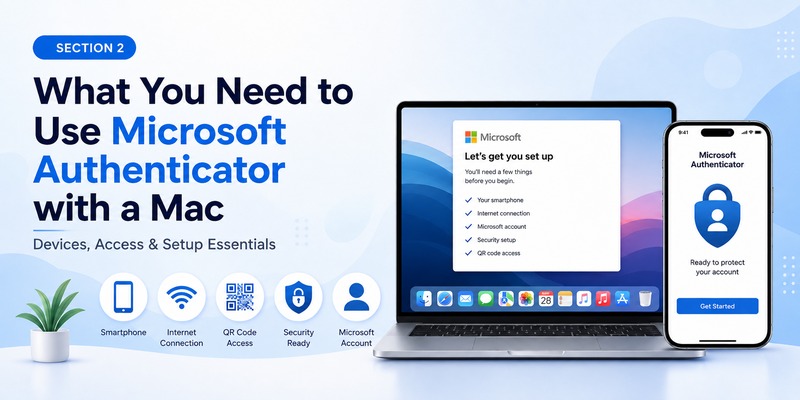
How to Use Microsoft Authenticator on MacBook Air and Pro
Microsoft Authenticator works with sign-ins initiated from supported Mac computers, including MacBook Air, MacBook Pro, iMac, and Mac mini.
The official application remains on your smartphone rather than macOS.
Microsoft Authenticator for MacBook Air
If you use a MacBook Air, you can sign in to supported Microsoft services and approve authentication requests using your phone.
For example:
- Open Microsoft 365 in Safari.
- Enter your account credentials.
- Wait for the authentication prompt.
- Open Microsoft Authenticator on your phone.
- Review the request and complete any required number matching.
- Approve the sign-in if you initiated it.
- Return to your MacBook Air.
This process works independently of whether your MacBook Air uses an Intel or Apple Silicon processor.
Microsoft Authenticator for MacBook Pro
The setup process is similar on a MacBook Pro.
You can use Microsoft Authenticator to protect supported accounts accessed through:
- Microsoft 365.
- Outlook.
- Microsoft Teams.
- OneDrive.
- Microsoft Entra-integrated applications.
- Third-party websites supporting standard TOTP.
The available authentication methods depend on the account provider.
For example, a Microsoft work account may support push approvals, while a third-party website may require a six-digit verification code.
Does Microsoft Authenticator Work on M1, M2, M3, M4, or M5 Macs?
Yes, you can use Microsoft Authenticator to approve sign-ins initiated on compatible Apple Silicon Macs.
However, Apple Silicon does not make the official iPhone version automatically available as a Mac application.
Apple allows some iPhone and iPad apps to run on Apple Silicon Macs, but availability depends on the app developer.
Microsoft does not currently provide an official macOS version of Microsoft Authenticator.
Therefore, users should not expect to find an official Microsoft Authenticator M1, M2, M3, M4, or M5 desktop installer.
Can Microsoft Authenticator Generate Codes Offline?
Yes. Standard TOTP verification codes can be generated without an internet connection once an account has been configured.
However, Microsoft Authenticator push notifications require internet connectivity.
This distinction is important when using Microsoft Authenticator while traveling or working with limited network access.
Best Microsoft Authenticator Alternatives for Mac
If you want to generate authentication codes directly on your Mac, several alternatives are available.
However, these alternatives do not necessarily support Microsoft Authenticator’s push approvals or Microsoft Entra-specific registration requirements.
1. Apple Passwords
Apple Passwords supports verification codes for compatible websites and services.
On supported macOS versions, it can generate standard TOTP codes directly on your Mac.
How to set up verification codes in Apple Passwords:
- Open the website you want to protect.
- Navigate to its two-factor authentication settings.
- Select the authenticator app option.
- Find the setup key or QR code.
- Open Apple Passwords on your Mac.
- Select or create the relevant account entry.
- Choose the option to set up a verification code.
- Enter the setup key or follow the available QR code workflow.
- Save the configuration.
- Enter the generated code on the website to confirm setup.
Apple Passwords can be convenient for users who primarily use Apple devices.
However, it does not replace Microsoft Authenticator push notifications or every organization-managed authentication method.
2. Third-Party Authenticator Apps for macOS
Some third-party applications provide desktop TOTP functionality.
When choosing a Mac authenticator, evaluate:
- macOS compatibility.
- Support for standard TOTP.
- Secure storage and encryption.
- Backup and recovery options.
- Developer reputation.
- Security updates.
- Multi-device synchronization.
- Account migration capabilities.
For users who need verification codes across multiple devices, a trusted cross-platform authenticator may be useful.
However, check whether the application supports the specific authentication method required by your service.
3. Passkeys and Touch ID
Passkeys provide another authentication option for supported websites and services.
On compatible Macs, passkeys can be used with Touch ID or another supported device verification method.
Unlike traditional TOTP codes, passkeys use cryptographic authentication designed to resist many phishing attacks.
However, passkeys are not a universal replacement for Microsoft Authenticator.
Your account provider or organization must support the chosen passkey method.
4. Hardware Security Keys
Compatible FIDO2 security keys provide another authentication method for supported services.
Depending on the device and account provider, you may be able to authenticate using USB-C, USB-A, or NFC.
Security keys can provide strong phishing resistance and may be useful for accounts requiring additional protection.
Before choosing a security key, verify that your Microsoft account or organization supports it.
Which Mac Authentication Method Is Best?
| Your goal | Recommended method |
|---|---|
| Microsoft 365 push approvals | Microsoft Authenticator on phone |
| Standard TOTP codes directly on Mac | Apple Passwords or trusted desktop authenticator |
| Phishing-resistant website sign-in | Passkeys |
| Hardware-based authentication | FIDO2 security key |
| Microsoft work account with enforced Authenticator | Organization-approved Microsoft Authenticator setup |
| Personal Microsoft account verification | Supported Microsoft Authenticator or alternative account method |
The best choice depends on your account provider and security requirements.
Can You Use Microsoft Authenticator on Mac Without a Phone?
You cannot run the official Microsoft Authenticator mobile application natively on macOS.
However, you may be able to authenticate without a phone if the service supports another method.
Option 1: Use Apple Passwords for TOTP
For websites that accept standard authenticator verification codes, Apple Passwords can generate codes directly on your Mac.
This is useful when you want to avoid switching devices during every login.
However, it cannot approve Microsoft Authenticator-specific push notifications.
Option 2: Use a Passkey
If your Microsoft account or another service supports passkeys, you may be able to authenticate using a passkey stored on your Mac.
Passkeys can provide a convenient and phishing-resistant sign-in experience.
Availability depends on the account and supported platform.
Option 3: Use a Hardware Security Key
A compatible security key may allow you to sign in without using Microsoft Authenticator on a smartphone.
This option is particularly useful for supported Microsoft Entra accounts.
However, your organization’s authentication policies determine whether security keys are permitted.
Option 4: Contact Your IT Administrator
If your employer or school requires Microsoft Authenticator but you cannot use a smartphone, contact your IT administrator.
Depending on organizational policies, approved alternatives may include:
- FIDO2 security keys.
- Hardware OTP tokens.
- Temporary Access Pass for supported enrollment or recovery scenarios.
- Other permitted authentication methods.
Do not attempt to bypass organization-managed authentication requirements.
Can You Install Microsoft Authenticator Through an Emulator?
Microsoft does not provide Android emulators or other desktop virtualization tools as an officially supported installation method for Microsoft Authenticator on Mac.
Such configurations may introduce compatibility problems, security concerns, and device registration failures.
For sensitive personal or work accounts, use supported authentication methods instead.
Common Microsoft Authenticator Mac Problems
Although Microsoft Authenticator can secure accounts accessed from macOS, users may encounter download, enrollment, or sign-in problems.
Microsoft Authenticator Mac Download Not Found
If you cannot find an official Microsoft Authenticator Mac download, this is expected.
Microsoft does not provide a native macOS version.
Install the official mobile application on a supported iPhone or Android device.
Avoid unofficial Mac installers claiming to be Microsoft’s desktop Authenticator.
Microsoft Authenticator QR Code Not Working on Mac
If your phone cannot scan the QR code displayed on your Mac:
- Check the phone’s camera permissions.
- Confirm that the QR code has not expired.
- Increase the browser zoom if necessary.
- Generate a new enrollment QR code from the official security page.
- Use the supported manual setup option if available.
Never upload authentication QR codes to an online scanning service.
For additional troubleshooting, read our Microsoft Authenticator unable to add account guide.
Microsoft Authenticator Notification Not Showing
If you do not receive an authentication notification:
- Confirm that your phone is connected to the internet.
- Enable Microsoft Authenticator notifications.
- Check Focus or Do Not Disturb settings.
- Update Microsoft Authenticator.
- Verify that the correct account is registered.
- Try another approved authentication method.
Push notifications require connectivity, while standard TOTP codes can be generated offline.
Microsoft Authenticator Code Not Working
If a verification code is rejected:
- Confirm that you selected the correct account.
- Enable automatic date and time on your phone.
- Wait for the next verification code.
- Enter the code before it expires.
- Confirm that the account’s authentication settings have not changed.
Avoid removing the existing authenticator unless you have a working recovery method.
Lost Your Phone With Microsoft Authenticator?
If you lose your registered phone, you may need to recover your accounts using another configured authentication method.
Recovery options depend on your account type and backup configuration.
Microsoft Authenticator supports backup and recovery in certain scenarios, but not every account can be restored automatically.
Work and school accounts may require re-registration.
For more information, see our Microsoft Authenticator backup guide.
Frequently Asked Questions
Is Microsoft Authenticator available for Mac?
No. Microsoft does not currently offer an official Microsoft Authenticator application for macOS. You can use the mobile app to authenticate sign-ins initiated on your Mac.
Can I download Microsoft Authenticator for MacBook?
There is no official Microsoft Authenticator MacBook desktop download. Install the application on a supported iPhone or Android phone instead.
Is Microsoft Authenticator available for MacBook Pro?
Microsoft Authenticator can protect accounts accessed from a MacBook Pro, but the official application runs on a supported mobile device rather than macOS.
Does Microsoft Authenticator work on MacBook Air?
Yes. You can use Microsoft Authenticator on your phone to approve supported sign-ins initiated from a MacBook Air.
Can I install Microsoft Authenticator on an M1 or M2 Mac?
Microsoft does not currently provide a native macOS version of Authenticator for M1 or M2 Macs. You can still use the mobile app to authenticate accounts accessed from these computers.
Is Microsoft Authenticator free for Mac users?
Yes. The official Microsoft Authenticator mobile application is free for standard authentication functionality. There is no official Mac desktop edition.
Can I use Microsoft Authenticator on Mac without a phone?
Not as a native Microsoft Authenticator application. However, supported services may allow Apple Passwords, passkeys, security keys, or another approved authentication method.
Is Apple Passwords the same as Microsoft Authenticator?
No. Apple Passwords can generate standard TOTP verification codes, but it does not provide all Microsoft Authenticator features, such as supported Microsoft push authentication.
Can Microsoft Authenticator generate codes without internet?
Yes. Standard TOTP verification codes can be generated offline after setup. Push notification approvals require internet connectivity.
Can I use Microsoft Authenticator with Safari?
Yes. Microsoft Authenticator can verify supported sign-ins initiated from Safari on macOS. The authentication approval or verification code is provided through the mobile application.
Does Microsoft Authenticator work with Microsoft 365 on Mac?
Yes. Microsoft Authenticator can approve supported Microsoft 365 sign-ins initiated from a Mac browser or application.
Can I download Microsoft Authenticator DMG for Mac?
No official Microsoft Authenticator DMG installer exists. Avoid downloading unofficial files claiming to provide Microsoft’s macOS Authenticator.
What is the best Microsoft Authenticator alternative for Mac?
For standard TOTP verification codes, Apple Passwords or a trusted desktop authenticator may be suitable. For phishing-resistant authentication, passkeys or compatible FIDO2 security keys are worth considering.
Conclusion
Although Microsoft Authenticator for Mac is a common search term, Microsoft does not currently provide an official macOS desktop application.
The supported way to use Microsoft Authenticator with a MacBook Air, MacBook Pro, iMac, or Mac mini is to install the official application on an iPhone or Android device and configure it through your account’s security settings.
If you prefer authentication directly on macOS, Apple Passwords, passkeys, hardware security keys, and compatible third-party TOTP applications may offer alternatives.
Always verify that your chosen method is supported by the account provider, protect your recovery information, and avoid unofficial Microsoft Authenticator Mac downloads.
For more authentication tutorials, explore our Microsoft Authenticator setup guide and additional security resources on Authenticator App.
