Best VPN for Privacy in 2026: 5 Most Private VPNs Compared
Published October 30, 2026
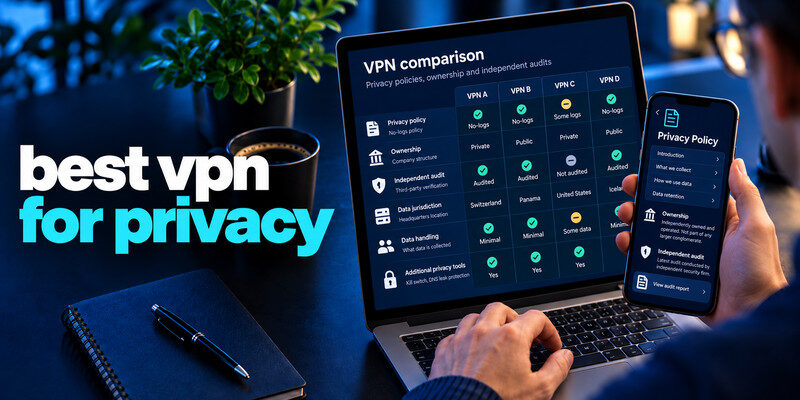
Quick answer: Mullvad VPN is our best VPN for privacy in 2026 for people who prioritize minimal personal-data collection. It requires no email address to create an account, supports anonymous payment methods, and publishes detailed privacy policies. Proton VPN is an excellent alternative with open-source apps and five consecutive annual no-logs audits. IVPN is another strong choice for privacy-focused users, while NordVPN and ExpressVPN offer audited privacy protections alongside broader everyday features.
Finding the best VPN for privacy is about more than hiding your IP address. A trustworthy VPN should minimize data collection, encrypt your connection, provide reliable leak protection, and demonstrate that its privacy promises are supported by verifiable evidence.
However, no VPN can guarantee complete anonymity.
Websites may still identify you through account logins, tracking cookies, browser fingerprinting, and information you voluntarily share.
A VPN also changes who you trust with your network traffic: instead of relying entirely on your internet service provider, you place some trust in the VPN company.
This guide compares five leading privacy-focused VPN providers using information available in 2026, explains the differences between their security approaches, and helps you make an informed decision.
1. Best VPN for Privacy in 2026: Quick Comparison
The best VPN for privacy should demonstrate strong privacy practices rather than simply advertise military-grade encryption or thousands of servers.
Here is how five established providers compare.
| VPN | Privacy advantage | Independent review evidence | Free plan | Best for |
|---|---|---|---|---|
| Mullvad VPN | No email required, numbered accounts, cash payments | Independent security audits in 2025–2026 | No | Data minimization |
| Proton VPN | Published no-logs audits, open-source applications | Securitum no-logs audit, 2026 | Yes | Overall privacy and free protection |
| IVPN | No-email registration, transparent ownership | Annual security audits; last dedicated no-logs audit in 2019 | No | Privacy-conscious users |
| NordVPN | Independently reviewed logging practices | Sixth no-logs review, completed in 2025 | No permanent free tier | Privacy plus everyday features |
| ExpressVPN | RAM-only server architecture, privacy audits | KPMG privacy assessment, 2025 | No permanent free tier | Straightforward multi-device use |
Our overall recommendation: Mullvad VPN.
Its approach focuses on reducing the personal information associated with a VPN account before you even connect.
For users who want a free option, Proton VPN provides an unusually strong combination of unlimited data and independently examined no-logs practices.
The best VPN for privacy depends on your threat model, budget, preferred devices, and how much personal information you are willing to provide to a VPN provider.
2. The 5 Best VPNs for Privacy Reviewed
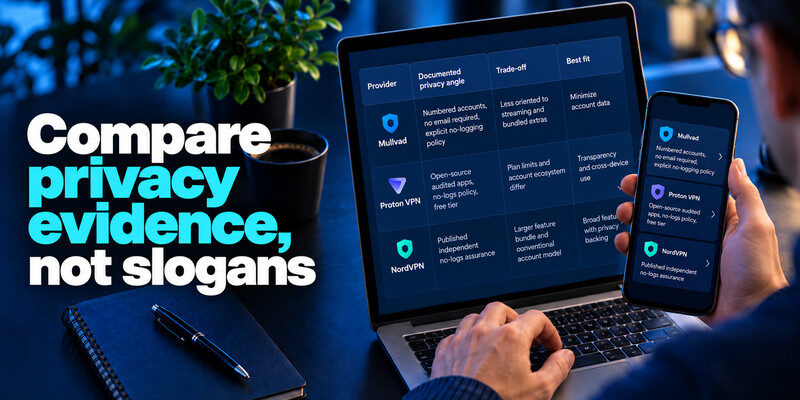
A provider deserves consideration only when its privacy claims can be evaluated.
We selected these five VPNs based on their published policies, technical safeguards, external assessments, and available privacy controls.
2.1. Mullvad VPN — Best Overall for Privacy
Best for: People who want to minimize the information collected during account registration and payment.
Mullvad is our leading best VPN for privacy recommendation because its service is designed around data minimization.
Unlike VPN companies that require an email address and password, Mullvad generates a random account number.
You can use that number to access your subscription without providing your name or email address.
According to Mullvad’s official no-logging policy, it does not retain browsing activity, DNS requests, source IP addresses, connection timestamps, or bandwidth usage associated with user sessions.
Key privacy features:
- No email address or username required
- Randomly generated account numbers
- Open-source applications
- WireGuard-based VPN connections
- Built-in connection protection
- Cash and cryptocurrency payment options
- Published privacy policies and external security assessments
Mullvad has also continued publishing security-assessment results.
In January 2026, it reported an X41 D-Sec review covering its account and payment infrastructure.
The assessment identified five security-relevant findings: three medium and two low severity. The provider stated that the identified issues did not expose customer information.
This assessment should not be confused with a full no-logs audit; it examined specific systems.
How much does Mullvad cost?
Mullvad uses a flat price of €5 per month, without requiring a long-term subscription.
One account supports up to five devices.
Main limitation: Mullvad offers no permanent free plan, has fewer entertainment-oriented features than some mainstream competitors, and does not prioritize streaming-unblocking guarantees.
Verdict: Mullvad is particularly attractive when privacy begins with minimizing account data rather than merely encrypting traffic.
Sources: Mullvad no-logging policy | Pricing | 2026 security audit
2.2. Proton VPN — Best for Audited No-Logs Protection
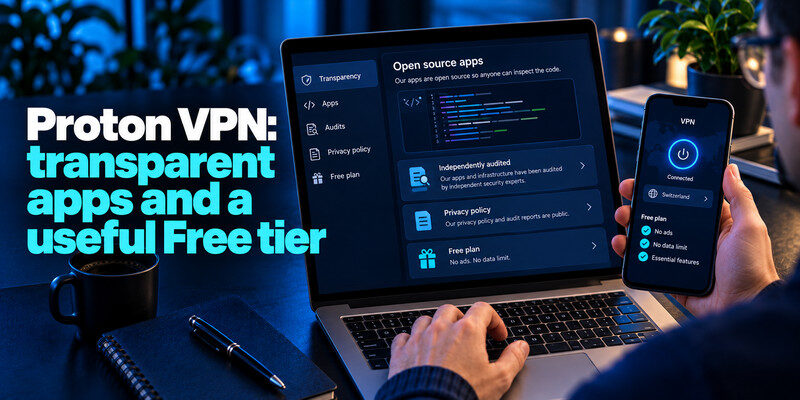
Best for: Users who value published audit evidence, open-source applications, and a usable free plan.
Proton VPN is a leading best VPN for privacy alternative, particularly for people who want their provider’s logging practices examined regularly.
The company is based in Switzerland and publishes privacy documentation covering the data it collects and does not retain.
Its applications are open source, allowing independent researchers to examine publicly available code.
Key privacy features:
- Strict no-logs policy
- Open-source VPN applications
- Independent infrastructure assessments
- WireGuard and other secure protocols
- DNS leak protection
- Kill-switch capabilities
- Secure Core multi-hop routing on eligible paid plans
In 2026, Proton announced its fifth consecutive annual no-logs audit, conducted by Securitum.
According to the published findings, the reviewed server infrastructure did not show evidence of logging browsing activity, DNS queries, traffic contents, or user-identifiable connection metadata.
Proton’s transparency report also states that it received 59 legal orders concerning Proton VPN in 2025 and denied all 59, explaining that it could not provide the requested activity logs.
These figures offer useful evidence about the company’s handling of information requests.
However, the outcome of past requests does not guarantee what will happen under every future legal or technical circumstance.
Is Proton VPN available for free?
Yes.
Proton VPN Free includes unlimited data, no advertisements, one simultaneous connection, and access to a limited selection of free server locations.
Its paid plans offer additional countries, devices, and advanced features.
Main limitation: Free accounts have less server control, and creating a Proton account involves an account system rather than Mullvad’s numbered-account approach.
Verdict: Proton VPN is an excellent choice when regular independent logging reviews and a free entry-level option matter most.
Sources: Proton’s 2026 audit | Transparency report | Pricing
2.3. IVPN — Best for Privacy Transparency
Best for: Users who prefer a transparent business model, minimal account requirements, and detailed technical controls.
IVPN stands out as a best VPN for privacy candidate because it emphasizes privacy-focused design instead of exaggerated anonymity promises.
The service does not require an email address for ordinary account registration.
It also supports alternative payment methods, including cash and privacy-oriented cryptocurrencies.
IVPN publishes information about its ownership, infrastructure, security practices, and audits.
Key privacy features:
- Registration without an email address
- Open-source applications
- WireGuard and OpenVPN support
- Firewall-based kill switch on supported platforms
- Private DNS infrastructure
- AntiTracker blocking features
- Multi-hop connections
- Independent security assessments
In May 2026, IVPN updated its subscription structure.
Its Standard plan costs $6 monthly or $60 annually, supports five devices, and includes multi-hop functionality.
The company’s approach to audits is particularly interesting.
IVPN conducts recurring security assessments, but explicitly states that its last dedicated no-logs audit occurred in March 2019.
It argues that auditing a logging policy at one moment cannot prove a system will never change.
That distinction is important when comparing VPN providers.
Main limitation: IVPN does not have a permanent free plan, and users seeking the largest server network or extensive streaming features may prefer another provider.
Verdict: IVPN is a compelling option for people who value transparency, open-source software, and clear communication about privacy limitations.
Sources: IVPN official website | 2026 plan changes | Audit policy
2.4. NordVPN — Best for Privacy and Everyday Features
Best for: People who want independently reviewed privacy practices alongside a broader feature set.
NordVPN is another best VPN for privacy option, especially for users balancing privacy with speed, convenience, and international server availability.
The company operates under a no-logs policy and uses privacy-focused server infrastructure.
Its security features include:
- Independently reviewed no-logs practices
- Modern VPN encryption
- NordLynx, based on WireGuard
- Kill-switch functionality
- DNS leak protection
- Double VPN routing
- Additional threat-protection features, depending on the plan
NordVPN completed its sixth independent no-logs review in late 2025, with the results publicized in early 2026.
Deloitte examined whether the company’s relevant systems and operating practices aligned with its stated logging policy.
A history of repeated assessments makes its privacy claims more verifiable than those of providers that publish only marketing statements.
However, an independent review is not a guarantee against every vulnerability, future policy change, or account-identification method.
Main limitation: NordVPN uses conventional subscription accounts, and its most attractive prices usually involve longer commitments. Renewal prices should be checked before purchasing.
Verdict: NordVPN is suitable for users seeking a balance between documented privacy protections and everyday VPN functionality.
Source: NordVPN no-logs documentation
2.5. ExpressVPN — Best for Simple Privacy Protection
Best for: Users who want a straightforward VPN experience with audited infrastructure controls.
ExpressVPN is frequently considered among the best VPN for privacy options because of its technical approach to reducing data retention.
Its TrustedServer architecture runs VPN servers using RAM instead of relying on persistent storage for the operating environment.
According to ExpressVPN, server data is cleared on reboot, and the software stack is reinstalled when servers start.
This approach can reduce certain risks associated with persistent server storage.
Key privacy features:
- TrustedServer RAM-only infrastructure
- Independently assessed privacy controls
- Lightway VPN protocol
- Network Lock kill-switch functionality
- Private DNS handling
- Applications for major operating systems
- Published transparency reports
In June 2025, ExpressVPN announced another KPMG assessment of its privacy commitments and TrustedServer controls.
The review evaluated relevant systems against the company’s policy claims as of February 28, 2025.
What should users understand?
RAM-only servers provide a technical safeguard, but they do not automatically prove that a provider never monitors or records activity elsewhere.
Independent reviews, operational policies, and incident reporting remain essential.
Main limitation: ExpressVPN requires a paid subscription and does not follow the anonymous numbered-account model offered by Mullvad and IVPN.
Verdict: ExpressVPN is a good choice for people who want accessible applications supported by documented infrastructure assessments.
Sources: ExpressVPN Trust Center | TrustedServer technology
3. What Makes a VPN Truly Private?
The best VPN for privacy should reduce unnecessary information exposure at several different points: account registration, payment, VPN connection, and ongoing service operation.
Understanding these layers makes it easier to distinguish meaningful safeguards from marketing claims.
Minimal Data Collection
A VPN cannot expose stored information that it never collected.
That is why account requirements deserve attention.
Some providers allow users to register without an email address, while others retain account details needed for billing, support, or fraud prevention.
Neither model automatically determines whether a VPN is trustworthy.
However, collecting less identifying information can reduce the consequences of a data breach or disclosure request.
Clear No-Logs Policies
A no-logs policy should identify exactly what information is excluded from collection.
Look for clear statements covering browsing history, DNS queries, connection timestamps, original IP addresses, and traffic destinations.
Providers may still process information necessary to operate their services, such as subscription status or simultaneous connection counts.
A trustworthy policy explains these distinctions.
Independent Verification
The best VPN for privacy should offer evidence that can be assessed beyond its own marketing materials.
Independent audits are valuable when they examine production systems, relevant configurations, or logging practices.
Read the audit date and scope carefully.
A mobile application penetration test is not equivalent to an assessment of VPN server logging.
Privacy-Friendly Payment Options
Traditional payment methods can connect a purchase to your real-world identity.
Cash, vouchers, and certain digital currencies may reduce information exposure in some circumstances.
However, cryptocurrency transactions are not automatically anonymous, and payment processors may retain their own records.
The Electronic Frontier Foundation recommends considering these trade-offs when evaluating VPN services.
Privacy is a combination of technical controls, business decisions, and user behavior—not one feature.
4. Essential Privacy Features to Look for in a VPN
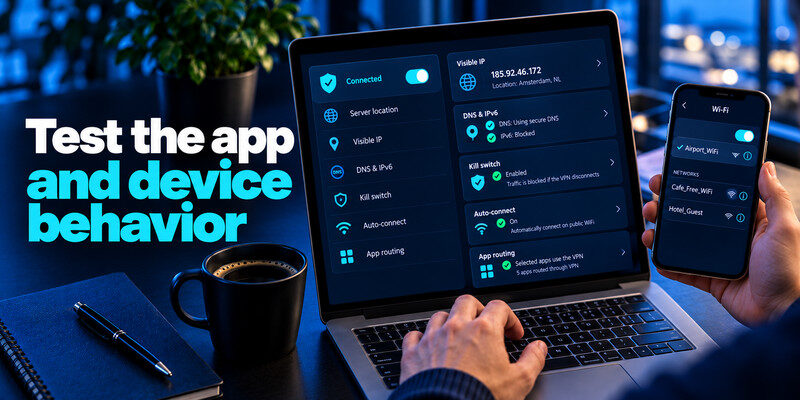
Choosing the best VPN for privacy also requires understanding which technical features protect your connection.
Modern Encryption and VPN Protocols
Reputable VPNs commonly use established cryptographic protocols such as WireGuard and OpenVPN.
WireGuard is designed around a comparatively small codebase and modern cryptography.
OpenVPN remains a widely supported option, although individual providers may support different protocols.
Encryption protects traffic between your device and the VPN server.
It does not replace HTTPS or guarantee that information remains encrypted after leaving the VPN server.
Reliable Kill Switch
A kill switch helps prevent traffic from leaving your device through the normal network connection if the VPN unexpectedly disconnects.
This is particularly useful when you need to avoid accidental exposure of your ordinary IP address.
Check whether the feature operates automatically and whether it protects traffic during startup, reconnecting, and network changes.
DNS Leak Protection
DNS queries help translate domain names into network addresses.
If your device sends these requests outside the intended VPN tunnel, your network provider may still learn about some destinations you access.
A well-configured VPN should route DNS requests as intended.
DNS protection matters because hiding a public IP address alone does not establish complete connection privacy.
Open-Source Applications
Open-source applications allow researchers to examine published code for potential vulnerabilities or questionable behavior.
Mullvad, Proton VPN, and IVPN all provide openly available application code.
However, open source does not guarantee security.
The software still needs competent maintenance, appropriate build practices, and review.
Multi-Hop Connections
Multi-hop VPN configurations route traffic through more than one VPN server.
This may reduce certain risks associated with a single server observing both ends of a connection.
However, multi-hop connections can increase latency and do not guarantee anonymity.
For most everyday users, a trustworthy single-server connection is sufficient.
The best VPN for privacy is not necessarily the one with the longest feature list. It is the provider that implements the features you actually need reliably.
5. How to Verify No-Logs Claims and Independent Audits
A VPN’s no-logs claim is one of its most important privacy promises.
Unfortunately, such statements are also easy to advertise without meaningful supporting evidence.
When researching the best VPN for privacy, evaluate the quality of an audit rather than merely checking whether an audit badge appears on a website.
Understand Different Audit Types
| Audit type | What it examines | What it does not necessarily prove |
|---|---|---|
| No-logs assessment | Relevant logging practices and systems | Permanent future compliance |
| Infrastructure audit | Server configurations and technical protections | Every business data practice |
| Application security audit | Software vulnerabilities and implementation | Server-side logging behavior |
| Privacy-policy assessment | Selected controls and compliance claims | Complete anonymity |
| Penetration test | Security weaknesses within its defined scope | Absence of all vulnerabilities |
For example, Proton VPN’s 2026 Securitum review focused on its no-logs infrastructure.
Mullvad’s January 2026 assessment examined account and payment services.
IVPN’s recurring security audits examine selected services, while the company separately acknowledges that its last dedicated no-logs audit took place in 2019.
These are all useful pieces of evidence, but they answer different questions.
Check the Provider’s Transparency Report
Transparency reports may disclose government requests, legal orders, and how the provider responded.
They help readers understand how privacy commitments operate in practice.
Proton’s published report, for instance, identifies 59 Proton VPN orders in 2025 and states that all were denied.
That provides more concrete information than a generic privacy slogan.
Understand the Limits of an Audit
Audits represent conditions observed within a defined period and scope.
A provider can later update its infrastructure, introduce new software, or modify policies.
Therefore, repeated audits, public reports, responsible vulnerability disclosures, and transparent company governance should all influence your assessment.
No single certificate can establish that a VPN is permanently private.
6. Free vs. Paid VPNs: Which Offers Better Privacy?
You do not necessarily need to purchase a VPN subscription to receive meaningful privacy protection.
However, the best VPN for privacy will not always be free.
A free service still requires funding for servers, software development, and security operations.
Can a Free VPN Protect Your Privacy?
Yes, provided the service has a trustworthy operating model.
Proton VPN Free is a notable example.
Its official pricing information confirms unlimited data, one simultaneous connection, and access to servers across 10 countries through its free server-selection system.
The free plan uses the provider’s no-logs protections rather than a separate data-monetization model.
For users searching for best vpn for privacy free, Proton VPN is our primary recommendation.
Its main disadvantages concern flexibility, connection limits, and premium features rather than an advertised monthly data cap.
Why Consider a Paid Privacy VPN?
Paid services can offer features such as wider server selection, additional devices, specialized routing, and more flexible payment arrangements.
Mullvad and IVPN also demonstrate that some providers deliberately build their businesses around paid subscriptions and minimal data collection.
Neither uses a conventional permanent free VPN tier.
When Should You Avoid a Free VPN?
Be cautious if a service has unclear ownership, excessive app permissions, unexplained advertising practices, or vague data-retention terms.
A free VPN that records sensitive activity may undermine the privacy you intended to gain.
Choose a transparent free provider over an unknown service promising unlimited anonymity.
7. How to Use a VPN for Maximum Online Privacy
Even the best VPN for privacy cannot protect someone who shares sensitive information through insecure accounts or suspicious websites.
The following steps help reduce common privacy risks.
Step 1: Install the Official VPN App
Download applications from the provider’s website or a verified application store.
Avoid modified APKs, unofficial installers, and cracked premium applications.
These may contain malware or altered security settings.
Step 2: Configure Connection Protection
Enable the kill switch where supported.
Review DNS protection, automatic connection settings, and VPN protocol options.
For unfamiliar Wi-Fi networks, consider automatic VPN connection when the feature is available.
Step 3: Check Your IP and DNS
Before connecting, note your public IP address.
Connect to the VPN, then check the address again.
It should normally change to the VPN server’s public address.
You can also use a DNS leak test to check which DNS resolvers are visible.
Remember that passing an IP or DNS test does not verify the provider’s entire privacy policy.
Step 4: Protect Your Accounts With MFA
A VPN does not stop attackers from using stolen passwords or successfully phished credentials.
For additional protection, learn what is authenticator app and enable multi-factor authentication on your important accounts.
You can also review is authenticator app safe when selecting a verification application.
The Cybersecurity and Infrastructure Security Agency recommends phishing-resistant authentication, such as FIDO-based passkeys or security keys, where available.
Authenticator codes are still useful, but they do not provide the same phishing resistance.
For account-security decisions, compare SMS vs authenticator app and YubiKey vs Microsoft Authenticator.
Step 5: Reduce Browser Tracking
Use a privacy-conscious browser configuration, limit unnecessary extensions, and review tracking permissions.
Consider separating activities into different browser profiles when you do not want websites to connect them.
Avoid assuming that private browsing mode or a VPN prevents account-based tracking.
A strong privacy setup combines a VPN, secure browsing habits, software updates, and account protection.
8. Common VPN Privacy Mistakes to Avoid
Many users install a VPN and immediately assume their digital identity is hidden.
Understanding the following mistakes is essential when selecting the best VPN for privacy.
Mistake 1: Believing a VPN Makes You Anonymous
A VPN can change the IP address visible to websites.
However, it cannot hide your identity from a service where you deliberately sign in.
Tracking cookies, browser fingerprinting, and location permissions can also reveal information.
The EFF specifically warns that VPNs are not comprehensive anonymity tools.
Mistake 2: Trusting Unverified No-Logs Claims
A privacy statement is not proof of implementation.
Research the company’s audit history, ownership, operating policies, and responses to security issues.
Mistake 3: Ignoring Account and Payment Data
Even when browsing activity is not recorded, billing and account systems may retain personal information.
Check which data is collected before registration.
Mistake 4: Assuming More Servers Means Better Privacy
A large server network may improve convenience and location choice.
However, server count alone says little about data retention, infrastructure security, or provider trustworthiness.
Mistake 5: Forgetting About VPN Disconnections
A VPN may disconnect when your device changes networks, wakes from sleep, or encounters software errors.
Test whether your kill switch behaves as expected.
Mistake 6: Replacing Other Security Tools With a VPN
A VPN cannot replace password managers, phishing-resistant MFA, device encryption, or reliable backups.
Treat a VPN as one part of your privacy strategy, not your entire security strategy.
9. Best VPN for Privacy FAQs and Final Verdict
What is the best vpn for privacy 2026?
Mullvad VPN is our overall privacy-focused recommendation, particularly for users who want minimal account-data collection.
Proton VPN is an excellent alternative for users who prioritize recurring no-logs assessments and open-source applications.
IVPN is also worth considering for transparent operational policies and account registration without an email address.
Which VPN has the strongest no-logs evidence?
No audit permanently proves that a company cannot collect information.
However, Proton VPN provides strong published evidence through five consecutive annual no-logs reviews, including its 2026 assessment by Securitum.
NordVPN has also completed six independent reviews of its no-logs practices.
Always compare the scope, publication date, and accessibility of these reports.
Which vpn for privacy should i choose?
Choose Mullvad if you want to minimize registration information, Proton VPN if you value published audits and a free option, or IVPN if you prefer a privacy-first operating model with extensive controls.
NordVPN and ExpressVPN are alternatives when you need broader everyday functionality.
Select the provider that addresses your main privacy concern rather than one that merely promises the most features.
Can the best VPN for privacy hide my browsing history?
A VPN can reduce your internet provider’s visibility into the destination information associated with traffic routed through the VPN tunnel.
However, it cannot erase browsing history already stored on your device or prevent a website from recording activity associated with your account.
The VPN provider may also have access to network metadata, depending on its technical design and operating practices.
Is a VPN better than Tor for anonymity?
Not necessarily.
The Electronic Frontier Foundation explains that Tor is generally more appropriate when anonymity is the primary goal.
A conventional VPN depends heavily on trusting one provider.
Tor distributes traffic through multiple relays, reducing the extent to which one relay can observe both endpoints.
However, Tor can be slower and may be less convenient for some everyday activities.
Is a top vpn for privacy always expensive?
No.
Mullvad charges a flat €5 monthly, while IVPN Standard is available for $6 monthly or $60 annually.
Proton VPN provides a permanent free tier with unlimited data.
The price of a VPN should be considered alongside transparency, security, data collection, and the features you genuinely need.
A higher subscription price does not automatically provide better privacy.
Does a VPN prevent websites from tracking me?
Not completely.
Websites can still recognize logged-in users, store cookies, and apply device or browser fingerprinting techniques.
A VPN primarily changes network routing and the public IP address presented to destination services.
Use browser privacy controls and limit unnecessary account-based tracking alongside VPN protection.
Can I trust a VPN based in a privacy-friendly country?
Jurisdiction matters, but it is only one consideration.
A provider’s legal environment may affect data requests and retention obligations.
However, technical infrastructure, actual logging practices, and the personal information already collected are equally important.
A company based in a favorable jurisdiction can still have poor privacy practices.
Should I keep my VPN connected all the time?
Continuous protection can make sense on unfamiliar networks or when you consistently want to conceal your ordinary IP address from destination websites.
However, some applications, banking services, or local-network devices may behave differently when routed through a VPN.
There is no universal requirement to remain connected permanently.
Consider your individual risks and test the services you regularly use.
Final Verdict: What Is the Best VPN for Privacy?
Our best VPN for privacy recommendation in 2026 is Mullvad VPN, primarily because it minimizes personal information at registration, supports alternative payment methods, publishes detailed policies, and maintains an ongoing security-review program.
Proton VPN is our preferred alternative for users who value recurring independent no-logs assessments, open-source applications, and a genuine free plan.
IVPN offers another compelling privacy-focused option, while NordVPN and ExpressVPN provide established alternatives for broader use cases.
Ultimately, the best VPN for privacy is not the service that promises complete anonymity.
It is a provider that collects as little information as practical, clearly explains its limitations, supports modern security protections, and provides evidence that its claims can be trusted.
Before subscribing, review the latest privacy policy, independent audit information, device compatibility, and applicable pricing.
References and Sources
- Electronic Frontier Foundation — Choosing the VPN That’s Right for You. Last reviewed July 28, 2026. Guidance on VPN trust, limitations, anonymity, and data collection.
- Mullvad — No-Logging of User Activity Policy. Updated June 17, 2026. Details about registration, activity logging, and account information.
- Mullvad — Account and Payment Security Audit. Published January 21, 2026.
- Mullvad — Official Pricing. Payment options, monthly pricing, and device limits.
- Proton VPN — Annual No-Logs Audits. Updated in 2026 with the fifth annual assessment by Securitum.
- Proton — Transparency Report. Legal requests and documented outcomes.
- Proton VPN — Official Plans. Free and paid subscription features.
- IVPN — 2026 Plan Changes. Published May 8, 2026.
- IVPN — Annual Security Audit Policy. Published June 19, 2026.
- NordVPN — Independently Reviewed No-Logs Policy. Information about six independent reviews.
- ExpressVPN — Trust Center. Independent security reports and transparency disclosures.
- ExpressVPN — TrustedServer. Technical details about RAM-only infrastructure.
- CISA — Mobile Communications Best Practice Guidance. Guidance on phishing-resistant authentication and account security.