
Microsoft Authenticator vs Okta: Which Authentication Solution Is Better?
Published August 13, 2026 · Updated October 2, 2026
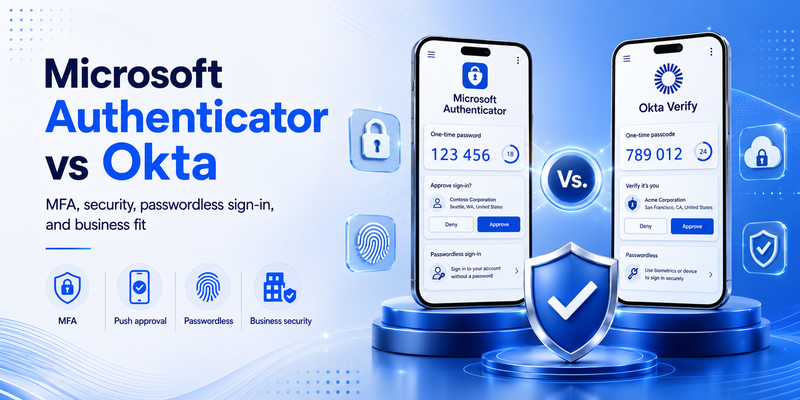
Choosing between microsoft authenticator vs okta is not simply a matter of deciding which mobile app has the cleaner interface. The two products overlap in multi-factor authentication, one-time codes, push approvals, and passwordless workflows, but they sit inside different identity ecosystems. Microsoft Authenticator is closely connected to Microsoft Entra and Microsoft account sign-in, while Okta Verify is designed to work as an authenticator inside the broader Okta identity platform. Microsoft documents support for notifications, verification codes, passkeys, passwordless sign-in, and MFA through Authenticator. Okta documents TOTP, push notifications, and Okta FastPass as verification options in Okta Verify.
For an individual user, the practical question may be which mobile authenticator is easier for everyday logins. For an IT team, the comparison is broader: policy control, device context, passwordless strategy, application integrations, account recovery, deployment effort, and how well the solution fits the identity provider already in use. That is why a useful microsoft authenticator vs okta comparison needs to examine both the mobile experience and the surrounding identity architecture.
1. Microsoft Authenticator vs OKTA: Quick Answer
The short answer is that microsoft authenticator vs okta does not have one universal winner. Microsoft Authenticator is usually the more natural choice when Microsoft Entra ID and Microsoft 365 are already central to the organization. Okta Verify is usually the more natural choice when Okta is the primary identity provider and the organization wants authentication policies, device assurance, and passwordless sign-in to operate through the Okta platform.
Overview & Core Architecture Differences
To make an accurate comparison between Microsoft Authenticator and Okta Verify, it is essential to distinguish the client applications from the cloud identity platforms behind them.
-
Microsoft Authenticator is Microsoft’s mobile authentication application. It is tightly coupled with Microsoft Entra ID and consumer Microsoft accounts. It provides multi-factor authentication (MFA) via push notifications, OATH TOTP codes, phone sign-in, passkeys (FIDO2), and passwordless authentication across Microsoft 365, Azure, and Entra-protected resources.
-
Okta Verify is the dedicated authentication app for the Okta Identity Engine. It enables organizations to enforce verification through six-digit TOTP codes, push approvals, and Okta FastPass—Okta’s flagship passwordless, device-aware authentication mechanism.
Industry Ratings & Customer Feedback
Based on aggregated data from leading enterprise software review platforms (Gartner Peer Insights, Capterra, and SoftwareAdvice):
-
Microsoft Authenticator averages 4.7 / 5 stars across thousands of IT administrator reviews. Reviewers consistently highlight its Value for Money, as the authenticator capabilities are bundled directly into existing Microsoft 365 and Entra ID licensing without additional per-user fees.
-
Okta Verify also averages 4.6 – 4.7 / 5 stars. Reviewers frequently praise its Customer Support, rapid SaaS provisioning, and seamless single sign-on (SSO) experience across heterogeneous, multi-cloud enterprise environments.
Key Takeaway: Evaluating Microsoft Authenticator vs Okta Verify is an ecosystem and identity-architecture decision, not an isolated app comparison.
Download Authenticator App
Secure your accounts with fast, reliable two-factor authentication. Download now and protect your login in seconds.
2. What Are Microsoft Authenticator and Okta Verify?
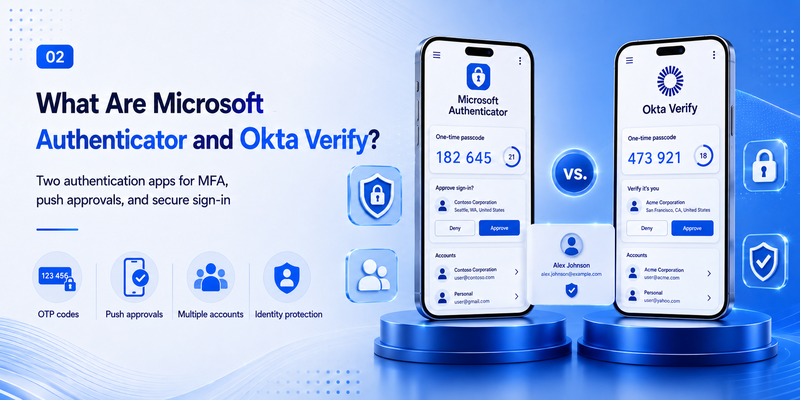
Before comparing microsoft authenticator vs okta, it helps to separate the products from the platforms behind them. Microsoft Authenticator is Microsoft’s mobile authentication application. Microsoft states that it can be used for MFA, notifications, verification codes, passkeys, and passwordless sign-in in supported Microsoft Entra configurations.
Okta Verify is Okta’s authentication application. Within Okta Identity Engine, administrators can enable verification methods including a six-digit TOTP code, push notification, and Okta FastPass. Okta also states that Okta Verify can be configured as a third-party authenticator for compatible services that use standard MFA codes.
This distinction changes the meaning of microsoft authenticator vs okta. Microsoft Authenticator is especially strong when a user is authenticating to Microsoft Entra-backed resources and Microsoft accounts. Okta Verify is especially strong when an organization uses Okta to broker access to many cloud and enterprise applications. Both can generate one-time codes, but enterprise deployments are about much more than displaying six digits on a phone.
3. Feature Comparison: Microsoft Authenticator and Okta Verify
A feature-by-feature view makes microsoft authenticator vs okta easier to understand. Both products cover the core needs of modern MFA, but their advanced capabilities are expressed through different administrative platforms.
| Area | Microsoft Authenticator | Okta Verify |
| One-time codes | Supports verification codes | Supports six-digit TOTP codes |
| Push approval | Supported for Microsoft Entra MFA | Supported through Okta Verify Push |
| Passwordless | Supports passwordless phone sign-in and passkeys in supported scenarios | Supports Okta FastPass and passwordless flows |
| Biometric/device unlock | Can use device biometrics or PIN as part of supported flows | Can require device passcode or biometric user verification |
| Enterprise policy | Managed through Microsoft Entra authentication policies | Managed through Okta Identity Engine policies |
| Third-party TOTP use | Can store compatible TOTP accounts | Can also act as a third-party authenticator for compatible sites |
Microsoft’s documentation describes Authenticator as supporting passkeys, passwordless sign-in, MFA notifications, and verification codes. Okta’s documentation lists Authentication Code, Push Notification, and Okta FastPass as Okta Verify methods and allows biometric or device-passcode user verification depending on policy.
The key point in microsoft authenticator vs okta is not that one has MFA and the other does not. Both do. The meaningful difference is where policy is defined and how the authenticator interacts with the organization’s identity provider, enrolled devices, application sign-in rules, and passwordless strategy.
💡 Discover Helpful Guides: Microsoft Authenticator for iPhone iOS: Complete Guide 2026
4. Security, MFA, and Passwordless Authentication
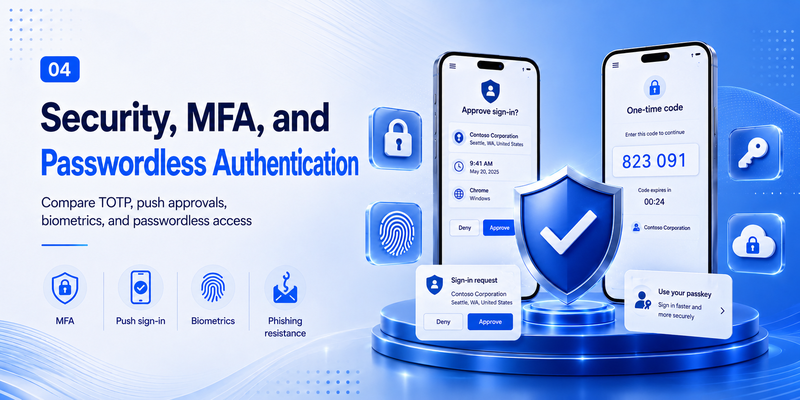
Security is often the main reason people research microsoft authenticator vs okta. Traditional TOTP codes improve security over password-only sign-in, but modern enterprise identity systems increasingly prefer stronger methods that reduce reliance on manually entered codes and make phishing harder.
Microsoft Authenticator supports passwordless sign-in and passkeys in Microsoft Entra scenarios, in addition to push MFA and OATH verification codes. Microsoft also documents number-based interaction for some passwordless or push experiences, depending on the sign-in flow and policy configuration.
Okta Verify adds Okta FastPass, which Okta describes as a passwordless capability that evaluates the authentication request and is designed to prevent authentication from being completed on a malicious site. FastPass can work across supported desktop and mobile platforms when the user has an enrolled Okta Verify account.
From a security architecture perspective, microsoft authenticator vs okta therefore becomes a question of which platform your organization trusts to evaluate users, devices, applications, and authentication context. Strong authentication is not only about the phone app. The surrounding policy engine determines when MFA is requested, which methods are allowed, whether device conditions matter, and how unusual sign-ins are handled.
Neither product eliminates user responsibility. Push-based authentication can still create problems if users approve requests they did not initiate. For that reason, organizations comparing microsoft authenticator vs okta should favor phishing-resistant or passwordless methods where practical, configure clear sign-in policies, and educate users to reject unexpected requests.
🧭 Explore Guides: Is Microsoft Authenticator Free to Use? Everything You Need to Know
🔐 Enterprise-Grade Security Simplified by Begamob
Begamob specializes in utility and security applications built to protect your digital identity. Whether you are managing personal 2FA tokens or looking for an intuitive authentication solution, our products combine robust encryption with seamless user design.
5. User Experience & Enterprise Administration
The End-User Experience
For everyday logins, both applications present a streamlined user interface.
-
Microsoft Authenticator shines for users operating within Microsoft Teams, Outlook, Azure, and Windows environments. Users can approve push requests or sign in passwordlessly using device biometrics (Face ID / Touch ID / Windows Hello).
-
Okta Verify offers an unobtrusive experience on desktop and mobile platforms. When paired with Okta FastPass, desktop users clicking a SaaS tile in their browser are authenticated instantly in the background via biometric verification.
Administration & Policy Governance
-
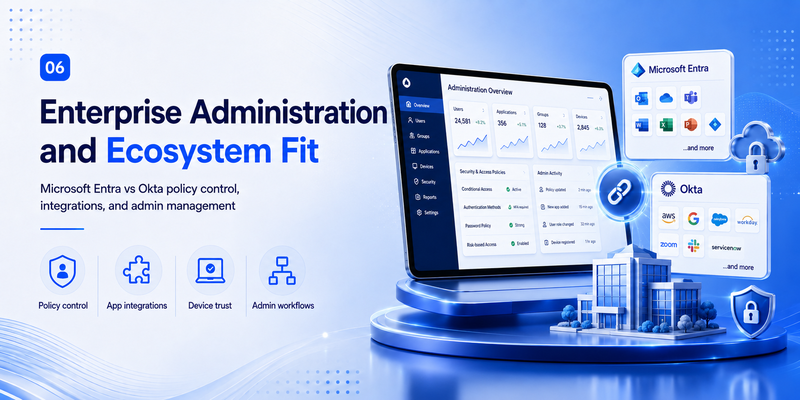
Microsoft Entra Administration: Controls are configured inside the Entra Admin Center under Authentication Methods. Admins can restrict passwordless phone sign-in to specific user groups, enforce number matching, and restrict enrollment based on Intune compliance.
-
Okta Identity Engine Administration: Managed through the Okta Admin Console under Security > Authenticators. Administrators define global and app-level sign-in policies, setting granular rules for biometric checks, device health checks, and fallback mechanisms.
Deployment & Recovery Considerations
When replacing or upgrading authenticators across an enterprise, IT departments must account for:
-
Self-Service Phone Replacement: Microsoft Authenticator supports cloud backup to Personal iCloud or Microsoft Accounts for OATH tokens. Okta Verify allows multi-device enrollment when permitted by policy.
-
Help-Desk Overhead: Migrating users from one MFA platform to another requires clear communication, step-by-step documentation, temporary access pass (TAP) workflows, and automated enrollment prompts.
🗺️ Browse How-To Guides: Microsoft Authenticator Passwordless Sign-In: Complete Guide
6. Microsoft authenticator vs okta for Business
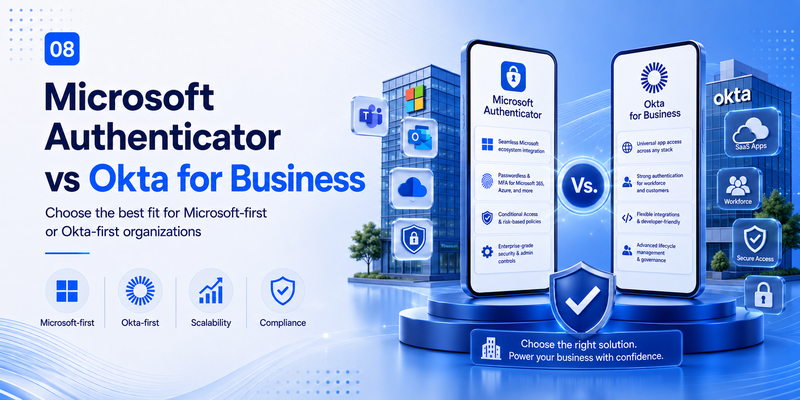
For businesses, microsoft authenticator vs okta should start with the identity platform, not the mobile download. A company already standardized on Microsoft Entra can usually deploy Microsoft Authenticator as part of its existing authentication-method strategy. A company standardized on Okta can use Okta Verify as part of its Okta sign-in and device policies.
Microsoft positions Authenticator as one of the supported authentication methods in Entra, with capabilities that include MFA notifications, verification codes, passwordless phone sign-in, and passkeys. Okta positions Okta Verify as an authenticator that can provide TOTP, push, and FastPass depending on configured options.
When evaluating microsoft authenticator vs okta for business, decision-makers should consider application coverage, identity lifecycle, endpoint strategy, recovery processes, privileged access, compliance requirements, and the skills of the IT team. The best authentication experience is one that fits the access-control system already responsible for users and applications.
Businesses should also account for change management. Switching from one authenticator to another means re-enrollment, user communications, temporary fallback methods, support documentation, and a plan for lost or replaced devices. Those operational costs can matter as much as the feature checklist in a microsoft authenticator vs okta evaluation.
7. microsoft authenticator vs duo
People researching microsoft authenticator vs okta often compare Duo as a third enterprise option. The keyword microsoft authenticator vs duo usually reflects the same underlying question: should authentication be centered on the existing identity platform or on a dedicated access-security product?
Duo Mobile supports Duo Push and can generate passcodes for authentication, including offline passcodes in supported enrollment scenarios. Duo also offers passwordless capabilities in its broader platform.
In a microsoft authenticator vs duo comparison, Microsoft Authenticator has an obvious ecosystem advantage for Entra-centric organizations, while Duo is commonly evaluated by organizations that want Duo’s access and device-oriented security model across a broad set of applications. The same principle applies to microsoft authenticator vs okta: the app itself is only one part of the decision. Policy, integrations, device signals, and administrative ownership matter more than icon design.
8. 2FAs vs microsoft authenticator
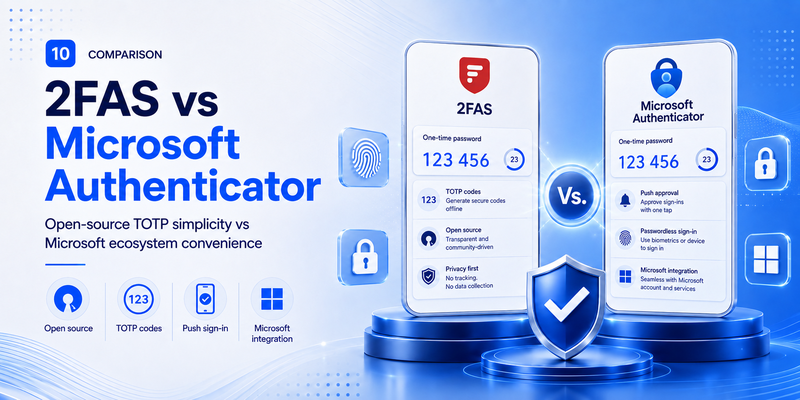
Another useful comparison is 2fas vs microsoft authenticator, especially for users who care more about TOTP portability and open-source software than enterprise push authentication. 2FAS describes its authenticator as free and open source and provides a browser extension designed to work with the mobile app for a faster browser-based 2FA workflow.
The main difference in 2fas vs microsoft authenticator is focus. 2FAS is primarily a dedicated two-factor authentication tool for storing and using tokens, while Microsoft Authenticator also participates deeply in Microsoft Entra push, passwordless, and passkey experiences. 2FAS may appeal to users who want a more provider-neutral TOTP experience; Microsoft Authenticator may be more convenient for people and organizations already invested in Microsoft identity.
This is also why microsoft authenticator vs okta should not be reduced to a generic list of code-generator features. Enterprise authenticators increasingly act as extensions of identity policy, while apps such as 2FAS can focus more narrowly on portable second-factor workflows.
🛠️ Learn with Step-by-Step Guides: Microsoft Authenticator: Complete Setup, Login, Backup & Troubleshooting Guide
9. Deployment and Migration Considerations
A careful microsoft authenticator vs okta migration plan should start with inventory. Identify which users are enrolled, which applications depend on the current method, which fallback factors are allowed, and whether users have multiple devices. Do not assume that moving the mobile app automatically moves the underlying identity configuration.
Next, test the intended authentication methods. Microsoft Entra administrators can scope Microsoft Authenticator methods and passwordless options through authentication policies. Okta administrators can configure Okta Verify options such as TOTP, push, and FastPass.
Then design recovery. Lost phones, new phones, damaged devices, and employee offboarding are predictable events. A microsoft authenticator vs okta deployment should define who can reset enrollment, which backup methods are acceptable, how identity is verified during recovery, and how privileged administrators are protected from weak fallback methods.
Finally, communicate clearly. Users should know which app to install, how to recognize a legitimate prompt, what to do with an unexpected approval request, and how to get help. A technically strong microsoft authenticator vs okta deployment can still fail operationally if employees are confused by multiple prompts or do not understand which system is requesting authentication.
10. Frequently Asked Questions
Is Microsoft Authenticator better than Okta Verify?
Not universally. microsoft authenticator vs okta depends on your identity environment. Microsoft Authenticator usually fits best with Microsoft Entra and Microsoft accounts, while Okta Verify usually fits best with organizations that use Okta as their identity provider. Both support MFA and modern passwordless options through their respective ecosystems.
Can Microsoft Authenticator replace Okta Verify?
Sometimes for standard TOTP accounts, but not for every enterprise workflow. microsoft authenticator vs okta becomes non-interchangeable when an organization requires Okta Verify Push, FastPass, Microsoft-specific push, passkeys, device enrollment, or another platform-controlled method. Users should follow their organization’s configured authentication requirements.
Does Okta Verify generate six-digit codes?
Yes. Okta documents TOTP as an Okta Verify option that generates a six-digit one-time passcode. That makes basic code entry similar to other authenticators, but microsoft authenticator vs okta still differs significantly once push, passwordless authentication, device context, and administrative policy are considered.
Does Microsoft Authenticator support passwordless sign-in?
Yes. Microsoft documents passwordless phone sign-in and passkeys among Authenticator capabilities for supported Microsoft Entra scenarios. This is one of the major reasons microsoft authenticator vs okta is more than a TOTP comparison.
Is Okta FastPass the same as Microsoft Authenticator passwordless sign-in?
They serve a similar goal—reducing or removing password dependence—but they are implemented inside different identity ecosystems. Okta FastPass is an Okta Verify capability managed through Okta, while Microsoft Authenticator passwordless methods are managed through Microsoft Entra. In microsoft authenticator vs okta, the surrounding platform determines enrollment, policy, and application behavior.
Which option is better for a Microsoft 365 company?
If the organization already uses Microsoft Entra as the primary identity provider, Microsoft Authenticator is usually the simpler fit because its authentication methods are integrated directly into Entra policy. Still, microsoft authenticator vs okta may favor Okta in a company that uses Okta as the central access layer even when many Microsoft 365 applications are present.
Which option is better for a company with many SaaS applications?
The answer depends on which identity provider manages those applications. Okta is often evaluated for heterogeneous SaaS environments, while Microsoft Entra also supports broad application access. The practical microsoft authenticator vs okta decision should be based on existing integrations, policy ownership, device strategy, and operational cost rather than the number of logos in a catalog.
11. Conclusion
The most useful way to evaluate microsoft authenticator vs okta is to stop thinking of them as two isolated code-generator apps. Microsoft Authenticator is an authentication method deeply integrated with Microsoft Entra and Microsoft accounts. Okta Verify is an authenticator deeply integrated with Okta’s identity platform. Both can support one-time codes, push-based verification, and passwordless experiences, but they are governed by different administrative systems.
For Microsoft-first organizations, microsoft authenticator vs okta often points toward Microsoft Authenticator because it aligns with Entra authentication policies and Microsoft passwordless capabilities. For Okta-first organizations, Okta Verify is usually the more coherent choice because Push and FastPass fit directly into Okta’s policy and device model. For individuals, the choice is more about account compatibility and whether they need enterprise push features or simply TOTP codes.
Alternatives matter too. Duo offers push, passcodes, and broader enterprise authentication capabilities, while 2FAS provides a free, open-source TOTP-focused experience with browser-extension support. The right answer is not to install every option. It is to choose the authentication method that matches the identity platform, security requirements, recovery model, and user experience you actually need.
Ultimately, microsoft authenticator vs okta is an identity-strategy decision. Start with the platform that owns your users and access policies, choose the strongest practical authentication methods it supports, minimize redundant enrollment, and make recovery as secure as the sign-in process itself.
Download Authenticator App
Secure your accounts with fast, reliable two-factor authentication. Download now and protect your login in seconds.